


Japan Departure Tax: Everything Travelers Need to Know in 2026

The Japan departure tax, officially known as the International Tourist Tax (国際観光旅客税, kokusai kanko ryokyaku zei), is a government levy charged to nearly every person who leaves Japan by air or sea.
Japan introduced this tax on January 7, 2019, at a flat rate of 1,000 yen per person.
Starting July 1, 2026, the Japanese government will raise the departure tax to 3,000 yen (approximately $20 USD), tripling the original amount.
This guide covers who pays the tax, who is exempt, how the money is collected, where the revenue goes, and how to account for the increase when planning your trip.
We also cover related fees such as hotel taxes in major cities and changes to tax-free shopping rules, giving you a complete picture of the costs that may affect your travel plans in 2026 and beyond.
What is the Japan departure tax?

The Japan departure tax is a flat fee collected from travelers when they leave Japan on an international flight or sea voyage.
The tax applies to all departures from any Japanese airport or port, including Narita Airport, Haneda Airport, Kansai International Airport, and regional hubs.
The tax is not a visa fee or an entry charge.
It is specifically tied to the act of departure and is automatically included in the price of your airline or ferry ticket at the time of booking.
The formal name for this levy is the International Tourist Tax, though it is sometimes referred to informally as the "Sayonara Tax."
Despite its nickname, the tax is not limited to tourists. It applies equally to foreign visitors, Japanese citizens, business travelers, and residents of Japan leaving the country.
How much is the Japan departure tax?
Here is a summary of the departure tax rates since the policy was introduced:
Period |
Tax Amount (JPY) |
Approximate USD |
January 7, 2019 to June 30, 2026 |
1,000 |
~$7.50 |
July 1, 2026 onward |
3,000 |
~$20 |
The tax is a flat rate per person, per departure.
It does not vary based on cabin class, airline, nationality, or trip purpose.
A person flying economy on a budget carrier pays the same amount as a person flying business class on a legacy airline.
For a family of four (with all members aged 2 or older), the total cost of the departure tax from July 2026 will be 12,000 yen (approximately $80 USD), compared to 4,000 yen under the previous rate.
While this is a relatively small amount compared to the total value of a flight ticket, it is worth factoring into your travel budget, especially for families and frequent travelers.
Who pays the Japan departure tax?
The tax applies broadly. The following groups are required to pay:
Foreign visitors leaving Japan after a holiday or short stay. This includes tourists from every country, regardless of visa type.
Japanese citizens departing Japan for international travel. The tax applies to nationals leaving for vacation, work, or any other reason.
Business travelers on work assignments, conferences, or corporate trips. There is no exemption for business class tickets, corporate bookings, or frequent flyer status.
Long-term residents of Japan, including expats holding work visas, spouse visas, or permanent residency. Any resident who boards an international flight or ferry must pay the tax.
In short, the departure tax is collected from nearly every person aged 2 and older who passes through immigration and boards an outbound international flight or ship.
Who is exempt from the departure tax?
A small number of categories are exempt from the departure tax. Understanding these rules can help certain travelers avoid the fee or confirm whether it applies to their situation.
Children under 2 years old. Infants who have not yet reached their second birthday at the time of departure are exempt. Children aged 2 and older must pay the full amount.
Transit passengers. If you are connecting through a Japanese airport and your total stay in Japan is 24 hours or less, you may be exempt. This exemption applies only if you do not clear Japanese immigration. If you leave the transit area and enter Japan, the tax applies.
Airline crew members. Flight crew and cabin crew operating the departing aircraft are exempt from the tax.
Diplomats and government officials. Certain diplomatic passport holders may be exempt under international agreements, though the details vary by country.
There are no exemptions based on nationality, income level, frequent flyer membership, or the kind of ticket purchased. The flat levy is the same for everyone who does not fall into the categories above.
How is the tax collected?

One of the most important details about the Japan departure tax is its collection method.
The tax is automatically included in your airline or ferry ticket at the point of purchase. You do not need to take any separate action.
When you buy a flight departing Japan, the 3,000 yen tax (or 1,000 yen for departures before July 1, 2026) is embedded in the total ticket price. Airlines handle the process of collecting and remitting the tax to Japan's tax authorities. Major carriers such as ANA, JAL, United, Delta, and Lufthansa all follow this process.
If you want to see the breakdown, check the fare details or tax line items on your booking confirmation.
The tax may appear as "International Tourist Tax," "Japan Departure Tax," or a similar label, depending on the airline's ticketing system.
Because the tax is built into the ticket price, there is no risk of being stopped at the airport for failing to pay. You will not need to carry extra cash for this purpose. The entire process is handled before you board.
Why did Japan raise the departure tax?
The Japanese government approved the increase from 1,000 yen to 3,000 yen as part of its 2026 fiscal reform package.
The primary reason is to generate additional revenue to address the growing challenges of overtourism across the country.
Japan welcomed over 32 million international visitors in 2025, a figure that has strained popular destinations such as Kyoto's temples, Himeji Castle, and major urban transit systems.
In fiscal year 2024, the government collected a record 52.4 billion yen (approximately $340 million USD) from the departure tax at the 1,000 yen rate.
The tripled rate is expected to raise significantly more money, which the government plans to invest in several key areas:
Tourism infrastructure improvements. This includes upgrades to airports, seaports, restrooms, signage, and public transportation systems used by travelers.
Overtourism management. Revenue will fund reservation systems at overcrowded attractions, crowd management technology, and visitor flow control in popular cities.
Multilingual support. The government has committed to expanding language support at transit hubs, cultural sites, and tourist information centers, including AI-powered translation tools.
Cultural and environmental preservation. Funds will go toward protecting Japan's historic sites, national parks, and natural landmarks that attract millions of visitors each year.
Digital border processing. Improvements to immigration technology, including faster passport gates and streamlined entry procedures, are part of the investment plan.
The policy reflects a broader trend among governments worldwide.
Countries including Australia, South Korea, New Zealand, and the United Kingdom already collect similar departure levies, and the revenue model is well established in the travel industry.
Japan departure tax vs. Japan's exit tax on assets
It is important to understand the difference between the departure tax and Japan's "exit tax" on financial assets. These are two completely separate policies, and confusing them could lead to unnecessary worry.
The departure tax (International Tourist Tax) is the 3,000 yen flat fee charged to all travelers leaving Japan. It is small, automatic, and applies to everyone.
The exit tax on assets is a capital gains tax that applies to individuals who have lived in Japan for at least five of the past ten years and hold financial assets (such as stocks, bonds, or investment funds) with a total value exceeding 100 million yen (approximately $670,000 USD). When such a person leaves Japan permanently, they may be required to pay tax on unrealized capital gains as if they had sold those assets on the day before departure.
The exit tax on assets is a complex policy aimed at preventing wealthy individuals from relocating to low-tax countries to avoid capital gains taxes.
It does not affect the vast majority of tourists, short-term visitors, or even most expat residents. If you are simply visiting Japan for a holiday or a business trip, this tax has no bearing on your plans.
Hotel and accomodation taxes in Japan (2026)
In addition to the departure tax, travelers should be aware that many cities in Japan now collect local accommodation taxes on hotel stays.
These are separate from the departure tax and are typically paid directly at check-in or added to your hotel bill.
Here is a summary of accommodation tax rates in major cities as of 2026:
Tokyo
Nightly Room Rate (per person) |
Tax per Night |
Under 10,000 yen |
Exempt |
10,000 to 14,999 yen |
100 yen |
15,000 yen and above |
200 yen |
Tokyo's rates are among the lowest in the country. The Tokyo Metropolitan Government has announced plans to shift to a 3% percentage-based system starting in 2028.
Kyoto (From March 1, 2026)
Kyoto introduced Japan's highest accommodation tax as of March 2026:
Nightly Room Rate (per person) |
Tax per Night |
Under 6,000 yen |
200 yen |
6,000 to 19,999 yen |
400 yen |
20,000 to 49,999 yen |
1,000 yen |
50,000 to 99,999 yen |
4,000 yen |
100,000 yen and above |
10,000 yen |
The top-tier rate of 10,000 yen per person, per night is the highest in Japan. It applies only to luxury hotels and high-end ryokan stays.
Osaka
Nightly Room Rate (per person) |
Tax per Night |
Under 5,000 yen |
Exempt |
5,000 to 14,999 yen |
200 yen |
15,000 to 19,999 yen |
400 yen |
20,000 yen and above |
500 yen |
Other cities
Several other municipalities have introduced or expanded accommodation taxes.
As of 2026, over 20 cities and prefectures across Japan charge some form of lodging tax.
Notable additions include Hiroshima (200 yen per night for stays over 6,000 yen), Okinawa (2% of the room bill starting fiscal 2026), and Gifu (200 yen per night for all accommodation types).
Keep spare cash on hand when checking into hotels in smaller cities, as some properties only accept cash payment for accommodation taxes.
👉 Read also: Japan's luggage delivery services: A how-to guide
Changes to tax-free shopping in Japan (November 2026)

If you enjoy shopping in Japan, there is another significant change to be aware of. Starting November 1, 2026, the country's tax-free shopping system will shift from an instant discount model to a "pay first, refund later" model.
Under the current system (in effect until October 31, 2026), eligible foreign visitors can purchase goods at designated tax-free shops and receive an immediate exemption from the 10% consumption tax at the point of sale.
Visitors present their passport at checkout, and the store removes the tax from the total.
Under the new system, visitors will pay the full tax-inclusive price at the time of purchase.
To receive the refund, travelers must complete a declaration process at the airport before departure.
Self-service kiosks at major airports will scan your passport and automatically retrieve your purchase records. If everything checks out, the refund is credited to your payment method (typically a credit card).
Key details about the new system:
The minimum purchase threshold of 5,000 yen (excluding tax) per store, per day remains the same. The sealed packaging requirement for consumable goods (cosmetics, food, medicine) will be abolished. Purchased items must be taken out of Japan within 90 days. If items are missing at the time of departure, the entire transaction may be ineligible for a refund. Items shipped internationally by parcel are no longer eligible for tax exemption (effective April 1, 2025).
This change means travelers who plan on shopping should budget for paying the full price upfront and allow extra time at the airport for the refund process. It is recommended to keep all receipts organized throughout your trip.
Tips for budgeting your trip to Japan in 2026
With the departure tax increase, expanded hotel taxes, and changes to shopping rules, it helps to plan ahead. Here are practical tips for managing these fees:
Book flights departing before July 1, 2026 to lock in the lower departure tax rate. If your travel dates are flexible, departing Japan in June rather than July saves 2,000 yen per person.
Check accommodation tax rules for every city on your itinerary. Taxes vary significantly. A stay in Tokyo may cost only 100 to 200 yen extra per night, while a luxury stay in Kyoto could add up to 10,000 yen per person per night.
Carry some cash for hotel taxes. While many large hotels accept card payments for the accommodation tax, smaller inns and traditional ryokan often require cash.
Factor in the new shopping refund process. If you plan to do significant shopping, set aside time at the airport and bring a credit card that can receive refunds easily. Avoid opening or consuming tax-free purchases before you leave Japan.
Visit during shoulder seasons. Traveling in months like March (before Golden Week) or late October to early November can help you avoid peak pricing and overcrowding, giving you a more enjoyable trip overall.
Consider staying outside major city centers. Hotels in surrounding areas are often cheaper and may fall below the accommodation tax threshold entirely. With Japan's efficient public transportation network, staying in a nearby suburb rarely adds significant travel time.
👉 Read also: Tipping in Japan: Insights, tips, and more for foreigners
Managing your Japanese mail and finances while abroad

For residents, expats, and business travelers with ongoing ties to Japan, staying on top of Japanese correspondence does not stop when you leave the country.
Government notices, tax documents, utility bills, and financial statements continue to arrive at your Japanese address even after departure.
If you are leaving Japan for an extended period or relocating while maintaining business or financial accounts in Japan, a virtual mailbox service can help you stay organized.
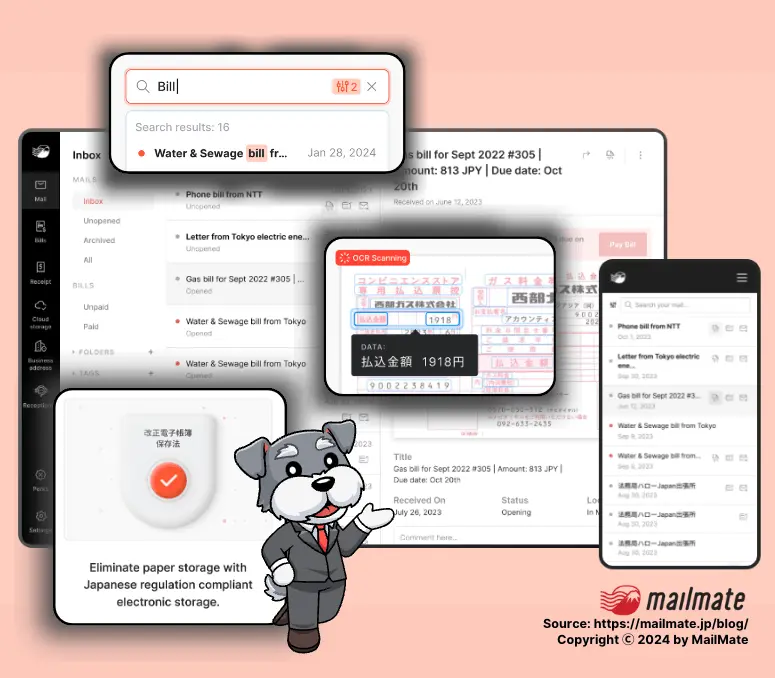
MailMate, Japan's bilingual virtual mail service, allows you to receive, scan, and manage your Japanese mail from anywhere in the world through an online dashboard.
MailMate scans your incoming mail and uploads it to a secure cloud account, so you can view everything from your phone or computer. You can request translations of Japanese documents, pay bills on your behalf, and forward physical mail to an international address when needed. This is especially useful for anyone who needs to track tax notices, insurance renewals, or government correspondence that arrives by post after they leave Japan.
Whether you are a business traveler who splits time between Japan and another country, an expat who recently moved away, or someone who owns property in Japan and needs ongoing mail access, having a reliable way to manage your Japanese mail gives you the freedom and flexibility to handle important matters without being physically present.
👉 Read also: How to receive mail while traveling abroad from Japan
Frequently asked questions
Do I need to pay the departure tax separately at the airport?
No. The Japan departure tax is automatically included in the price of your airline or ferry ticket at the time of booking. You will not need to pay anything extra at the airport, and there is no separate counter or line for this tax. The airline or ferry company handles the entire process of collecting the tax and remitting it to the Japanese government on your behalf.
Does the departure tax apply to Japanese citizens?
Yes. The International Tourist Tax applies to all travelers leaving Japan by air or sea, regardless of nationality. Japanese citizens pay the same 3,000 yen (from July 2026) as foreign visitors. The tax is not limited to tourists and covers everyone from holiday travelers to business travelers to residents departing for personal reasons.
Are children exempt from the Japan departure tax?
Children under 2 years old are exempt from the departure tax. Once a child reaches their second birthday, they are required to pay the full tax amount. There is no reduced rate for children between the ages of 2 and 17. For a family with two adults and two children aged 5 and 8, the total departure tax from July 2026 would be 12,000 yen.
Can I get a refund on the Japan departure tax?
No. Once the departure tax is included in your ticket, it is not refundable. If you cancel your flight, refund policies for the tax portion depend on your airline's fare rules. Some fully refundable tickets may include a refund of the tax, but most economy and discount fares do not. Always check the fare conditions before booking.
How is the departure tax different from Japan's exit tax?
The departure tax is a small flat fee of 3,000 yen (from July 2026) that applies to all travelers leaving Japan. Japan's exit tax on assets is a completely separate policy. The exit tax targets individuals who have been residents of Japan for at least five of the past ten years and hold stocks, bonds, or other financial assets with a total value over 100 million yen. Most tourists and short-term visitors are not affected by the exit tax.
What does the departure tax revenue pay for?
The Japanese government uses revenue from the departure tax to fund tourism infrastructure improvements, including airport upgrades, multilingual signage, public transportation enhancements, overtourism management measures, and cultural preservation projects. In fiscal 2024, the tax generated 52.4 billion yen in revenue at the 1,000 yen rate. The tripled rate is expected to generate significantly more money for these programs.
Does the tax apply if I am just transiting through Japan?
Transit passengers who stay in Japan for 24 hours or less and do not clear Japanese immigration are generally exempt from the departure tax. If you leave the transit area and enter Japan (for example, to visit the city during a long layover), you will need to pay the tax when you depart. Always check with your airline if you are unsure whether your connection qualifies for the transit exemption.
When does the new 3,000 yen rate take effect?
The increased departure tax rate of 3,000 yen per person takes effect on July 1, 2026. Any international flight or ferry departing Japan on or after that date will carry the new rate. If you book a flight departing on June 30, 2026, the tax remains at 1,000 yen. The date of departure, not the date of booking, determines which rate applies.
In closing
The Japan departure tax is a straightforward levy that affects nearly every traveler leaving the country. From July 1, 2026, the rate increases from 1,000 yen to 3,000 yen per person. The tax is automatically included in airline and ferry tickets, requires no action from travelers at the airport, and applies regardless of nationality or trip purpose. Combined with expanding accommodation taxes in cities like Kyoto, Tokyo, and Osaka, and the upcoming changes to tax-free shopping rules in November 2026, understanding these fees is an important part of planning any trip to Japan.
By budgeting for these costs in advance and staying informed about the latest policy changes, you can enjoy your time in Japan without any financial surprises. For those with ongoing connections to Japan, services like MailMate can help ensure you stay on top of tax documents, government notices, and other correspondence that may follow you after you leave.
일본 우편물 처리에 너무 많은 시간을 소비하고 있나요?
가상 우편함 + 번역 서비스는 월 3800원부터 시작합니다. 30일 환불 보장.