


Bookkeeping in Japan: Corporate Tax & Filing Guide (2026)


Bookkeeping in Japan means keeping daily financial transactions in Japanese Yen, in most cases in the Japanese language, while meeting deadlines set by the National Tax Agency and local tax offices.
Quick facts to start with:
- Corporate tax returns are due within two months of fiscal year-end
- Roughly 20% of Japanese corporations close their fiscal year on March 31
- Only a licensed tax accountant (zeirishi, 税理士) can legally prepare and file a return
- Around 90% of corporate tax returns in Japan involve a licensed tax accountant
For foreign companies without a Japan-based finance team, this combination of language, currency, and licensing requirements is usually the first real friction point after incorporation.
This guide covers:
- What bookkeeping and accounting services actually involve
- What corporate tax and consumption tax obligations apply
- How Blue Form status and record retention rules work
- Three approaches foreign companies end up choosing for legal compliance
Bookkeeping in Japan at a Glance
| Requirement | Detail |
|---|---|
| Incorporation Notification | Within 2 months with the National Tax Agency (tax office) |
| Corporate tax return deadline | Within 2 months of fiscal year-end |
| Blue Form status application deadline | New company: Within 3 months of establishment (or first fiscal year-end, whichever is earlier) Existing company: Day before the start of the fiscal year |
| Blue Form status filing deadline | Within 2 months of the fiscal year-end |
| Standard consumption tax rate | 10% |
| Consumption tax return threshold | Required once taxable sales exceed ¥10 million in the base period (two years prior) or the business is a registered invoice-issuing business (regardless of base-period sales) |
| Corporate tax rate (From April 2025) | Large/Standard Company (Capital > ¥100M): 23.20% SME (Capital ≤ ¥100M) first ¥8M income, ordinary company: 15% / (17%*) SME (Capital ≤ ¥100M) first ¥8M income, but “excluded business” (適用除外事業者): 19% *17% applies to the first ¥8M of SME income if total company income exceeds ¥1 billion. Source: National Tax Agency, 法人税の税率 |
| Statutory book retention | 10 years under the Companies Act |
| Primary source document retention | 7 years |
| Non-filing penalty & Delinquency tax | 5%–30% of the unpaid tax (up to 40% if intentional concealment is found), plus delinquency interest of 2.8% per annum for the first 2 months and 9.1% per annum after that. |
| Full accounting services cost | Can exceed ¥3 million annually for a fully staffed setup |
Bookkeeping in Japan: What It Actually Involves
Bookkeeping in Japan is the daily recording of transactions, receipts, invoices, and payroll entries into a general ledger and journal entry system.
It is distinct from accounting:
- Bookkeeping records what happened — transactions, receipts, journal entries
- Accounting analyzes that data to prepare tax filings, a profit and loss statement, and a balance sheet
- Bookkeeping alone cannot satisfy corporate tax return requirements — a company needs both clean books and someone qualified to turn them into a filed return
Japanese companies are expected to maintain:
- A trial balance
- A general ledger
- Supporting documentation for every transaction, in a form a tax accountant and the tax office can review
Two important details foreign companies should know:
- Foreign transactions must be recorded in Japanese Yen, using the market exchange rate on the transaction date
- Important accounting records — general ledgers, bank statements, payroll records — need to stay consistent enough to satisfy an audit trail if the tax authorities ever ask questions
Corporate Tax in Japan: What Every Company Must File
Corporate tax returns in Japan are due within two months of fiscal year-end, based on finalized financial statements rather than estimates. (Source: National Tax Agency, 確定申告書の提出期限 )
A few things that affect the timeline:
- A company's fiscal year can be any 12-month period it chooses, so the deadline moves depending on the incorporation date
- Close to one-fifth of Japanese corporations use a March 31 year-end (Source: National Tax Agency, 決算期月別法人数 )
- Corporate income tax is only one part of the bill — companies also owe corporate inhabitant tax (local tax) and, above certain thresholds, consumption tax
Two requirements worth flagging separately:
- Tax filings must be based on finalized financial statements, which means bookkeeping and reconciliation have to be done before the return is prepared, not alongside it
- The deadline for the corporate tax return is within 2 months of fiscal year-end, and it must be filed with the National Tax Agency (e-Tax). (Source: National tax Agency, 確定申告書の提出期限 )
👉Read Corporate Tax in Japan: Rates, Deadlines, and Filing Requirements for more details about corporate tax in Japan!
Bookkeeping Services vs Accounting Services in Japan
Bookkeeping services and accounting services are often bundled together, but they solve different problems:
| Bookkeeping services | Accounting services | |
|---|---|---|
| Covers | Recording money in and out, matching bank statements to invoices, keeping the trial balance current | Producing the P&L, balance sheet, and cash flow statement; calculating taxable income |
| Who typically does it | A bookkeeper, in-house or outsourced | A tax accountant or accounting firm |
| When it happens | Ongoing, ideally monthly | Mainly at filing time, built on finished books |
A company can, in principle, do its own bookkeeping and only bring in professional accounting support at filing time. In practice, most foreign companies outsource both — Japanese accounting conventions, chart-of-accounts structure, and documentation standards differ enough from what a foreign finance team is used to that mistakes are easy to make and expensive to unwind later.
Why You Need a Licensed Tax Accountant
Only licensed tax accountants can prepare and file tax returns in Japan. This is not a convention — it is regulated by law, and tax-related work in Japan is strictly regulated as a result.
A licensed tax accountant (zeirishi) typically:
- Represents clients before the National Tax Agency
- Answers questions from the tax office on the company's behalf
- Takes on legal responsibility for what gets filed
- Ensures compliance with Japan's complex tax regulations
- Flags tax optimization opportunities within what the law allows
- Acts as the ongoing point of contact if the tax office follows up
Roughly 90% of corporate tax returns in Japan are filed with a licensed tax accountant involved — which tells you how rarely companies attempt this alone. (Source: Ministry of Finance, 国税庁実績評価書 ) For a foreign company without a bilingual finance hire, this relationship is usually the single most important vendor relationship in the company's first few years in Japan.
👉Read How to File Your Final Income Tax Return in Japan to learn how to file tax in Japan!
Bookkeeping in Japan for Foreign Companies: Where It Gets Harder
Foreign companies operating in Japan run into a specific set of complications that domestic companies do not face in the same way.
Language and Currency
Japanese law requires bookkeeping to be conducted in Japanese Yen and the Japanese language. A foreign parent company's finance team, even a strong one, usually cannot read the resulting books or communicate directly with a Japanese tax accountant without translation support at every step.
Qualified Invoices and Overseas Transactions
Since the Qualified Invoice System was implemented on October 1, 2023:
- Qualified invoices must contain prescribed information, including a registration number and tax rate
- Overseas transactions and intercompany transactions between a Japan entity and its foreign parent need to be documented carefully enough to satisfy both Japanese tax authorities and, often, a parent company's own auditors
👉Learn more about the latest information on the Qualified Invoice System: Japan Invoice System News: What Businesses Need to Know
Registration and Blue Form Deadlines
- New companies must register with the National Tax Agency within 3 months
- Existing companies must register by the day before the start of the fiscal year
- Blue Form status, which allows a 10-year carryforward of tax losses, has its own early application window
- Missing either deadline is a common and avoidable mistake among first-time foreign entrants
Accounting Software for Japanese Bookkeeping
Most companies in Japan today use cloud accounting software rather than paper ledgers or spreadsheets.
| Software | Common among | Notes |
|---|---|---|
| Money Forward | Small and mid-sized companies | Widely used, strong bank feed integration |
| freee accounting | Small and mid-sized companies | Popular alternative to Money Forward |
| Yayoi accounting | Longer-established Japanese firms and accounting firms | Legacy standard, still common with traditional accountants |
These tools automate bank feeds and generate the profit and loss statement, balance sheet, and journal entry records a tax accountant needs at filing time.
What software does not do on its own:
- Match a receipt to a transaction
- Decide how to categorize an ambiguous expense
- Catch errors before they compound over a fiscal year
That is the work a bookkeeper — in-house or outsourced — still has to do.
At MailMate, we provide an all-in-one solution, from a cloud bookkeeping system, accounting & reconciliation, to tax filing by a licensed tax accountant. You can have peace of mind with our bilingual concierge.
Consumption Tax in Japan: Rates, Thresholds, and Filing
Key facts:
- Standard consumption tax rate: 10%
- Reduced rate on most food and beverage sales: 8%
- Consumption tax return required once taxable sales exceed ¥10 million
Consumption tax returns require tracking:
- Taxable sales
- Input tax on purchases
- Withholding taxes on payroll
All of this needs to tie back cleanly to the general ledger. Since the Qualified Invoice System took effect on October 1, 2023, suppliers also need a registration number on every invoice for a purchaser to claim input tax credit — for companies with overseas transactions or a mix of domestic and international suppliers, checking invoice compliance has become part of routine monthly bookkeeping rather than a once-a-year concern.
To learn more about consumption tax, read: Easy Japan Consumption Tax Guide
Monthly Bookkeeping: Building a Process That Holds Up
Monthly bookkeeping is what keeps a company from facing a chaotic scramble at fiscal year-end. A company that closes its books every month has receipts matched, bank statements reconciled, and a trial balance ready on an ongoing basis — and a current P&L and balance sheet to manage against.
A typical monthly cycle:
- Capture receipts and invoices as they arrive
- Match them to bank and credit card transactions
- Reconcile intercompany transactions where relevant
- Update the general ledger
- Review the trial balance before it rolls into the next month
Companies that skip this discipline usually pay for it later — either in accountant fees for cleanup work or in penalties for late or inaccurate filings.
Payroll Processing and Withholding Taxes
Payroll processing in Japan is tightly linked to bookkeeping. Payroll withholding taxes must be integrated into daily accounting entries, not handled as a separate side process.
What employers need to track each pay cycle:
- Employee gross salary
- Income tax withholding
- Social insurance contributions
The company pays gross salary less withholding taxes and social insurance, then remits the withheld amounts to the tax office and relevant agencies on a set schedule.
For companies with even a small number of employees, payroll errors tend to surface at tax filing time, when payroll records do not match the general ledger. Building payroll into the same monthly bookkeeping cycle as other transactions is the most reliable way to avoid this.
👉Learn more about how payroll works in Japan: Japan payroll guide for foreign companies
Filing Requirements and Deadlines for Japanese Companies
Filing requirements typically include:
- Corporate tax return — due within 2 months of fiscal year-end (Source: National Tax Agency, 法人税、地方法人税及び防衛特別法人税の申告 )
- Consumption tax return — where applicable, same 2-month window (Source: National Tax Agency, 法人に係る消費税の確定申告書の提出期限について )
- Local corporate inhabitant tax return — same 2-month window (Source: National Tax Agency, 法人税、地方法人税及び防衛特別法人税の申告 )
- Interim filings —
- Corporate tax interim filing: Required when the prior fiscal year's tax-based calculation exceeds ¥100,000 (fiscal year must also exceed 6 months), and the return is due within 2 months after the 6-month mark of the current fiscal year (Source: National Tax Agency, 法人税のあらまし ).
- Consumption tax interim filing: Required when the prior period's confirmed consumption tax exceeds ¥480,000(1–11×/year depending on amount), each due within 2 months of its period's end — except under the filing-extension special exception, where the first period is due 2 months after the 3-month mark instead (source: National Tax Agency, 中間申告の方法 ).
Temporary Consumption Tax Rate Reduction on Food and Beverages (April 2027–March 2029)
For a two-year period from April 1, 2027 to March 31, 2029, the consumption tax rate on transfers of food and beverages will be reduced. Because of this change, a special calculation method for interim filings will be introduced during this period.
For details, see the NTA's dedicated page: 消費税率引下げ特設サイト
Japanese Accounting: J-GAAP and What Foreign Companies Should Know
Japanese domestic private companies generally follow Japan-GAAP (J-GAAP), which differs from IFRS and US-GAAP in areas like:
- Asset valuation
- Consolidation
- Disclosure
A foreign parent used to its home accounting standards will often need a translation layer — both literal and accounting — between what the Japan subsidiary's books show under J-GAAP and what the parent's consolidated financial statements require.
This is a common blind spot for foreign companies opening their first Japan entity. Japanese accounting is not simply the domestic company's own accounting software translated into Japanese — it involves different account structures, different treatment of certain transactions, and different expectations from the tax office, all of which a Japan-based tax accountant or accounting firm will already know.
Source: ASBJ, About Japanese GAAP
What This Means for Foreign Companies Choosing an Accounting Firm
Between the language requirement, the licensing restriction on who can file, the retention rules, and the deadlines layered on top of each other, most foreign companies end up choosing between three approaches:
| Approach | Best fit | Trade-off |
|---|---|---|
| In-house bilingual accounting staff | Larger subsidiaries with steady transaction volume | Slow to hire, expensive to maintain, hard to scale down |
| Traditional Japanese accounting firm | Companies that already have a Japan-based bookkeeper or admin | Communication clusters around deadlines; receipts and mail often live outside the firm's system |
| All-in-one bookkeeping and filing service (e.g. MailMate) | Foreign companies without a dedicated Japan finance hire | Less customization than a bespoke in-house setup |
Which fits best mostly depends on transaction volume and whether the company already has someone in Japan managing receipts and mail:
- Fewer than roughly 50 transactions a month, no local staff → usually more value from an all-in-one service
- Own finance team, higher volume → may only need the licensed tax accountant piece
The first option is expensive and slow to build. The second usually works well but often means managing a separate mail address, a separate document trail for receipts, and communication that happens in bursts around deadlines rather than continuously.
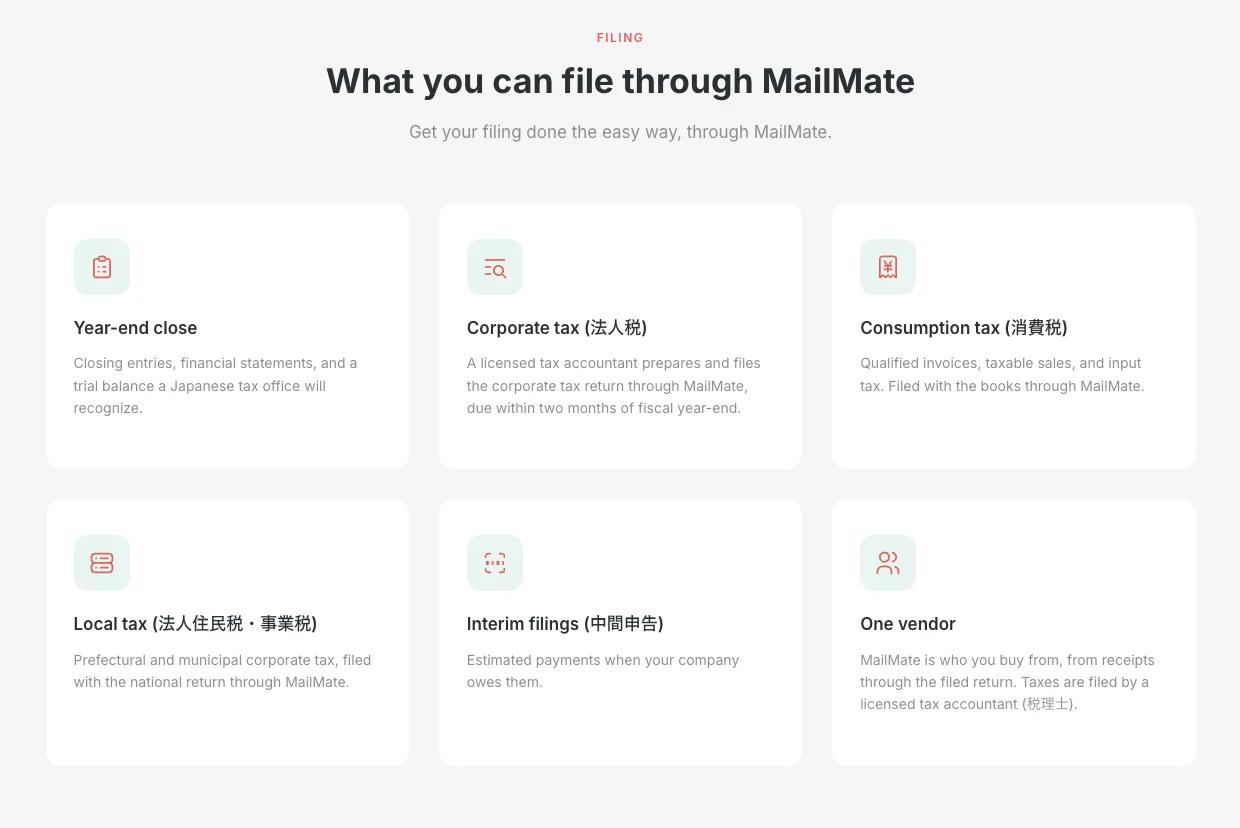
This is the specific gap MailMate is built to close: receipts, invoices, and incoming mail land in one place, a bookkeeper reconciles them onto a Japan-ready ledger, and when it is time to file, a licensed tax accountant prepares and files the corporate tax, consumption tax, and local tax returns through the same system — whether the company wants MailMate to run the entire process or just wants a compliant System of Record it can hand off at year-end.
Frequently Asked Questions
What does bookkeeping in Japan actually require?
Bookkeeping in Japan requires recording daily financial transactions in Japanese Yen and generally in the Japanese language, maintaining a general ledger and trial balance, and keeping supporting documents organized enough to support an audit trail. Foreign transactions must be converted using the market exchange rate on the transaction date. Bookkeeping on its own does not satisfy corporate tax return requirements — a licensed tax accountant still has to prepare and file the actual return based on the finished books.
Can a foreign company do its own bookkeeping in Japan?
Yes. Many foreign companies keep their own books through cloud accounting software like Money Forward, freee accounting, or Yayoi accounting. The company still needs a licensed tax accountant to prepare and file the corporate tax, consumption tax, and local tax returns, since only licensed tax accountants are legally permitted to do so. Many companies choose to outsource bookkeeping as well, because Japanese accounting conventions and documentation standards differ from what most foreign finance teams are used to.
What is Blue Form status and why does it matter for bookkeeping?
Blue Form status is a tax filing status that allows a 10-year carryforward of tax losses, among other benefits, in exchange for maintaining orderly double-entry bookkeeping. Companies must apply within 3 months of establishment (or first fiscal year-end, whichever is earlier), and the status can be revoked if record-keeping standards are not maintained. Companies with Blue Form status must also file tax returns within 2 months of the fiscal year-end, which makes consistent bookkeeping throughout the year a requirement rather than a nice-to-have.
How long do companies in Japan need to keep accounting records?
Businesses must retain primary source documents for 7 years, while Japanese companies must maintain statutory books for 10 years under the Companies Act. Where the two retention periods differ, it is safest to apply the longer 10-year period. Japan's Electronic Bookkeeping Act also requires that digital transaction data be preserved in electronic form, not only printed and archived.
When are corporate tax returns due in Japan?
Corporate tax returns in Japan are generally due within two months of fiscal year end, based on finalized financial statements. Since a company's fiscal year can be any 12-month period, this deadline varies by company, though close to one-fifth of Japanese corporations use a March 31 fiscal year-end. Consumption tax returns and local corporate inhabitant tax filings typically follow the same two-month window.
Who is allowed to file a corporate tax return in Japan?
Only licensed tax accountants, known as zeirishi, are legally permitted to prepare and file tax returns in Japan. This is a matter of law, not convention, and roughly 90% of corporate tax returns in Japan are filed with a licensed tax accountant involved. A tax accountant also represents the company before the National Tax Agency if questions come up after filing.
What happens if a company files taxes late or keeps poor books in Japan?
Late filing triggers a non-filing penalty of 5%–30% of the unpaid tax (up to 40% if intentional concealment is found), plus delinquency interest of 2.8% per annum for the first 2 months and 9.1% per annum after that. Poor bookkeeping can also result in civil fines of up to ¥1 million under the Companies Act and may lead to loss of Blue Form status, forfeiting benefits like the 10-year loss carryforward.
In Closing
Bookkeeping in Japan is not simply a translated version of bookkeeping anywhere else. The combination of Japanese-language, Yen-denominated record-keeping, a licensing restriction on who can file tax returns, and layered deadlines around Blue Form status, consumption tax, and corporate tax makes this an area where foreign companies tend to underestimate the work involved.
No article replaces advice from a licensed tax accountant familiar with a company's specific requirements, and this guide is not a substitute for that relationship.
What most foreign companies actually need is one place where receipts, invoices, and mail turn into reconciled, Japan-ready books, and a licensed tax accountant who can take those books straight into a filed return. That is the entire process MailMate is built around, whether a company wants to keep its own books for free through MailMate's System of Record or hand reconciliation to a MailMate bookkeeper and file when ready.
일본 우편물 처리에 너무 많은 시간을 소비하고 있나요?
가상 우편함 + 번역 서비스는 월 3800원부터 시작합니다. 30일 환불 보장.