


6 Modern Japanese House Features To Have

A modern Japanese house blends minimalist design, natural materials like cedar and hinoki wood, and traditional Japanese architecture elements such as shoji screens (障子), lattice shutters (格子, koushi), and burnt cedar cladding (焼杉, yakisugi) with contemporary open plan living spaces.
These homes prioritize natural light, connection to the surrounding environment, and earthquake-resistant construction, while maintaining the sense of tranquility and simplicity that defines Japanese design.
A custom-built modern Japanese house costs approximately 30 to 50 million yen ($193,000 to $322,000 USD) in less urban areas and can exceed 100 million yen ($645,000 USD) in Tokyo.
This guide covers 6 distinctive features of modern Japanese houses, split between exterior and interior elements, that you should consider when building or renovating your home in Japan.
What is a modern Japanese house?
A modern Japanese house (gendai jutaku, 現代住宅) is known for its minimalist design, strong focus on natural materials, and integration of traditional Japanese architecture with contemporary building methods.
The key points are functionality, earthquake resistance, and energy efficiency, while creating living spaces that feel calm, spacious, and connected to nature.
Modern Japanese homes typically feature open plan arrangements, floor to ceiling windows, exposed beams, deep eaves for shade in summer, and indoor gardens or courtyards.
Japanese architects often design these homes to maximize natural light while adapting to the limited space common in urban Japan.
What does a modern Japanese house look like?
Modern Japanese house features at a glance
Feature |
Type |
Japanese name |
Key benefit |
|---|---|---|---|
Lattice shutters |
Exterior |
Koushi (格子) |
Privacy with ventilation and natural light. Adds warmth to the facade. |
Burnt cedar cladding |
Exterior |
Yakisugi (焼杉) |
Naturally fire-resistant, rot-resistant, and insect-resistant. Lasts 80 to 100 years. |
Wood and concrete accents |
Interior |
Various |
Cedar and hinoki add warmth. Exposed concrete creates a modern industrial look. |
Shoji screens |
Interior |
Shoji (障子) |
Diffuses natural light. Acts as sliding doors between rooms. Adds soft, clean aesthetic. |
Ground window |
Interior |
Jimado (地窓) |
Brings natural light into lower spaces. Frames garden views like a painting. |
Open courtyard |
Both |
Tsuboniwa (坪庭) |
Brings nature and light into the center of the home. Ideal for compact urban lots. |
Let’s split these modern Japanese house features into exterior and interior parts.
Exterior modern Japanese house features
1. Lattice shutters (格子)

People are looking to add lattice work, specifically lattice shutters, to the outside walls of their houses. It can be used anywhere from doors to windows.
Unlike metal shutters, usually wooden lattice adds an inviting and warm structure to your house, making it functional and aesthetically pleasing.
Many modern Japanese houses will use simple vertical patterns, but more traditional Japanese architecture for lattice doors will use more intricate design patterns such as mikado pattern, asanoha pattern, kakuasa pattern, etc.
2. Burnt cedar (焼杉)

Many modern Japanese houses have these black wooden exterior walls added to their house. These black walls are made of burnt cedar wood (焼杉, yakisugi). You'll most likely have seen an existing house or two in Japan that has a "black-box" design. And that's right, the black color comes from burnt cedar wood.
Yakisugi has been used as traditional Japanese materials, and it’s making a comeback in modern house features as it’s both durable and functional.
When adding it with white painted walls, it adds a bold contrast that is eye-catching to anyone passing your house.
Interior modern Japanese house features
3. Wood or concrete accents
Natural materials such as wood and concrete can be seen everywhere in many modern Japanese homes.
Depending on the Japanese architect, they might use local Japanese wood such as cedar, cypress, and hinoki as structures such as flooring and ceiling. Still, you can also see them in beams, columns, and furniture. These wood accents add warmth, versatility, and connection to nature.
Concrete is also commonly used in modern Japanese homes, particularly in urban areas and regions prone to extreme weather.
Reinforced concrete (RC) structures meet Japan's strict Building Standard Law (建築基準法, kenchiku kijun ho), which was significantly strengthened after the 1981 revision requiring all new buildings to withstand major seismic events.
Concrete homes can withstand earthquakes much better than older wooden construction, and many Japanese architects use exposed concrete to create interiors with a cool, industrial aesthetic.
4. Shoji screens (障子)
While shoji screens are traditionally found in Japanese-style rooms with tatami mats, they are making a return in modern Japanese houses as sliding doors between living spaces.
Unlike solid walls or conventional sliding doors, shoji screens allow natural light to pass through while maintaining privacy, making them ideal for homes with limited space where both openness and separation are needed.
Shoji screens in Japanese culture mainly use shoji paper, but plastic or glass versions are available and more durable, making them great if you have small children and pets.
5. Ground window (地窓)
As the name suggests, a ground window is a window for the ground.
Many Japanese designers would have the ground window to add natural lighting and give a sense of calmness to the modern Japanese interior.
Depending on where it is installed, a long but narrow ground window can frame a landscape or garden like a painting, adding nature back into a Japanese house.
6. Open courtyard (坪庭)
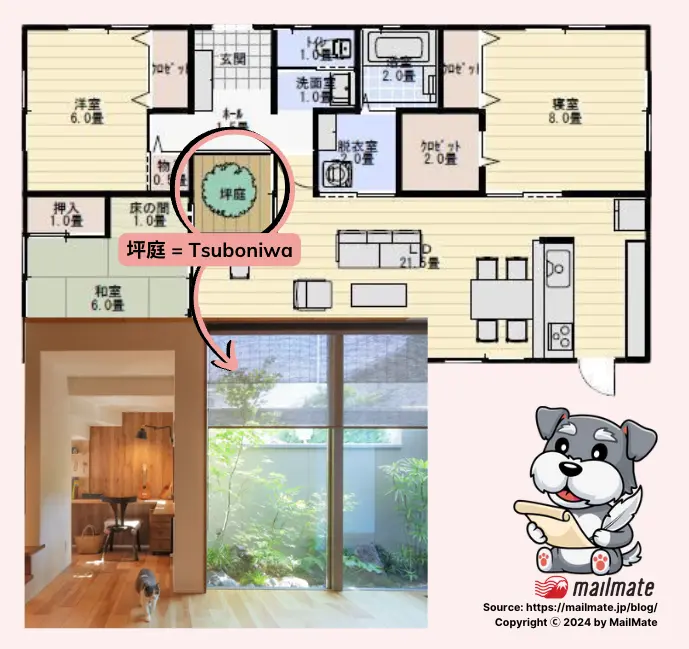
An open courtyard (坪庭, tsuboniwa) is an open area in the center of your house that’s mostly common in traditional Japanese houses. This area is often used as a central and surrounding garden within a Japanese house.
Modern Japanese homes have this feature since it’s making a comeback, especially if there are floor-to-ceiling windows to allow maximum natural light.
Many Japanese families use this inner courtyard as a play garden, a meditation space, or simply a place where children can play safely.
In modern Japanese architecture, the tsuboniwa is often paired with floor to ceiling windows or glass walls to create a seamless connection between interior and exterior living spaces.
This design brings nature, natural light, and ventilation into the center of the home, even on a compact urban lot where a surrounding garden is not possible.
How much does a modern house in Japan cost?
According to the Japan Housing Finance Agency for fiscal year 2024, the average purchase price for a custom-built home with land in Japan is approximately 50 million yen ($322,000 USD at 155 yen per dollar).
In less urban areas, a modern home can cost 30 to 50 million yen ($193,000 to $322,000 USD), varying by region, lot size, and whether land is included.
In Tokyo, Osaka, and Kyoto, custom-built modern homes frequently exceed 100 million yen ($645,000 USD).
Construction costs alone (excluding land) typically range from 15 to 35 million yen depending on the building method, with wooden frame construction being the most affordable and reinforced concrete the most expensive.
Frequently asked questions
What are the key features of a modern Japanese house?
Modern Japanese houses are defined by minimalist design, natural materials, and a strong connection to nature. Common features include lattice shutters (koushi), burnt cedar cladding (yakisugi), shoji screens as sliding doors, open courtyards (tsuboniwa), floor to ceiling windows for natural light, exposed wood beams, and deep eaves for shade and rain protection. Most modern Japanese homes use open plan arrangements combining the living room, dining area, and kitchen (known as LDK layout) to maximize the sense of space.
How much does it cost to build a modern Japanese house?
According to the Japan Housing Finance Agency's Flat 35 survey for fiscal year 2024, the average price for a custom-built home with land in Japan is approximately 50 million yen ($322,000 USD). In rural and suburban areas, modern homes cost 30 to 50 million yen. In Tokyo, Osaka, and Kyoto, custom builds frequently exceed 100 million yen. Construction costs alone range from 15 to 35 million yen depending on the building method, with wooden frame being the most affordable at 500,000 to 600,000 yen per tsubo and reinforced concrete the most expensive at over 1 million yen per tsubo.
What is yakisugi (burnt cedar) and why is it used in modern Japanese homes?
Yakisugi (焼杉) is a traditional Japanese wood preservation technique that involves charring the surface of cedar boards to create a blackened, fire-resistant, rot-resistant, and insect-resistant exterior cladding. The technique dates back to at least the 1700s and fell out of use in the 1950s before experiencing a global resurgence in the 2000s. Modern Japanese architects use yakisugi for its striking black aesthetic, low maintenance requirements, and natural durability that can last 80 to 100 years with proper care.
Which house builders specialize in modern Japanese homes?
Japan has two categories of home builders. House makers (hausu meikaa) are large companies that build homes at scale, including Sekisui House, Misawa Homes, Mitsui Home, Ichijo Komuten, Yamada Homes, and Daiwa House. For a fully custom modern Japanese design, architecture firms such as Suppose Design Office (founded by Makoto Tanijiri), Kengo Kuma and Associates, and SANAA offer bespoke residential projects. House makers are more affordable and faster, while architecture firms offer more creative freedom at a higher cost.
Are modern Japanese houses earthquake resistant?
Yes. All modern Japanese houses built after 1981 must meet the seismic standards set by Japan's revised Building Standard Law (kenchiku kijun ho). This law requires buildings to withstand major earthquakes without collapse. Reinforced concrete and steel-frame houses offer the strongest seismic performance, while modern wooden frame houses use engineered joints and cross-bracing to meet the same standards. Many house makers, including Sekisui House and Ichijo Komuten, exceed the minimum code requirements and offer the highest seismic rating of 3 (taishin todokyu san, 耐震等級3).
What is a tsuboniwa (open courtyard) in a modern Japanese house?
A tsuboniwa (坪庭) is a small inner courtyard or garden traditionally found in machiya townhouses and larger Japanese residences. In modern Japanese architecture, the tsuboniwa brings natural light, fresh air, and greenery into the center of the home, even on compact urban lots where a surrounding garden is not possible. Architects often pair the courtyard with floor to ceiling windows or glass walls to create a seamless connection between interior living spaces and nature.
Can foreigners build a modern Japanese house in Japan?
Yes. There are no restrictions on foreigners purchasing land or building a house in Japan. You can hire a Japanese house maker or architecture firm regardless of your nationality or visa status. However, navigating the building process in Japanese can be challenging. Services like MailMate can help with property-related mail, utility setup, and tax payments. Some architecture firms, such as those listed on japanese-architects.com, offer English-language support for foreign clients.
In closing
Whether you're building a new house from scratch or exploring existing houses, many modern Japanese houses have a mix of modern and traditional home features to perfectly create a sense of tranquility, functionality, and aesthetic appeal that’s uniquely Japanese.
일본 우편물 처리에 너무 많은 시간을 소비하고 있나요?
가상 우편함 + 번역 서비스는 월 3800원부터 시작합니다. 30일 환불 보장.