


Visa Renewal Japan 2026: Fees, New October Fee Table & How to Apply


Visa renewal in Japan currently costs 6,000 yen for an in-person application and 5,500 yen online, a rate that has held since the Immigration Services Agency (ISA) raised it from 4,000 yen on April 1, 2025.
That is about to change again: a law enacted on May 29, 2026 raised the legal fee ceiling, and the ISA's draft cabinet order, published July 3, 2026, would replace the flat fee with a table reaching 75,000 yen for a 5-year visa and 200,000 yen for permanent residence, targeted to take effect October 1, 2026.
The ISA has stated that applications filed before that date will pay the current, pre-revision fee even if approval comes later.
Applicants can submit a visa renewal, formally an extension of period of stay, up to three months before their current visa expires, either at a regional immigration bureau or through the ISA's Online Residence Application System, which was rebuilt on January 5, 2026.
This article walks through the current and upcoming application fee, the required documents by visa type, the new online application process, and what happens if a renewal is delayed or rejected.
👉 Read also: Japan E-Visa: The Complete Guide to Applying Online (2026) and An Easy Guide To The Certificate of Eligibility Japan
Key facts at a glance
| Metric | Figure |
|---|---|
| Current extension of period of stay fee | 6,000 yen in person, 5,500 yen online |
| Current permanent residence application fee | 10,000 yen |
| Deadline to keep the current fee | File before October 1, 2026 |
| New fee range starting October 1, 2026 | Approximately 10,000 to 75,000 yen, depending on visa length |
| New permanent residence fee starting October 1, 2026 | Approximately 200,000 yen |
| Earliest you can apply before expiry date | 3 months |
| Automatic extension while application is pending | Up to 2 months, or until a decision is made |
| Online system relaunch date | January 5, 2026 |
| Standard processing time (official guidance) | 2 weeks to 1 month |
Japan visa renewal fees in 2026: The current application fee
Anyone researching visa renewal in Japan this year needs to separate three things: the fee that applies right now, the fee that is coming on October 1, 2026, and the cutoff date that determines which one you pay. Confusing these leads to bad planning, and with the changeover about two months away, the timing now matters more than the amount.
👉 Read also: Japan Immigration News: What Every Foreign Resident Needs to Know (August 2026)
What changed for the extension of period of stay fee on April 1, 2025
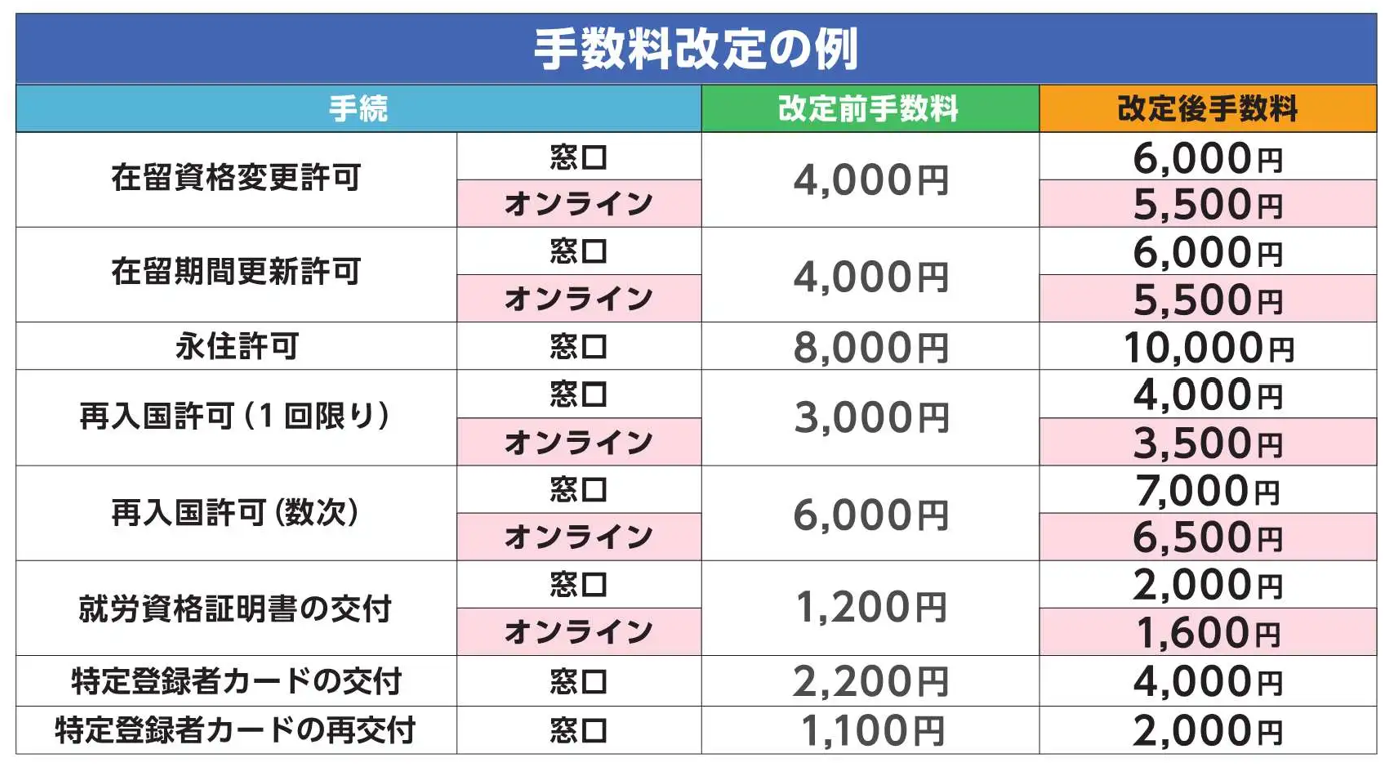
Image source: ISA Japan
Effective April 1, 2025, the Immigration Services Agency raised the application fee for extension of period of stay and change of status of residence from 4,000 yen to 6,000 yen for in-person filing, with a slightly lower 5,500 yen rate for online application. The permanent residence application fee rose from 8,000 yen to 10,000 yen at the same time. These are the fees that apply to a visa renewal filed today.
The fee is paid using a revenue stamp (収入印紙, shunyu inshi), a government stamp similar to postage that gets affixed to the application at the immigration office once the renewal is approved, not before. Revenue stamps are sold at the immigration bureau itself, at post offices, and at many convenience stores, so it is worth buying one in advance so payment does not delay pickup of your new residence card.
The October 1, 2026 fee increase and the tiered structure
In November 2025, the Japanese government under Prime Minister Sanae Takaichi announced plans for a much larger increase, citing a record foreign resident population of 4.13 million at the end of 2025 and a desire to bring Japan's immigration fees closer to those charged in the United States, the United Kingdom, and Germany.
That plan is no longer just an announcement.
On May 29, 2026, the Diet passed an amendment to the Immigration Control and Refugee Recognition Act raising the statutory upper limit for these fees, a legal ceiling that had not moved since 1982, to 100,000 yen for extension and change of status applications and 300,000 yen for permanent residence. The amendment was promulgated on June 5, 2026.
Raising the legal ceiling is not the same as setting the actual new fee, and this is where the two remaining steps come in.
On July 3, 2026, the Immigration Services Agency published a draft cabinet order with the specific proposed amounts and opened a public comment period that closes August 2, 2026. Under the draft, the flat 6,000 yen extension of period of stay fee would be replaced by a tiered structure based on how long a period of stay is granted, with a separate, lower rate for online applications:
| Period of stay granted | Counter fee | Online fee |
|---|---|---|
| 3 months or less | 10,000 yen | not listed |
| Over 3 months, up to 6 months | 18,000 yen | 15,000 yen |
| Over 6 months, under 1 year | 25,000 yen | 21,000 yen |
| 1 year | 33,000 yen | 27,000 yen |
| Over 1 year, under 3 years | 48,000 yen | 42,000 yen |
| 3 years, under 5 years | 64,000 yen | 56,000 yen |
| 5 years or more | 75,000 yen | 65,000 yen |
| Permanent residence (counter only) | 200,000 yen | not applicable |
The permanent residence application fee would rise from 10,000 yen to 200,000 yen, well below the new 300,000 yen legal cap but still a twenty-fold increase. The ISA's own published rationale notes that longer periods of stay carry a lower per-year cost, since applicants granted longer stays are treated as posing less ongoing administrative burden.
The government has stated the target implementation date for this fee change is October 1, 2026, though the figures remain a draft subject to change until the public comment period closes and the cabinet order is formally adopted.
The amended law sets a hard legal deadline of March 31, 2027 for implementation, meaning that if the public comment period or cabinet order process runs longer than expected, the effective date could shift past October 1 without the law being violated—though all current government communications point to October 1 as the target. MailMate will update this section once that happens.
👉 Read also: Working Holiday Visa Japan: Your Ultimate Preparation Guide
If you file before October 1, 2026, the Immigration Services Agency has stated directly that you pay the fee under the current, pre-revision schedule, even if your approval is granted on or after that date.
This means the submission date, not the approval date, decides which fee you pay.
There is also a reduction available for applicants facing financial hardship, capped at 10,000 yen for extension or change of status applications and 20,000 yen for permanent residence, aimed at people with refugee or complementary protection status and similar humanitarian cases; the ISA has published draft eligibility guidelines for this reduction separately.
If your current visa expires anytime from now through early 2027, filing before October 1 is the single most useful thing you can do to avoid the new fee schedule.
When to apply for your Japan visa renewal before your expiry date
You can submit your visa renewal application from three months before your current period of stay expires. Applying at the earliest possible date is generally the safer choice, especially in a year when processing volumes and fee rules are both in flux.
The special period: How your current visa stays valid
If you submit your extension of period of stay application before your current visa's expiry date, Japanese immigration law grants you a special period: your current status of residence stays valid for up to two months past the original expiry date, or until a decision is issued, whichever comes first.
During the special period you can continue working and living in Japan exactly as your current visa permits. This is the rule that prevents someone from becoming an illegal resident simply because the immigration office has not finished processing their file yet.
The special period only applies if you filed before your visa expired. Missing that window changes your situation considerably, so treat the expiry date as a hard deadline for submission, not for approval.
👉 Read also: A Simple Reentry Permit Guide for Japan For Foreign Residents
Processing time at the immigration bureau and why it varies
Official ISA guidance describes processing times for a standard extension of period of stay as roughly two weeks to one month once your application documents are complete. However, timelines vary depending on jurisdiction, visa type, and time of year.
Applications at busier bureaus, and any application filed during the March to April peak season when work and student visas turn over at once, tend to take noticeably longer than the standard guidance suggests. The immigration bureau does not provide status updates mid-review, so build in a buffer rather than assuming the fastest-case timeline.
Additionally, the ISA does not publish an official breakdown of processing time by visa category, but some patterns are widely reported anecdotally. For example, spouse and dependent visa renewals, which involve a smaller supporting-document set, are often described as moving somewhat faster than work visa renewals, which require verifying employment, tax, and income records.
Permanent residence applications are the outlier, with current processing in Tokyo commonly exceeding a year regardless of category.
👉 Read also: Japan Digital Nomad Visa Explained: What You Need To Know
Required documents for Japan visa renewal by visa type
The documents required for an extension of period of stay vary depending on your current visa status and individual circumstances, but a core set of application documents applies to nearly everyone.
Required documents and application form for all visa types
- Valid passport
- Current residence card (zairyu card, 在留カード)
- Application form for extension of period of stay (在留期間更新許可申請書, zairyu kikan koshin kyoka shinseisho)
- One photograph, 4cm by 3cm, taken within the last three months against a plain background
- Revenue stamp for the application fee, paid once the renewal is granted
Note that the exact documents listed for your case can vary depending on your visa type, your employer or school, and your individual circumstances, so always refer to the checklist for your specific status of residence before your appointment.
Necessary documents for work visas (Engineer/Specialist in Humanities/International Services)
Applicants on a work visa typically need to prepare additional documents beyond the general list:
- Certificate of employment from your current employer
- Certificate of residence tax payment (住民税納税証明書, juminzei nozei shomeisho), which confirms you have no residence tax arrears
- Recent payslips or a certificate of income
- A letter explaining any change in job duties, employer, or salary since your last renewal
👉 Not sure which job category your visa covers? See our breakdown of high-demand jobs and their visa pathways.
Highly skilled professional (HSP) visa renewal
Highly Skilled Professional visa holders generally submit the same core documents as other work visa applicants, plus items specific to the points-based system that qualifies them for the status:
- A recalculated Highly Skilled Professional points table confirming you still meet the required point threshold
- Certificate of employment confirming continued work in the qualifying role
- Certificate of residence tax payment, reviewed closely given the additional privileges tied to HSP status
Because HSP status comes with benefits like longer periods of stay and a faster route to permanent residence, the immigration bureau's compliance checks on tax and income documentation tend to be strict, so keep your residence tax certificates and payslips current well before your renewal date.
👉 Read also:【2026 Update】 The Business Manager Visa Japan, Explained and The Japan Startup Visa: A Speedy Guide
Spouse visa renewal in Japan
Spouse visa holders face a distinct set of required documents that reflect the family relationship underlying the status, not just employment:
- Family register (戸籍謄本, koseki tohon) or an equivalent document proving the marriage
- Proof of the marriage itself if the family register does not fully cover it
- Evidence of the sponsoring spouse's income and financial support for the household
- A letter from the couple if there have been any changes in living arrangements since the last renewal
Spouse visa renewal in Japan draws close scrutiny of financial support because the immigration bureau wants evidence that the couple can sustain the household without relying on public assistance. If your household income has dropped since your last renewal, be prepared to explain the change and to provide additional documents such as savings statements or a letter from your employer confirming continued employment.
👉 Read also: Getting Married in Japan: Easy Guide + Checklist and How to Retire in Japan As a Foreigner: A Comprehensive Guide
Dependent and family visa renewal: Status of residence requirements
A dependent visa, granted to a family member of a work or student visa holder, generally requires:
- Proof of the family relationship to the primary visa holder
- Evidence that the primary visa holder's own current visa is being renewed or remains valid
- Proof of the primary visa holder's continued financial support for the dependent family member
Student visas and cultural activities status
Student visa holders renewing their status typically submit a certificate of enrollment status from their university confirming continued enrollment status, along with proof of academic progress and, where relevant, evidence of financial support from a sponsor or scholarship.
Applicants on a cultural activities visa, a smaller category covering unpaid study of Japanese arts, language, or culture, need a letter from their sponsoring institution describing the activities and confirming the arrangement continues.
Visa renewal Japan: Applying in person vs. online
Every applicant can choose between the traditional in-person process at an immigration office and the ISA's online application system, though not every visa type or individual circumstance qualifies for online submission.
Applying in person at the Immigration Bureau for your new residence card
- Confirm the immigration bureau with jurisdiction over your registered address; this is not necessarily the nearest office to where you work.
- Gather all required documents listed for your specific visa type in advance, since incomplete applications are typically turned away rather than accepted with a note to follow up later.
- Submit the application form, passport, residence card, and supporting documents at the counter.
- Collect a receipt with a processing number, then return on the date specified, or check status online, to pick up your new residence card and pay the application fee with a revenue stamp.
Tokyo's main immigration office in Shinagawa is the busiest in the country and draws applicants from a wide jurisdiction across the city. Arriving before opening, avoiding late March and early April when student and work visa turnover peaks, and using the online reservation system where available can meaningfully reduce your wait.
👉 Read also: A Simple Residence Card Renewal Japan Guide For Foreigners
Applying online: Submitting Your application documents through the ISA system
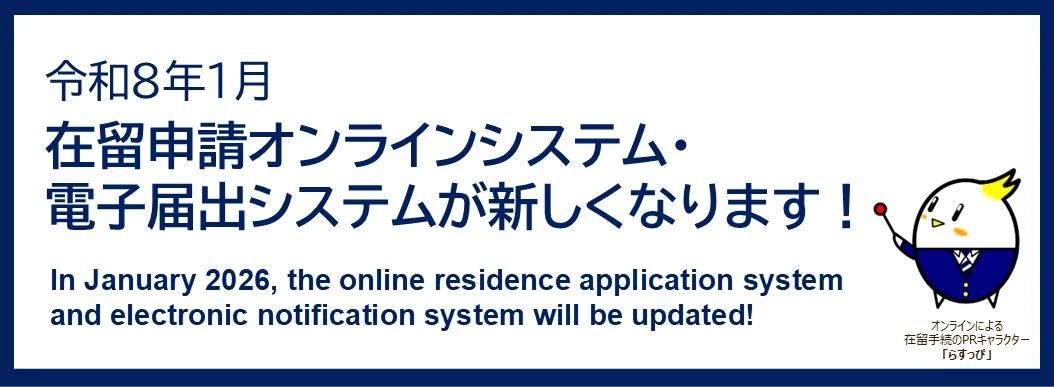
Image source: ISA Japan
The ISA relaunched its Online Residence Application System on January 5, 2026, with several improvements aimed at reducing repeat trips to the immigration office.
Who is eligible for online application?
Online applications are generally limited to holders of specific status of residence categories, including many work visas sponsored by a registered organization, and are not available for every visa type or every individual circumstance. Check the current list of eligible categories before assuming your renewal qualifies.
What changed on January 5, 2026
The system now allows larger attachments, up to 25MB, and multiple file attachments in a single application, where the previous version accepted only one file. Applicants can also save an in-progress application as an XML file and resume it later, which is useful for anyone still waiting on a document like a certificate of residence tax payment.
One important note from the ISA: applications submitted before December 2025 may no longer appear in the new system's application history, so print or save your records from the old system if you need them.
How to submit your residence card by mail
Once your online extension of period of stay is approved, you typically mail your current residence card to the immigration bureau using a registered, trackable service such as Letterpack, then receive your new residence card by return mail once it has been issued.
Typical turnaround for online applicants in 2026 has generally run close to the standard published processing time, though individual circumstances and document completeness still matter more than the filing method itself.
What happens if your Japan visa renewal is rejected?
Rejections are not common, but they are reportedly becoming more frequent in 2026 as the immigration bureau applies stricter compliance checks, particularly regarding residence tax payments.
Common reasons a renewal application is denied include:
- Unpaid or overdue residence tax
- A gap in health insurance enrollment or unpaid premiums
- A change of job, employer, or visa-relevant activity that was never reported to the immigration bureau
- Missing or inconsistent required documents, including outdated certificates of employment or enrollment status
If your application is rejected, the immigration bureau issues a written notice explaining the reason.
Depending on the reason and your individual circumstances, you may be able to reapply with additional documents addressing the issue, appeal the decision, or in some cases consult an immigration lawyer or a registered gyoseishoshi before deciding on next steps.
Someone whose renewal is denied and whose current visa has already expired can become an illegal resident if they do not act quickly, so treat any rejection notice as urgent, not something to open later.
Note that the letters and certificates that determine approval, residence tax certificates, health insurance renewal notices, and employer documents almost always arrive by post at your registered address.
Foreign residents who travel frequently, move often, or simply cannot check a physical mailbox regularly are more likely to miss one of these documents and face an avoidable delay or rejection.
Frequently Asked Questions
How much does Japan visa renewal cost in 2026?
A standard visa renewal, formally an extension of period of stay, currently costs 6,000 yen for an in-person application or 5,500 yen if filed online, a rate in effect since April 1, 2025. A confirmed law change is replacing this flat fee with a table based on visa length, targeted for October 1, 2026, running from 10,000 yen for a short period of stay up to 75,000 yen for a 5-year visa, with permanent residence rising to 200,000 yen. The Immigration Services Agency has stated that applications filed before October 1, 2026 will pay the current, lower fee even if approval comes later, so filing before that date matters more than the exact final amount. Applicants pay the fee using a revenue stamp once the renewal is approved, not at the time of submission.
What documents do I need for Japan visa renewal?
Required documents for every applicant include a valid passport, current residence card, a completed application form, a passport-style photo sized 4cm by 3cm, and a revenue stamp for the fee. Additional documents required vary depending on your visa type: work visa holders typically need an employment certificate and a residence tax payment certificate, while spouse visa holders need a family register and evidence of financial support.
How long does Japan visa renewal take?
Official guidance from the Immigration Services Agency describes standard processing as roughly two weeks to one month, though individual circumstances, jurisdiction, and seasonal volume can extend that considerably. Busier bureaus, including Tokyo's Shinagawa office, and applications submitted during the March to April peak season tend to take longer than the standard estimate.
Can I renew my Japan visa online?
Yes, for eligible visa types, through the ISA's Online Residence Application System, which was rebuilt with new features on January 5, 2026. Online eligibility depends on your current status of residence and individual circumstances, and not every category qualifies. Approved online applicants typically mail their current residence card to the bureau and receive their new card by return mail.
What is the special period for Japan visa renewal?
The special period is the automatic extension of your current visa status that applies once you submit a renewal application before your visa's expiry date. It lasts up to two months past the original expiry date, or until a decision is issued, whichever is shorter, and lets you keep working and living in Japan under your current visa while the immigration bureau reviews your application.
What are the requirements for spouse visa renewal in Japan?
Spouse visa renewal requires the general documents listed for all visa types, plus a family register or equivalent proof of marriage and evidence of the sponsoring spouse's income and financial support for the household. The immigration bureau reviews financial support closely, so a documented change in household income since the last renewal should be addressed with additional supporting documents.
What happens if my Japan visa renewal is rejected?
The immigration bureau issues a written notice explaining the reason for rejection, commonly unpaid residence tax, a health insurance gap, or an unreported change in employment. Depending on individual circumstances, applicants may be able to reapply with corrected documents, appeal, or consult an immigration lawyer, and should act quickly since a rejection with an already-expired current visa can create illegal resident status.
What happens if my Japan visa renewal is taking too long?
The immigration bureau does not typically provide case-by-case status updates, and a wait beyond the standard two-week to one-month guidance does not necessarily mean anything is wrong. As long as you applied before your visa's expiry date, the special period keeps your current status valid while the review continues, so a long wait alone is not grounds for concern unless the bureau has specifically requested additional documents you have not yet provided.
Should I renew my visa before the October 2026 fee increase?
If your current visa expires anytime soon or within the next several months, filing before October 1, 2026 is worth doing if you are eligible, since the Immigration Services Agency has stated that applications received before that date pay the current, lower fee even if approval comes later. The new fees, expected to run from 10,000 yen up to 75,000 yen depending on visa length, and 200,000 yen for permanent residence, are still a draft subject to a public comment period ending in early August 2026, so the final numbers could shift slightly before they take effect.
In closing
The fee for visa renewal in Japan is still 6,000 yen in person or 5,500 yen online, but that changes on October 1, 2026, when a draft fee schedule reaching 75,000 yen for longer visas and 200,000 yen for permanent residence is expected to take effect.
If you can file before October 1, 2026, the Immigration Services Agency has stated you pay the current, lower fee regardless of your visa type. That gives most readers a real, time-limited window to act.
Beyond the fee, the most important action for any applicant is to file from three months before your current period of stay expires and to confirm required documents for your specific visa type well ahead of that date, since individual circumstances change what is required.
This article is a general guide and does not replace advice from a licensed immigration lawyer or gyoseishoshi for a complicated case, particularly if your renewal has already been rejected or if you are at risk of becoming an illegal resident.
Dành quá nhiều thời gian xử lý thư tín từ Nhật Bản?
Dịch vụ hộp thư ảo + dịch thuật bắt đầu từ 3800 đồng mỗi tháng. Bảo đảm hoàn tiền trong 30 ngày.