


How to Get Permanent Residency in Japan: The Total Guide

Permanent residency in Japan (eijuken, 永住権) lets you live and work in Japan with no time limit. You never need to renew your visa status again. Only your residence card needs renewing, every 7 years.
To get permanent residency, most applicants must live in Japan for at least 10 years. A highly skilled professional can apply after 3 years with 70 points, or after one year with 80 points. From October 1, 2026, you also need household income above the Japanese average for your household size. The approval fee is 200,000 yen for applications received from that date.
This guide explains how to get permanent residency in Japan step by step. It covers the October 2026 rule changes, each eligibility route, the documents, and the full application process.
Quick answer
To get permanent residency in Japan, you need to live in Japan for at least 10 years. At least 5 of those years must be on a work visa or residence-based status.
Fast track: A highly skilled professional with 70 points can apply after 3 years. With 80 points, you can apply after one year.
Visa length: You need a 5-year visa. A 3-year visa counts for applications filed by March 31, 2027. A narrow exception applies after that.
Income: From October 1, 2026, household income must exceed the Japanese average for your household size.
Payments: You must pay every tax, pension and health insurance bill on time.
Fee: Approval costs 200,000 yen for applications received from October 1, 2026.
From April 2027: The ISA will also assess B1-level Japanese, your pension projection and your knowledge of Japanese rules. Spouses will wait longer.
What changed for permanent residency in Japan in 2026?
Japan tightened its permanent residency rules in three stages. Some changes took effect on October 1, 2026. Others start on April 1, 2027.
Date |
What changes |
Who it affects |
February 24, 2026 |
The ISA sets March 31, 2027 as the end date for treating a 3-year visa as the maximum period of stay. |
3-year visa holders |
October 1, 2026 |
The approval fee rises from 10,000 yen to 200,000 yen. |
Applications received from October 1 |
October 1, 2026 |
Household income must exceed the Japanese average for your household size. |
New applications, plus those filed from April 1, 2026 and still pending |
March 31, 2027 |
Last day to apply with a 3-year visa as the maximum. Current holders then get one more application, if decided before that visa expires. |
3-year visa holders |
April 1, 2027 |
B1 Japanese, a pension projection, a rules-knowledge check, school attendance for children, a stricter absence rule, and longer spouse and child routes. |
Applications filed from April 1, 2027 |
April 2027 |
The ISA can revoke PR status for intentional non-payment of tax or insurance. |
Existing permanent residents |
If you already qualify, apply before April 1, 2027. You will avoid the new language, pension and spouse rules.
👉 For every update in one place, see Japan Immigration News: What Every Foreign Resident Needs to Know.
What is permanent residency in Japan?
💡 Eijuken (永住権) is the Japanese term for permanent residency. In English, people also call it "PR" or "permanent resident status." The formal legal term is eiju kyoka (永住許可), meaning "permission for permanent residence."
Permanent residency in Japan (eijuken, 永住権) is a residence permit that lets you live and work in Japan with no time limit. In other words, you do not have to renew your visa status again.
If you plan to live in Japan for many years, permanent residency also comes with practical, everyday benefits. Applying is part of a longer process, but the benefits last:
Easier bank loans. Japanese banks are often more willing to approve personal loans for permanent residents. This is especially true for mortgages.
No employer restrictions. You can work any legal job. You do not need an employer to sponsor your status.
Simpler family status. Your spouse and children can qualify for their own related residence status.
No repeat visa applications. You do not need to file a new visa application every few years.
Most people need to live in Japan for at least 10 years. At least 5 of those years must be on a work visa or residence-based status.
The highly skilled professional visa points system shortens this wait. The J-Skip visa shortens it further for high earners. The fast-track section below explains each route.
The rules became stricter in 2026. See "What changed for permanent residency in Japan in 2026?" above for every date.
👉 Bookmark this guide. You will want to come back to it as you prepare your application.
👉 Note: This article cannot serve as a substitute for tailored legal guidance. We suggest you ask an immigration lawyer to help you with research for specific questions on how to get PR in Japan.
What are the basic eligibility requirements for permanent residency in Japan?
The Immigration Services Agency (ISA) checks three legal requirements for permanent residence. All three must apply to you.
Good conduct (sokou youken, 素行要件). You follow the law and live without social criticism.
Independent livelihood (dokuritsu seikei youken, 独立生計要件). You earn enough to support your household without public help.
National interest (kokueki youken, 国益要件). Your permanent residence benefits Japan.
The spouse or child of a Japanese citizen, permanent resident or special permanent resident does not need to meet requirements 1 and 2.
Under the national interest test, the ISA also checks these conditions (October 1, 2026 revision):
-
You have lived in Japan for at least 10 years in a row.
From April 1, 2027: in those 10 years, no single trip abroad lasted 6 months or more. Total absences stayed under 2 years and 6 months.
At least 5 of those years were on a work visa or residence-based status. Technical Intern Training and Specified Skilled Worker (i) years do not count. From April 1, 2027, more statuses stop counting. These are Employment for Skill Development (ikusei shuro, 育成就労), Intra-company Transferee, working holiday and internship. Job-hunting periods will not count toward the 10 years either.
You have no fines or prison sentences.
You paid every tax, pension and health insurance bill by its original deadline.
You hold the maximum period of stay for your visa status.
Your work matches the conditions of your current visa.
You pose no risk to public health.
You also need a guarantor. Step 2 below explains who can act as one.
Income requirement from October 1, 2026
Your household income must exceed the average Japanese household income for your household size. The ISA checks that you meet this level consistently, not in one good year.
The old benchmark was about 3 million yen for a single applicant. It no longer applies to new applications. It also no longer applies to applications filed from April 1, 2026 and still pending on October 1.
The final guideline (October 1, 2026) sets no fixed yen amount. For context, the average Japanese household earned 5.752 million yen in 2024. That household averaged 2.17 people.
Three household rules decide which income counts:
Income of a family member on a non-work status, such as Family Stay, is not added.
Relatives you support abroad count toward your household size.
Households of 5 or more people need extra income on top of the standard level.
Japanese language requirement from April 2027
From April 1, 2027, the ISA will assess whether you have Japanese at CEFR B1 level. B1 sits roughly between JLPT N3 and N2.
The guideline exempts some groups:
Highly skilled professionals and their families
People with 6 or more years of elementary or secondary schooling in Japan
Some Japan-born children of permanent residents
Check the Immigration Services Agency website before you apply.
Pension requirement from April 2027
Your projected pension must match 30 years of Employees' Pension (kosei nenkin, 厚生年金) at your income level. The asset amount you need depends on your age. Younger applicants need less, because they have more years to save.
If you plan to apply for permanent residency later, do not claim the pension lump-sum withdrawal (dattai ichijikin, 脱退一時金) when you leave Japan. It resets your contribution record.
Rules knowledge and school attendance from April 2027
From April 1, 2027, the ISA will check your understanding of Japan's systems and rules. It uses a method the ISA designates, based mainly on the Life and Work Guidebook (seikatsu shuro gaidobukku, 生活・就労ガイドブック).
If you have school-age children, they must attend elementary or junior high school. If you are of school age yourself, you must attend school.
5-year visa requirement and the 3-year transition
You need the maximum period of stay for your visa. For most work and family visas, that is 5 years. A February 24, 2026 revision set an end date for the 3-year exception.
If you apply by March 31, 2027, a 3-year visa counts as the maximum period of stay. After that, it counts only if all three conditions apply:
You held a 3-year visa on March 31, 2027.
This is your first PR application filed on or after April 1, 2027.
You receive a decision before that 3-year visa expires.
👉 Read also: Visa Renewal Japan 2026: Fees, Now October Fee Table & How to Apply and Japan Immigration News: What Every Foreign Resident Needs to Know
Special provisions to the 10-year residency clause
The standard route to permanent residency is 10 years of residence in Japan. Long trips abroad can count against you. For applications filed from April 1, 2027, the ISA checks the 10 years before you apply. A single trip of 6 months or more counts against you. So do absences that total 2 years and 6 months. Both rules apply unless you have a reasonable explanation.
Some routes shorten this wait if you have lived in Japan for a shorter time under a qualifying status. Check the table below to see if you qualify for a faster path.
Route |
Time in Japan (until March 2027) |
From April 2027 |
Key condition |
|---|---|---|---|
Standard |
10+ years |
No change |
5+ years on a work or residence-based status |
Spouse of a Japanese national, permanent resident, or special permanent resident |
3 years married + 1 year in Japan |
5 years married + 3 years in Japan |
Genuine marriage |
Child of a Japanese national, permanent resident, or special permanent resident |
1+ year |
3+ years |
Continuous residence |
Long-term resident |
5+ years |
No change |
Continuous residence as a long-term resident |
Recognized refugee |
5+ years after recognition |
No change |
Continuous residence |
Contribution to Japan |
5+ years |
Revised contribution criteria |
Recognized diplomatic, social, economic or cultural contribution |
Regional revitalization |
3+ years |
No change |
Research or IT work (Designated Activities no. 36 or 37) at an institution in an approved area |
Structural reform special zone |
Until March 2027 |
Not listed |
Contribution through a designated special zone project |
Highly skilled professional (70 points) |
3+ years |
No change |
70 points held for the full 3 years |
Highly skilled professional (80 points) |
1+ year |
No change |
80 points held for the full year |
J-Skip |
1+ year |
No change |
Meets J-Skip income and experience rules |
From April 2027, these shorter routes do not apply if you received special permission to stay or land. You then need 10 years.
If you are the spouse of a Japanese citizen, apply before April 2027. You can still use the shorter 3-year and 1-year route.
Points-based preferential eligibility clause
The highly skilled professional points system offers two faster routes to PR:
70 points: You have lived in Japan for 3 years in a row and held 70 points throughout.
80 points: You have lived in Japan for one year in a row and held 80 points throughout.
You do not need the highly skilled professional visa itself. You only need to prove your points for the full period.
J-Skip (Special Highly Skilled Professional) holders can apply after one year. J-Skip skips the points calculation entirely:
Researchers and engineers: a master's degree or 10+ years of experience, plus 20 million yen in annual income.
Business managers: 5+ years of management experience, plus 40 million yen in annual income.
For easy calculation, use this Japan PR calculator.

Image: The Points Calculation Table from MOJ
Additionally, for those interested, here is the English-language Point Calculation excel form, hosted on the MOJ site.
What documents are needed for permanent residency in Japan?
The following list is translated and summarized from the MOJ site and outlines what to prepare and the documents needed for permanent residency in Japan. Also note, that some of the required documents will depend on your current visa/employment status.
Here are the documents to prepare for your PR application:
Permanent resident permit application 永住許可申請書 = eiju kyoka shinseisho
Photograph 4x3 (taken within the last 3 months)
A reason letter for permanent residency Japan (free form, but must be submitted in Japanese) 理由書 = riyuusho
Certificate of employment (if you are working for a company) 在職証明書 = zaishoku shomeisho
Tax return (if self-employed) 確定申告書の控え= kakutei shinkokusho no hikae
Business permit (if self-employed and applicable) 営業許可書 = eigyo kyokasho
Tax payment proof, covering the past 5 years for work visa holders 納税証明書 = nozei shomeisho / 課税証明書 = kazei shomeisho
National tax payment certificate (part 3) 納税証明書(その3)= nozei shomeisho (sono 3)
Proof of income/assets (photocopy of bank book, etc.) 預貯金通帳の写し= yochokintsuchou no utsushi
National pension payment proof 各月の年金記録 / 国民年金保険料領収証書 = kakutsuki no nenkin kiroku / kokumin nenkin hokenryo ryoshusho
Health insurance premium payment proof 健康保険・厚生年金保険料領収証書 = kenkouhoken/kouseinenkinhokenryou ryoushuushousho
Passport ID page photocopy
Residence card photocopy, front and back 在留カード= zairyu card
Guarantor's letter (English form; Japanese form) 身元保証書 = mimoto hoshousho
Written consent form 了解書 = ryokaisho
Documents certifying guarantor's nationality, residence, income, and occupation
Additionally, if you are applying with the point-based system, you will need to prepare the following:
Your points calculated based on the previously mentioned Point Calculation Table
Evidence to support your point calculation score (photocopy of degrees, JLPT certificate, etc.)
Some other Japan permanent residency application documents includes a photocopy of your national health insurance card, letters of recommendation from upstanding citizens, and other additional material documenting your contributions to Japan and proof of good character as recommended by other immigration experts.
Permanent residency vs. naturalization: what's the difference?
People often confuse permanent residency with becoming a Japanese citizen. They are very different outcomes.
Permanent residency (eijusha, 永住者) lets you keep your current nationality. Naturalization (kika, 帰化) makes you a Japanese citizen, and you generally must give up your other nationality.
Permanent residency |
Naturalization |
|
Nationality |
You keep your current nationality |
You become Japanese; you generally give up your prior nationality |
Typical wait |
10 years (1 to 5 years on a fast-track route) |
Around 10 years for most applicants, as of April 2026 |
Voting rights |
No |
Yes |
Passport |
You keep your current passport |
You become eligible for a Japanese passport |
Risk of losing status |
Possible, including under new 2027 revocation rules |
Very low once granted |
There is also a separate status called Special Permanent Resident (tokubetsu eijusha, 特別永住者). This status mainly applies to Zainichi Koreans and Taiwanese residents and their descendants. It is governed by a different law than standard permanent residency.
If you want a Japanese passport and voting rights, naturalization is the path you need. If you want to keep your current nationality, permanent residency is the better fit for most long-term residents.
Step-by-step guide on how to apply for permanent residency in Japan
Break down an arduous task—one step at a time. Use this step-by-step roadmap to help you plan and prepare for how to apply for a permanent visa in Japan.
Step 1. Assess if you are eligible.
Examine the eligibility guidelines and determine if you meet the criteria for permanent residency. There is enough documentation on the topic in English to complete this first step on your own.
Step 2. Find a guarantor.
Your guarantor must be willing to sign and submit a Letter of Guarantee. This is a moral responsibility, not a financial one. Your guarantor does not co-sign any debt and is not financially liable for you.
Their purpose is to attest for your good character.
All that is required of guarantors is that they are willing to sign the Letter of Guarantee and provide the following documents: a certificate of residence, tax certificate, and employment certificate.
The guarantor must be a Japanese national or another individual who has PR in Japan. For those married to a Japanese national, their spouse can be their guarantor. If that is not the case for you, asking colleagues, bosses, or even Japanese friends would suffice.
Step 3. Consult a lawyer or book a consultation with an immigration bureau.
For cases where you have a spouse, dependents, or other questions that may or may not affect your eligibility, consult a lawyer or a legal office specializing in visas. They can explain on how to get permanent residency in Japan for your specific case.
Alternatively, the Immigration Services Agency runs the Foreign Residents Support Center (FRESC) in Yotsuya, Shinjuku. It offers free consultations.
Step 4. Enroll and pay National Pension premiums.
If you aren't already enrolled in Japan's National Pension System, you must apply and then show proof of having paid premiums for the last 24 months.
To acquire proof of payment, register to the nenkin.go.jp site and (after having paid your premiums) print out the “Monthly Pension Record” (各月の年金記録 = kakutsuki no nenkin kiroku).
Step 5. Write a “reason” letter.
There is no set form for this letter, but it must include why you desire a permanent resident visa.
You may also want to include a brief background, history of stay, career highlights in Japan, and your family structure. You can write it in English, but submit a Japanese translation, too.
Step 6. Prepare documentation.
Gather all needed documentation, print out the Japan PR application form, and get any English-language documentation translated to Japanese.
Step 7. Do a final check.
Give the MOJ guidelines a final check, ensuring that all your documents are in order. Remember, one mistake on a form or forgetting a requested document can equal numerous delays.
Step 8. File your application.
Bring all your documents to the immigration bureau for your area. You cannot file a PR application online, so you must go in person.
Offices open on weekdays only. Check your bureau's hours before you go, as some close for lunch. Arrive early, because queues run long.
After submitting your documents, you will be asked to write your address and name on a postcard, which they will send to you when your application results are ready.
Step 9. Wait and wait some more.
The ISA lists a standard processing period of 4 months. In practice, most applicants wait much longer.
ISA statistics put the national average at 282 days as of March 2026, about 9 months. In Tokyo, practitioners report waits of 18 months or more. Waits grow if the bureau requests extra documents.
Your current visa does not extend while you wait. If it expires before a decision, you need to renew your visa as usual.
Step 10. Pick up your permanent residence card.
When the application has gone through all the checks, a postcard will be sent to your address, notifying you that your permanent residence card is ready to be picked up.
Go to the specified bureau counter. Pay the approval fee with a revenue stamp. The amount depends on when immigration received your application:
Received by September 30, 2026: 10,000 yen, even if approval comes later.
Received from October 1, 2026: 200,000 yen.
Approved hardship reduction: 20,000 yen.
The Cabinet approved the new fee on August 25, 2026. You pay only if immigration approves your application.
Receive your Japan permanent residence card, and … might we suggest celebrations are in order?
👉 Note: If your application has been denied, you will receive a refusal notification in your mail. You can bring this refusal notification to the Immigration Bureau and ask for the refusal to be explained. Bring a Japanese speaker if you need help. Once you fix the cause, you can reapply at any time.
What does the permanent residence card look like?
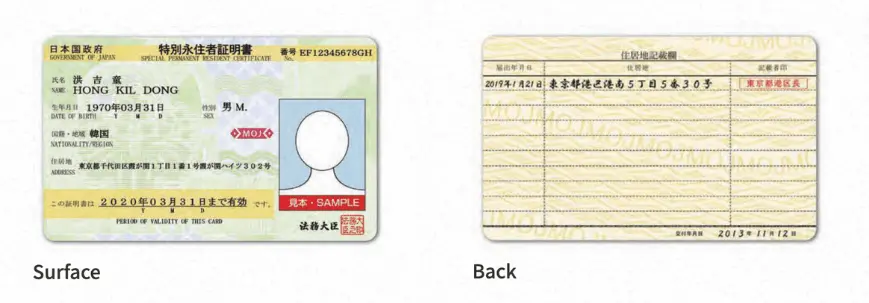
A permanent resident card example from MOJ
Your permanent residence card looks like a standard residence card. It lists your name, photo, and address. It shows "Permanent Resident" as your residence status.
Carry your residence card at all times, just as you did on your previous visa.
Set a reminder to yourself to renew your permanent resident card every 7 years. Your PR status itself does not expire. Only the card does.
Plan trips abroad carefully. The special re-entry permit (minashi sainyukoku kyoka, みなし再入国許可) lets you return within one year. If your residence card expires sooner, you must return before it does.
For longer trips, apply for a standard re-entry permit before you leave. It lasts up to 5 years.
If your permit expires while you are abroad, you lose your PR status. You cannot restore it from outside Japan.
Important: PR revocation rules from April 2027
A revised Immigration Control and Refugee Recognition Act takes effect in April 2027. It lets the ISA revoke permanent residency on three grounds:
Deliberate non-payment of taxes or social insurance premiums
Failure to meet Immigration Act duties, such as residence notifications
Certain criminal offenses that lead to a prison sentence
Unpaid bills caused by illness or job loss are not targeted. Revocation is not automatic, either. The ISA can switch you to another residence status instead, and you can later reapply for PR.
Existing PR holders should keep every tax, pension and health insurance payment current.
👉 Official source: 永住許可制度の適正化Q&A, Immigration Services Agency of Japan (Japanese)
7 common missteps to avoid when applying for permanent residency status in Japan
The following missteps to avoid are summarized from accounts relayed on a broad range of immigration-related law sites and forums and reflect real-world experiences of the process.
Misstep 1: You didn't submit all your documents in Japanese.
All documentation must be submitted in Japanese. E.g., if you include a photocopy of an English-language degree, add an attached paper that provides the Japanese equivalent.
Misstep 2: You are late on a pension payment, or you aren't enrolled.
Many immigration services state that one of the primary causes for refusal is not enrolling in Japan's pension system or delayed pension payments.
The ISA guideline counts late payments against you, even if you paid them before applying. One late tax, pension or health insurance payment can lead to a refusal. This applies to all social insurance obligations, and particular care is needed during job changes when switching between employer-managed insurance and the National Pension and National Health Insurance systems. (Source: Tokyo Immigration)
Misstep 3: You didn't promptly submit further requested documentation.
During the application process, an immigration official may reach out to you to request further proof or additional documentation. A prompt response is necessary. (Source: Tokyo Immigration)
Misstep 4: Your annual income did not match the requirements.
From October 1, 2026, your household income must exceed the Japanese average for your household size. Each dependent raises the level you need to reach, including relatives you support abroad. A spouse's part-time income on a Family Stay visa does not count toward household income. Dependent deductions also lower your taxable income, which can weaken your case. (Source: Continental Immigration)
Misstep 5: You left Japan for longer than 6 months during the PR application process.
If you left Japan after applying for a PR visa and stayed out of Japan for longer than 6 months, your application will be rejected due to the absence. (Source: June Advisors Group)
Misstep 6: You have repeated traffic violations.
Repeated traffic violations could be cause for refusal. The ISA publishes no fixed limit. Some practitioners advise fewer than 5 minor violations in 5 years. (Source: Continental Immigration)
Misstep 7: You did not have the correct number of points for the required number of years.
If you are applying based on the Point system, you must have the full amount of points at the time of application + 3 full years for the 70 points clause or 1 full year for the 80 points clause. (Source: Continental Immigration)
Frequently asked questions
What are the requirements for permanent residency in Japan?
You need good conduct, independent income, and permanent residence that benefits Japan. In practice, you must live in Japan for at least 10 years, including 5 on a work visa or residence-based status. You must hold the maximum period of stay and pay every tax and insurance bill on time. From October 1, 2026, household income must also exceed the Japanese average for your household size. Stricter rules, including B1 Japanese and a pension test, apply to applications filed from April 1, 2027.
How long does it take to get permanent residency in Japan?
Most people need to live in Japan for at least 10 years before they can apply. A highly skilled professional can apply after 3 years with 70 points, or one year with 80 points. After you apply, the national average wait is about 9 months. In Tokyo, waits often run 18 months or more.
What income do I need for Japan PR in 2026?
From October 1, 2026, household income must exceed the average Japanese household income for your household size. The old benchmark of about 3 million yen for a single applicant no longer applies. The rule also covers applications filed from April 1, 2026 and still pending. The ISA checks that your income stays at this level consistently.
Do I need to speak Japanese to get permanent residency in Japan?
Not for applications filed by March 31, 2027. From April 1, 2027, the ISA will assess whether you have Japanese at CEFR B1 level, roughly JLPT N3 to N2. The guideline exempts highly skilled professionals and their families. It also exempts people with 6 or more years of schooling in Japan, and some Japan-born children of permanent residents.
Can I apply for permanent residency in Japan with a 3-year visa?
Yes, if you apply by March 31, 2027. After that, a 3-year visa counts only for your first application filed from April 1, 2027. You must also have held that 3-year visa on March 31, 2027 and receive a decision before it expires. Otherwise, you need a 5-year visa.
How much does a permanent residency application cost?
The approval fee is 200,000 yen for applications received from October 1, 2026. Applications received by September 30, 2026 pay 10,000 yen, even if approval comes later. An approved hardship reduction lowers the fee to 20,000 yen. You pay with a revenue stamp, and only if immigration approves you.
How can a spouse of a Japanese citizen get permanent residency?
A spouse of a Japanese citizen or permanent resident can use a shorter route. Until March 2027, you need 3 years of marriage and one year living in Japan. From April 2027, you will need 5 years of marriage and 3 years in Japan. If you qualify now, apply before the change.
Can I get permanent residency in Japan after only one year?
Yes, through two routes. You can hold 80 or more highly skilled professional points for one full year. Or you can qualify for J-Skip, which needs 20 million yen in income plus a master's degree or 10 years of experience. Both routes still require the general PR requirements.
Can Japan revoke permanent residency status?
Yes. From April 2027, the ISA can revoke PR status on three grounds: deliberate non-payment of taxes or social insurance, breaking Immigration Act duties, and certain crimes. Unpaid bills caused by illness or job loss are not targeted. The ISA can also switch you to another status instead of removing you. You also lose PR status if your re-entry permit expires while you are abroad.
What is the difference between permanent residency and special permanent residency?
Special permanent residency (tokubetsu eijusha, 特別永住者) is a separate status under a different law. It mainly covers Zainichi Koreans, Taiwanese residents and their descendants. Special permanent residents carry a Special Permanent Resident Certificate instead of a residence card. Other foreign residents apply for regular permanent residency through the ISA.
In closing
Permanent residency in Japan gives you the freedom to live in Japan for as long as you want. You can change jobs, get a mortgage and stop renewing your visa.
The rules are stricter now, and more changes start in April 2027. If you already qualify, apply soon.
The PR application process needs careful paperwork in Japanese. MailMate's bilingual assistant service helps with research and forms. It is available exclusively to MailMate users.
Sources
This guide was last checked against these official sources on October 1, 2026.
Guidelines for Permission for Permanent Residence, October 1, 2026 revision (永住許可に関するガイドライン), Immigration Services Agency of Japan (Japanese)
Application for Permission for Permanent Residence (永住許可申請), Immigration Services Agency of Japan (Japanese)
Required documents for work status holders (提出書類), Immigration Services Agency of Japan (Japanese)
Justice Minister press conference on the income rule timing (法務大臣閣議後記者会見), Ministry of Justice (Japanese)
Q&A on permanent residence revocation rules (永住許可制度の適正化Q&A), Immigration Services Agency of Japan (Japanese)
Special Highly Skilled Professional system (J-Skip), Immigration Services Agency of Japan (Japanese)
Life and Work Guidebook (生活・就労ガイドブック), Immigration Services Agency of Japan
Lump-sum withdrawal payments (脱退一時金), Japan Pension Service (Japanese)
October 1, 2026 fee revision (令和8年10月1日付け在留許可手数料の額の改定等について)
Spending too long figuring out your Japanese mail?
Virtual mail + translation services start at 3800 per month. 30-day money-back guarantee.