


Employer of record Japan: what it covers, what it doesn't & when to use it (2026)

An employer of record in Japan is a company that becomes the legal employer of your Japanese staff on your behalf. It handles the employment contract, payroll, income tax withholding, and mandatory insurance schemes. Essentially, EOR services let foreign companies hire employees in a foreign country like Japan without opening a local entity.
This guide covers what an EOR actually handles, what it doesn't, and how to choose between an EOR provider and your own Japanese entity.
What is an employer of record in Japan?
Your company stays the client company throughout the arrangement. The EOR carries the legal responsibility for the worker under Japanese law instead. Japanese labor laws put significant legal risk on whichever entity holds that employer role.
The legal employer relationship, explained
Your company directs the employee's day-to-day work. The EOR company owns the employment contract, statutory filings, and tax authorities relationship. This split is what makes international hiring possible without a legal entity in Japan.
EOR vs. PEO
A professional employer organization (PEO) is a related but different model. A PEO shares employer responsibilities with your business under a co-employment structure.
An EOR is the sole legal employer instead. That removes the need for your company to register as an employer in Japan at all.
EOR vs. haken (派遣)
Haken (派遣), meaning staffing agency, is a related term but not the same thing. Haken is a licensed dispatch arrangement under a separate law, with strict duration and industry limits.
An EOR is a direct, ongoing employment relationship between the worker and the EOR entity. The two structures carry different statutory obligations. Don't treat them as interchangeable when evaluating an EOR provider.
Why international hiring in Japan is growing
Japan employment data explains why EOR services and other record services have grown fast. Foreign workers in Japan hit 2.57 million as of October 2025, per the Ministry of Health, Labour and Welfare. That's up 11.7% year on year, marking the 13th consecutive record year.
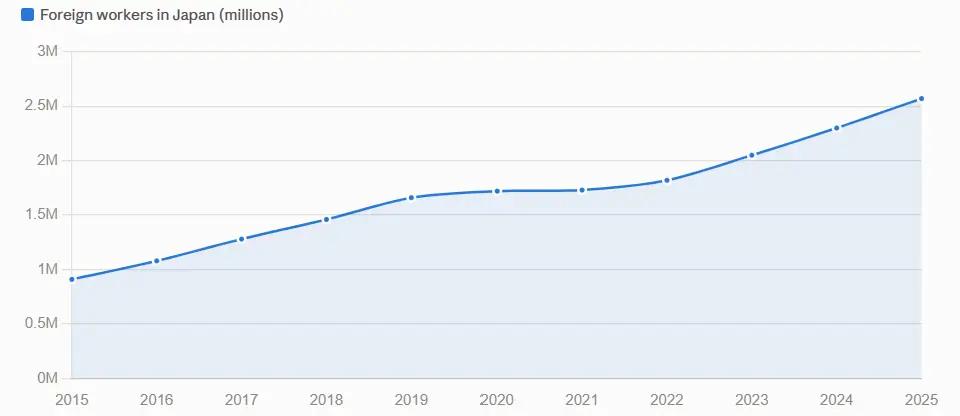
Highly skilled professional visa holders alone grew from about 167,000 in 2015 to 866,000 in 2025. Japan's shrinking working-age population is driving this trend. Both Japanese companies and overseas companies now look abroad for local talent and specialized skills.
For overseas companies planning market entry, this labor shortage cuts both ways. Demand for foreign talent is high, but navigating local labor laws without local expertise carries real legal risk. An EOR model gives foreign companies a faster, lower-risk way to test the japanese market first.
Why Japanese labor law makes EOR attractive
Japan's labour standards act sets strict rules on working hours and overtime. It also requires the mandatory working conditions notice every employer must issue at hire. Employers must also comply with the Labour Contract Act, which limits when a company can end employment.
Under the Labour Contract Act, a termination is only valid with objectively reasonable grounds and a socially acceptable process. Getting this wrong exposes the same employer to litigation, back pay, and reputational damage.
The Labour Standards Inspection Office enforces these rules directly. It can investigate a company's records, working hours, and payslips without advance notice. An EOR company with local expertise manages this exposure so you don't have to build that expertise in-house.
Social insurance enrollment deadlines add further pressure. Employers must complete social insurance enrollment for health insurance and pension within five days of the employee's start date, per the Japan Pension Service. Missing this window creates compliance risk for the employer and the employee.
Visa and immigration considerations for foreign companies
If you're planning to eventually run your own Japanese entity, not just use an EOR, factor in a steeper capital requirement. As of October 2025, the Business Manager Visa requires ¥30,000,000 in paid-in capital, up from ¥5,000,000 before, per the Immigration Services Agency of Japan.
This visa requires a genuine business office in Japan, not just a registered address on paper. That single change pushed many smaller foreign companies toward EOR arrangements instead. Most delay incorporation until at least their first one to three hires.
What does an EOR in Japan actually cover?
A good EOR company removes most of the administrative burden of hiring employees abroad. Here's what an EOR services provider in Japan typically includes.
Employee onboarding and contracts
- Compliant employment contracts drafted in Japanese and aligned with local labor laws
- Employee onboarding, including the mandatory working conditions notice
- Written contracts covering role, compensation, and working hours
Payroll and tax
- Global payroll processing with monthly payments in JPY
- Accurate income tax withholding based on the employee's gross salary
- Year-end tax adjustment (nenmatsu chosei, 年末調整), the annual reconciliation Japanese tax authorities require
Mandatory insurance schemes
- Health insurance (kenko hoken, 健康保険) enrollment
- Employees' pension insurance (kosei nenkin hoken, 厚生年金保険) enrollment
- Employment insurance (koyo hoken, 雇用保険) enrollment
- Workers' accident compensation insurance (rosai hoken, 労働者災害補償保険) enrollment
- The Child Rearing Support Contribution, a statutory obligation from April 2026
Employee lifecycle
- Employee benefits administration, including paid leave accrual and parental leave
- Termination support under Japan's strict wrongful dismissal protections
- Visa sponsorship for a foreign national, where the provider offers it
Any EOR provider whose payroll systems weren't updated for the April 2026 Child Rearing Support Contribution is already out of compliance. Confirm this directly before you sign.
The EOR hiring timeline: what to expect
Understanding the EOR process week by week helps set realistic expectations for your first hire. Most providers follow a similar sequence.
Week 1: Offer and contract. Your provider drafts compliant employment contracts in Japanese, covering role, compensation, and working hours. The employee reviews and signs, and the EOR countersigns as the legal employer.
Week 2: Onboarding and enrollment. The provider files the mandatory working conditions notice and begins social insurance enrollment. This has to happen fast, based on the employee's actual start date, not the contract signing date.
Ongoing: Payroll and compliance. Once the employee starts, the provider takes over processing payroll, income tax withholding, and monthly filings with tax authorities. This continues every month for as long as the employee stays hired through the EOR.
If sponsorship is involved, add 1 to 3 months upfront. The Immigration Services Agency needs that time to process the Certificate of Eligibility before the offer and contract stage begins.
👉 Read also: Japan Immigration News: What Every Foreign Resident Needs to Know
What an EOR in Japan does NOT cover
EOR services solve employment compliance. They don't solve business presence. Here's exactly what's missing.
1. A registered Japanese business address
Using an EOR alone doesn't require your company to have a Japanese address. Employees hired through the EOR process work under the EOR's legal entity, not yours.
A registered address becomes necessary the moment you want more than pure EOR employment. That includes incorporating a Japanese entity, applying for a Business Manager Visa, or presenting the kind of address Japanese vendors and clients expect on contracts and business cards.
2. A Japanese phone number
The phone number tied to your EOR arrangement belongs to the EOR, not your company. Japanese companies calling your business reach a generic line, not your brand. A Japanese virtual phone number solves this separately from your EOR arrangement.
3. Official business mail management
Once you have any registered address in Japan, whether for incorporation, a visa filing, or simple credibility, official mail starts arriving there. Tax notices, municipal letters, and statutory filings from bodies like the labor standards inspection office all go out by post.
An EOR only manages your employees' paperwork. It won't receive or forward mail addressed to your company. A virtual mailbox service closes that gap, scanning and forwarding everything to a dashboard you can access from anywhere.
4. A Japanese corporate bank account
Global payroll through an EOR doesn't include a bank account for your company. Opening one takes more than an EOR arrangement and more than just an address.
Japanese banks require a fully incorporated entity (KK or GK), complete with Articles of Incorporation, a registered company seal, and a registered address. Opening a corporate bank account generally isn't possible until that incorporation step is done.
If you plan to eventually invoice a Japanese company directly, pay local vendors, or hold JPY, budget for full incorporation, not just an EOR and an address.
5. Client-facing business presence
Your employees may be fully compliant on paper under Japanese law. But your company still has no visible presence in the Japanese market: no local address, no local number, and no local correspondence.
For international businesses selling into Japan, that gap affects credibility with every client company you approach.
6. Clean intellectual property assignment
Because the EOR is the legal employer on record, this gets tricky. Standard EOR employment contracts often assign work product intellectual property to the EOR entity by default, not to your company.
For most roles this is a formality your provider can fix with a side agreement. For engineering, product, or R&D hires, confirm this in writing before the employee's first day. Ask your EOR provider exactly how intellectual property assignment is handled in their standard contract template.
EOR vs. incorporating in Japan: which is right for you?
| EOR | Japanese Entity (KK/GK) | |
|---|---|---|
| Time to hire first employee | 1-2 weeks | 2-8 weeks |
| Setup cost | $0 upfront (monthly fee applies) | ¥150,000-¥550,000 |
| Ongoing cost | $199-$700/employee/month | Lower per employee at scale |
| Legal employer | The EOR company | Your company |
| Japanese business address | No | Yes |
| Bank account in your name | No | Yes |
| Best for | Testing the market, 1-5 employees | 5+ employees, long-term commitment |
Choose EOR when you're:
- Hiring 1 to 5 employees to test the Japanese market before committing further
- Working against a visa deadline and need to hire employees fast
- Running a short-term, project-based hire
- Building a small global team where local business presence isn't required yet
Choose incorporation when you're:
- Growing past 5 employees, where a Japanese entity often beats ongoing EOR cost
- Being asked by Japanese companies to contract with your own legal entity directly
- Applying for a Business Manager Visa, which requires your own entity and a physical office
- Committing to Japan as a long-term market, not a test
👉 Weighing a GK against a KK for that eventual entity? The two structures carry different setup costs, governance requirements, and credibility signals with japanese companies.
Japan EOR costs: what to budget in 2026
EOR pricing generally follows one of two models. Either a flat monthly fee per employee, or a percentage of the employee's gross salary.
Per-employee monthly fee:
- Budget tier: $199-$299/employee/month
- Mid-tier: $400-$505/employee/month
- Premium, full-service: $499-$700/employee/month
Percentage of salary: typically 8-15% of the employee's gross salary per month.
These fees usually cover payroll, statutory filings, employment compliance, and platform access. They don't cover a registered address, phone number, mail management, or bank account setup. Those stay separate.
A realistic cost example: a ¥6M/year ($40K) hire through a mid-tier EOR at $450/month. That adds roughly $5,400/year in fees, about 13.5% of gross salary. A registered address and mail service add modest overhead on top and keep the total cost of testing the Japanese market manageable.
The administrative burden of budgeting a Japan hire often gets underestimated. Companies plan for the EOR fee, then get surprised by extra costs. Social insurance contributions, corporate tax rate obligations after incorporating, and the business presence costs this guide covers can all add up.
Japan's mandatory insurance schemes: what EOR manages on your behalf
Social insurance contributions are the most complex part of employing anyone in Japan. Every EOR handles enrollment, but understanding the components helps you evaluate an EOR provider properly.
The four statutory schemes span two legal categories: shakai hoken (社会保険, social insurance), covering health and pension, and rodo hoken (労働保険, labor insurance), covering employment insurance and workers' accident compensation.
- Health insurance (kenko hoken, 健康保険): roughly 9.85% combined for Tokyo, about 4.925% each side, split equally between employer and employee. The exact rate varies by prefecture, from around 9.2% to 10.6%.
- Employees pension insurance (kosei nenkin hoken, 厚生年金保険): employer 9.15%, employee 9.15%, for 18.3% combined.
- Employment insurance (koyo hoken, 雇用保険): employer 0.85%, employee 0.5% for general businesses, effective April 2026.
- Workers' accident compensation insurance (rosai hoken, 労働者災害補償保険): employer 0.25%-8.8% depending on industry, no employee contribution.
New from April 2026: the Child Rearing Support Contribution (kodomo kosodate shienkin, 子ども・子育て支援金) adds 0.23% of standard monthly remuneration. It's split 50/50 between employer and employee, and the rate rises annually toward roughly 0.4% by 2028.
Total employer contributions typically run 14-16% of gross salary in social insurance for a standard office-based role, on top of the EOR fee itself. This is the figure most companies underestimate when budgeting international hiring. High-risk industries like construction or manufacturing pay more, since their workers' accident compensation insurance rate sits much higher.
Worked example: For an office-based employee earning ¥400,000/month in Tokyo, the employer side alone breaks down roughly like this:
| Scheme | Employer Share (Monthly) |
|---|---|
| Health insurance (~4.925%) | ¥19,700 |
| Employees' pension insurance (9.15%) | ¥36,600 |
| Employment insurance (0.85%) | ¥3,400 |
| Workers' accident compensation insurance (office-based, ~0.25%) | ¥1,000 |
| Child Rearing Support Contribution (0.115%) | ¥460 |
| Approximate total employer contribution | ¥61,000/month (about 15.3%) |
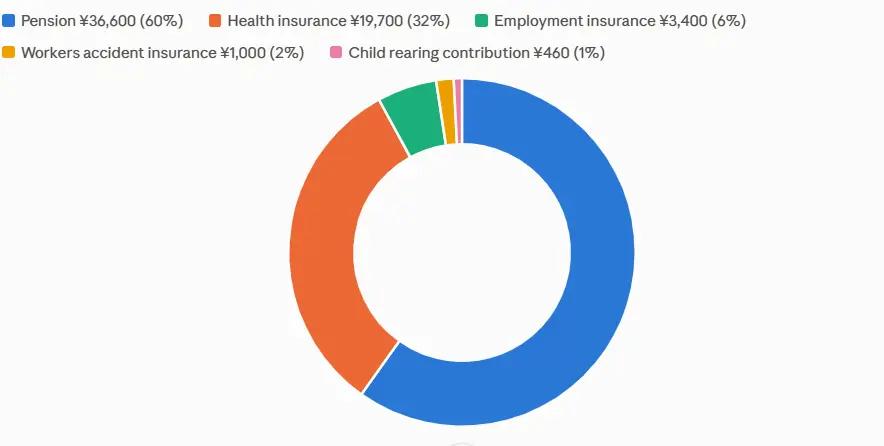
A high-risk industry like mining or forestry, where workers' accident compensation insurance runs up to 8.8%, pushes that same calculation closer to ¥95,000/month, well above the 14-16% figure. Check your specific industry's rate before budgeting.
This sits on top of the EOR's own service fee. Budget both lines separately. Confusing the EOR fee with the statutory obligation is the single most common Japan hiring budget mistake.
How to choose an EOR provider for Japan
Rather than ranking specific providers, here's what to evaluate when comparing options.
- Direct entity vs. partner network. Does the eor company operate its own Japanese entity or route employment through a local partner? A direct entity handles labor contracts and statutory filings itself and can represent you at the labor standards inspection office. A partner network adds an extra layer and an extra point of failure.
- April 2026 compliance. Ask directly whether payroll systems reflect the Child Rearing Support Contribution, covered in detail below.
- Social insurance enrollment timing. Ask exactly how the provider handles the statutory enrollment deadline covered above. Late enrollment creates compliance risk for your company and personal risk for the employee.
- Termination expertise. Japan's labor standards act makes wrongful dismissal costly and procedurally strict. Look for genuine local expertise, not a global template applied to Japan.
- Bilingual contracts. Japanese law requires written contracts in Japanese, but your global team needs to understand what it signs. Ask for a sample bilingual contract before you commit.
- Visa sponsorship track record. If you're hiring a foreign national who needs sponsorship, ask how many Certificates of Eligibility the provider has filed with the Immigration Services Agency and how often they're approved.
- Minimum wage and regional pay compliance. Japan's minimum wage is set per prefecture and revised annually. A provider processing payroll without checking the current regional minimum wage risks underpaying an employee, even unintentionally.
Setting up your Japan business presence alongside your EOR
As mentioned earlier, an EOR gives you compliant, legally hired employees under Japanese law. It does not give you a business presence in Japan. Most international businesses using an EOR still need three additional pieces, and MailMate provides all three.
- A registered Japanese business address, expected on contracts and business cards, and part of what's required if you later incorporate your own local entity
- A Japanese business phone number, a local number so client calls and vendor contact don't go through a generic international line
- A virtual mailbox for official correspondence, a service that receives, scans, translates, and forwards tax notices, municipal letters, pension bills, and other statutory filings addressed to your registered address
Together, an EOR plus MailMate gets you into the Japanese market without a physical office. The EOR handles HR, global payroll, and mandatory insurance schemes. MailMate handles your registered address, local phone number, mail management, and the credibility that comes with a real Japanese presence.

MailMate keeps working if you outgrow the EOR too. Once you incorporate your own KK or GK, MailMate's bookkeeping and tax filing service reconciles your books and files for corporate, consumption, and local tax through a licensed tax accountant. Bill-pay and invoice management catches duplicate invoices, extracts line-item data, and keeps records compliant with Japan's Electronic Bookkeeping Act.
None of this replaces incorporation if your plans require a Japanese corporate bank account or a Business Manager Visa. Those still require a fully registered Japanese entity. What MailMate covers is the presence and back-office layer on both sides of that decision. It sits alongside your EOR before you incorporate and alongside your own entity after.
Most companies using EOR in Japan already spend $199 to $700 a month on employment compliance, depending on provider tier. Adding MailMate closes the business presence gap for a fraction of the cost of a physical office lease, and it stays with your company as it grows into a full Japanese entity.
Frequently asked questions
What is an employer of record in Japan?
An employer of record (EOR) in Japan is a third-party company that becomes the legal employer of your Japanese staff. It manages the employment contract, payroll, mandatory insurance schemes, and Labor Standards Act compliance. Your company keeps day-to-day management of the work while the EOR carries the statutory obligation.
How much does an employer of record in Japan cost?
Pricing typically runs $200 to $700 per employee per month, depending on the provider and service level. Budget providers start near $199/month. Mid-tier providers charge $400 to $505/month, and premium full-service providers charge $500 to $700 or more. These fees cover payroll and compliance, not a registered address, phone number, or mail management.
Do I need to set up a company in Japan to use an EOR?
No. The entire point of an EOR is hiring in Japan without a local entity. The EOR's own japanese entity acts as the legal employer. Using an EOR doesn't give your company a business address, bank account, or registered presence. Those need arranging separately, for example through MailMate's virtual address service.
What is the difference between an EOR and a PEO in Japan?
An employer of record is the sole legal employer. Your company has no direct employment relationship with the staff. Professional employer organizations use a co-employment model instead, sharing employer responsibilities with your business.
In Japan, the EOR model is more common for foreign companies without a local entity. It removes the need for your company to register as an employer at all.
What does an EOR in Japan not cover?
An EOR handles employment compliance and global payroll. It doesn't provide a registered Japanese business address or a local phone number. It also skips a corporate bank account in your company's name and official mail management, so companies still need to arrange these separately.
Is an EOR the same as haken (派遣) in Japan?
No. Haken refers to Japan's licensed staffing dispatch system, regulated under a separate law with strict duration and industry limits. An EOR operates under an ongoing service agreement instead. The EOR is the permanent legal employer, not a temporary dispatching party, and the two are legally distinct.
Can an EOR sponsor work visas in Japan?
Visa sponsorship is available as an add-on from certain eor providers, usually for the Engineer/Specialist in Humanities/International Services visa or Specified Skilled Worker categories. This isn't standard across every provider and often adds cost and processing time. Confirm directly with any provider if visa sponsorship for a highly skilled professional or other foreign national is a requirement.
When should I switch from EOR to my own Japanese entity?
Common trigger points include crossing 5 employees, where incorporation often beats ongoing EOR fees. Japanese companies requiring contracts with your own legal entity is another. Applying for a Business Manager Visa also requires your own entity and office. So does needing a corporate bank account in your company's name. When you're ready, MailMate's company incorporation guide walks through the process.
Does Japan's labor shortage make it harder to hire local talent through an EOR?
It makes competition for local talent tighter, not the EOR process itself. Foreign worker numbers hit a record 2.57 million as of October 2025, per MHLW. Demand for both local and international hires is high across most industries. Expect longer sourcing timelines regardless of which hiring structure you use.
In closing
An EOR is the fastest, lowest-risk way to hire in Japan without a local entity. It handles the legal employer relationship, payroll, and mandatory insurance schemes that make japanese labor laws so unforgiving of mistakes.
But an EOR was never built to give your company a face in Japan. No registered address, no local phone number, no official mail handling. That gap surfaces fast, the moment a bank, a client, or a visa application asks for a Japanese address you don't have.
The companies that get market entry right run EOR and business presence side by side from day one. MailMate provides the registered address, local phone number, and bilingual mail management that pair with any EOR arrangement. Your company operates like a real Japanese business from the start.
일본 우편물 처리에 너무 많은 시간을 소비하고 있나요?
가상 우편함 + 번역 서비스는 월 3800원부터 시작합니다. 30일 환불 보장.