


What is a 1K Apartment in Japan? Layout, Costs, and Everything You Need to Know


A 1K apartment in Japan is a one room living space with a separate kitchen area, making it one of the most popular Japanese apartment layouts for students, young professionals, and foreign residents arriving in the country for the first time.
The "1" refers to a single room that serves as both the bedroom and living area, while the "K" stands for kitchen.
Unlike a 1R (one room) studio apartment where the kitchen and main room share a single open space, a 1K apartment features a physical partition or door between the kitchen and the rest of the unit.
With a total size typically ranging from 18 to 25 square meters and rent starting around 60,000 to 90,000 yen per month in Tokyo's suburbs, the 1K remains the most common entry point into the Japanese real estate market for anyone searching for affordable housing in Japan.
This guide covers everything you need to know before renting a 1K apartment, including how Japanese apartment layouts work, what to expect inside the unit, how costs break down, and how the 1K compares to other layout types like 1R, 1DK, and 1LDK.
👉 Read also: The Japanese Apartment Layout Guide: Finding a Perfect Place
How Japanese apartment layout letters work
If you have ever browsed apartment listings in Japan, you have probably noticed that properties are described using a combination of numbers and letters rather than terms like "studio" or "one bedroom."
These letters represent the types of rooms included in the layout.
Here is what each letter means:
R stands for Room. Used only in 1R listings, it means the entire unit is one undivided space.
K stands for Kitchen. The kitchen is a separate, distinct area from the main room.
D stands for Dining. A dining area is included alongside the kitchen.
L stands for Living. A living area is combined with the dining and kitchen space.
The number before the letters tells you how many separate rooms the apartment has, not counting the kitchen, dining, or living areas.
So a 1K apartment has one room plus a separate kitchen. A 1LDK apartment has one bedroom plus a combined living, dining, and kitchen area.
This system is governed by Japan's Building Standard Laws, so the letters are not marketing terms. They reflect real differences in room sizes and layout configurations.
What makes a kitchen a "K" vs. a "DK" or "LDK"?
The distinction between K, DK, and LDK depends on the size of the kitchen area:
K (Kitchen): The kitchen area is smaller than 4.5 tatami mats (approximately 7.3 square meters).
DK (Dining Kitchen): The dining kitchen area is between 4.5 and 8 tatami mats (approximately 7.3 to 13 square meters).
LDK (Living Dining Kitchen): The living dining kitchen area is larger than 8 tatami mats (approximately 13 square meters or more).
The difference between a 1K and a 1DK is not just a label. It directly affects how much space you have for cooking, eating, and day-to-day living.
What does a 1K apartment look like?
A typical 1K apartment in Japan follows a compact, efficient layout.
The main room
The main room in a 1K apartment functions as a combined living and bedroom space.
Room sizes typically range from 6 to 8 tatami mats, which translates to roughly 9.7 to 13 square meters (104 to 140 square feet). This single room is where you will sleep, work, relax, and store most of your belongings.
Most 1K apartments come with western-style flooring rather than traditional tatami mats, though some older buildings still have tatami in the main room.
A built-in closet with sliding doors is common but not guaranteed. If closet space is limited, many residents use freestanding storage solutions to make the most of the available space.
The kitchen

Image source: Real Estate Japan
The separate kitchen area is the defining feature that distinguishes a 1K from a 1R.
In a 1K, the kitchen is physically separated from the main room by a door, wall, or partition. This prevents cooking odors and steam from reaching the bedroom and living area.
That said, the kitchen in a 1K apartment is small.
You can expect a sink, a stovetop (usually a one-burner or two-burner gas or IH unit), and minimal countertop space.
While it is not a full kitchen by Western standards, the separate kitchen area gives you more flexibility than a 1R, where cooking happens inside the main room.
The bathroom and toilet

Most 1K apartments come equipped with a unit bath (yunitto basu), which is a prefabricated bathroom module that combines the bathtub, shower, sink, and toilet into a single waterproof room.
This is one of the most distinct features of budget Japanese apartments, and it can take some getting used to if you are coming from a country where the bathroom and toilet are always in separate rooms.
Some newer or slightly more expensive 1K units offer a separate toilet and bath, which is listed on floor plans as "BT betsu" (bath/toilet separate). If having distinct bathroom and toilet spaces matters to you, look for this designation when filtering properties in your search.
The entrance and hallway

Image source: Akiya Japan
The entrance typically includes a small shoe box (getabako) and a narrow corridor. This hallway area is where you will usually find the washing machine hookup, a small storage shelf, and the entrance to the kitchen and bathroom. In many layouts, the hallway essentially serves as the connection point between every part of the apartment.
How much does a 1K apartment in Japan cost?
Rent for a 1K apartment varies significantly depending on location, building age, distance from the nearest train station, and the floor of the building.
Here is a general breakdown of what to expect.
Monthly rent by city
City |
Average 1K Rent (per month) |
Tokyo (23 wards) |
80,000 to 130,000 yen |
Tokyo (suburban wards) |
60,000 to 90,000 yen |
Osaka |
50,000 to 70,000 yen |
Fukuoka |
35,000 to 55,000 yen |
Sapporo |
30,000 to 45,000 yen |
In Tokyo, a 1K apartment typically ranges from 75,000 JPY to 130,000 JPY per month, while a larger 1LDK configuration can exceed 120,000 JPY and reach up to 250,000 JPY monthly.
Moving a few stops outward to wards like Suginami, Nerima, or Itabashi can save you 20,000 to 40,000 yen per month while still keeping commute times reasonable.
In regional cities like Fukuoka and Sapporo, a 1K unit can often be secured for under 70,000 JPY, providing substantial savings compared to major metropolitan areas.
Move-in costs
One of the biggest surprises for foreign residents renting in Japan is the upfront costs required before you even receive the keys.
These typically add up to four to six months of rent, paid all at once at the time of signing.
Here is what those costs include:
Key money (reikin, 礼金): A non-refundable gift to the landlord, usually equivalent to one to two months of rent. This is a traditional Japanese custom with no practical benefit to the tenant.
Security deposit (shikikin, 敷金): A refundable deposit held against potential damage or unpaid rent. Typically one to two months of rent.
Agency fee (chukai tesuryo): The real estate agent's commission, usually one month of rent plus tax.
Guarantor company fee: Since most foreign residents do not have a Japanese guarantor, a guarantor company is used instead. Fees range from 50% to 100% of one month's rent.
Fire insurance: Required for most leases, typically 15,000 to 25,000 yen for a two-year policy.
First month's rent: Paid in advance at signing.
For a 1K apartment with a monthly rent of 80,000 yen, total move-in costs could range from 320,000 to 480,000 yen.
To save on these costs, look for properties listed with zero key money or reduced agency fees. These listings are increasingly common, especially in buildings that cater to foreign residents.
👉 Read also: Apartment Hunting in Tokyo, Insider Tips, and More! and A Guide to the Best Moving Companies in Japan in 2026
1K vs. 1R vs. 1DK vs. 1LDK: Which layout should you choose?
Understanding the difference between these layout types will help you find the right balance between budget and comfort.
Comparison table
Layout |
Rooms |
Kitchen Type |
Typical Size |
|---|---|---|---|
1R |
1 (open plan) |
Inside the main room |
15 to 20 sqm |
1K |
1 + separate kitchen |
Separate kitchen area (under 4.5 tatami) |
18 to 25 sqm |
1DK |
1 + dining kitchen |
Dining kitchen (4.5 to 8 tatami) |
25 to 35 sqm |
1LDK |
1 bedroom + living dining kitchen |
Full living dining kitchen (over 8 tatami) |
35 to 50 sqm |
1R vs. 1K
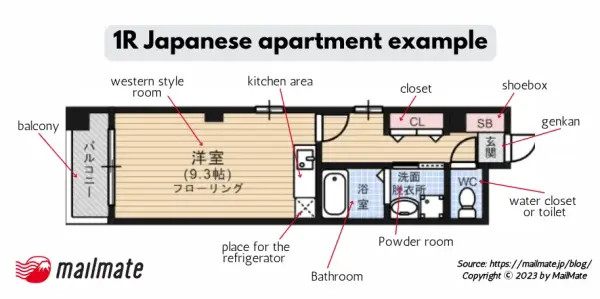
The main difference between a 1R and a 1K is the wall.
In a 1R, the kitchen is part of the main room, which means cooking smells, steam, and noise will fill your entire living space.
A 1K has that crucial partition between the kitchen and your room. This makes a meaningful difference in daily comfort, especially if you plan to cook at home.
The trade-off is that a 1R is typically cheaper. If you eat out most of the time or rely on convenience store meals, a 1R may be perfectly adequate. But if you value even a small separation between cooking and sleeping, a 1K is worth the slightly larger rent.
1K vs. 1DK
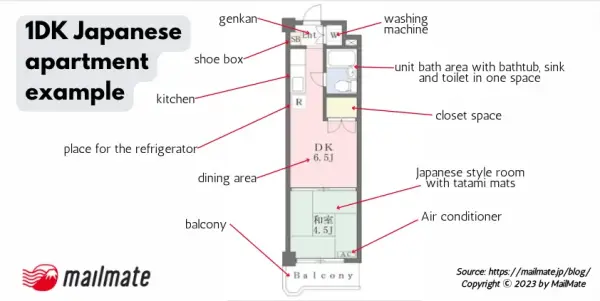
A 1DK apartment gives you a slightly larger kitchen area that doubles as a dining area.
The extra space means you can fit a small table and chairs in the kitchen, which frees up the main room for other uses. 1DK apartments tend to be found in older buildings, but they can offer surprisingly good value because of their larger floor plans.
1K vs. 1LDK
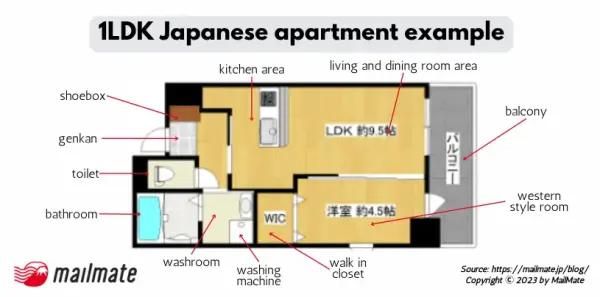
A 1LDK apartment is essentially what most people outside Japan would recognize as a standard one-bedroom apartment.
It includes a separate bedroom and a combined living, dining, and kitchen area large enough to serve as a proper living room.
The 1LDK layout offers more space, more privacy, and more flexibility, but it comes at a higher price. If your budget allows, a 1LDK is a significant upgrade from a 1K for anyone planning to stay in Japan long term.
Who is a 1K apartment best for?
A 1K apartment is a practical choice for a wide range of residents. Here is who benefits most from this layout.
Students
University students make up a large share of 1K tenants in Japan. The rent is affordable, the layout is easy to maintain, and the separate kitchen area allows for basic cooking without taking over the study and sleeping space.
Young professionals
For anyone starting a career in Japan, a 1K provides a functional home base at a price that leaves room in the budget for commuting, food, and daily expenses. The compact size also means less time and money spent on cleaning and furnishing.
Foreign residents new to Japan
If you are arriving in Japan for the first time, a 1K apartment is often the most practical starting point. It is the most commonly available layout, the approval process tends to be smoother for single applicants, and it gives you time to understand the Japanese rental system before committing to a larger and more expensive property.
Short-term stays
Some furnished 1K apartments cater to residents on shorter contracts, such as those on working holiday visas or fixed-term employment. These properties may come equipped with basic furniture and appliances, reducing the hassle of setting up from scratch. Monthly and short term furnished rentals are becoming more widely available in major cities.
👉 Read also: Moving in Japan? A Step-by-Step Moving Guide For Foreigners
Tips for making the nost of a small 1K Apartment
Living in a compact space does not have to feel cramped. Here are practical ways to create more space and comfort in a 1K apartment.
Think vertically
Japanese apartments tend to have higher ceilings than you might expect given the floor area. Use tall bookshelves, stacking storage, and wall-mounted shelves to take advantage of vertical space. Loft beds are popular among residents who want to reclaim the floor area underneath for a desk or seating.
Choose multi-purpose furniture
A low table that doubles as a desk, a sofa bed, or a storage ottoman can save a surprising amount of room. Many Japanese home goods stores like Nitori and Muji specialize in compact, multi-functional furniture designed for small living spaces.
Use the closet efficiently
If your 1K comes with a built-in closet, invest in closet organizers, hanging shelves, and vacuum storage bags for seasonal clothing. Treating the closet as a storage system rather than just a place to hang clothes will free up the rest of the room.
Keep the kitchen organized
With limited counter space in the kitchen area, a small rolling cart or magnetic rack on the refrigerator can provide extra storage for spices, utensils, and cooking supplies. Collapsible dish racks and over-the-sink cutting boards are also useful additions.
Common questions about Japanese apartment features
If you are new to the country, some features of a Japanese apartment may be unfamiliar. Here are the ones that come up most often.
What is a unit bath?
A unit bath is a prefabricated, all-in-one bathroom module commonly found in 1K and 1R apartments. It combines the bathtub, shower, sink, and toilet into a single sealed room. While efficient, many residents prefer apartments where the toilet and bath are separate. Listings that note "BT betsu" or "bath/toilet separate" indicate this feature.
What are tatami mats, and how do they measure room sizes?

Tatami mats (tatami, 畳) are traditional woven straw floor coverings still used to measure room sizes in Japan. One tatami mat is approximately 1.62 square meters (about 17.4 square feet), though the exact size varies slightly by region. A room described as "6 jo" (6 tatami mats) is roughly 9.7 square meters. Most modern listings also include square meter measurements, so you do not need to rely on tatami alone.
What does "equipped" mean in a Japanese listing?
Some listings describe apartments as "equipped" (setsubi) with specific features. This can include air conditioning, an intercom system, a washing machine hookup, or internet connectivity. Always confirm what is actually installed versus what the building offers as an option, as the distinction matters when calculating your move-in costs.
👉 Read also: How to set up utilities for the first time in Japan
Managing your Japanese mail after moving in
Once you settle into your 1K apartment, you will start receiving Japanese mail. Utility bills, ward office notices, tax documents, insurance renewals, and neighborhood circulars will arrive regularly, all in Japanese.
For foreign residents who do not read Japanese fluently, this can quickly become a source of stress and missed deadlines.
This is where a service like MailMate can help.
MailMate is a bilingual virtual mail service based in Tokyo that receives your Japanese mail, scans it, and uploads it to an online dashboard where you can view, translate, and take action on every item.

You can also use MailMate to pay utility bills directly through the platform, so you do not need to worry about deciphering payment slips in Japanese or missing a due date on your electricity, gas, or water bills.
If you travel frequently, move between cities, or simply want to stay on top of important documents without struggling through Japanese text, MailMate provides a practical solution.
For anyone renting a 1K apartment as their first home in Japan, having a reliable way to manage Japanese mail and pay bills on time removes two of the most common pain points of daily life as a foreign resident.
Frequently asked questions
What does 1K mean in a Japanese apartment?
1K stands for one room plus a separate kitchen. The "1" refers to a single main room that serves as both the bedroom and living area. The "K" refers to a kitchen that is physically partitioned from the main room. This layout is distinct from a 1R, where the kitchen and room share the same open space without any dividing wall or door.
How big is a 1K apartment in Japan?
A 1K apartment typically ranges from 18 to 25 square meters (approximately 194 to 269 square feet) of total floor space. The main room is usually 6 to 8 tatami mats in size (roughly 9.7 to 13 square meters), with the remaining space divided between the kitchen area, bathroom, hallway, and entrance.
How much does a 1K apartment cost in Tokyo?
In Tokyo, monthly rent for a 1K apartment ranges from about 60,000 yen in suburban wards like Nerima and Itabashi to over 120,000 yen in central areas like Minato and Shibuya. In addition to monthly rent, move-in costs in Japan typically total four to six months of rent and include a security deposit, key money, agency fee, guarantor company fee, and fire insurance.
What is the difference between a 1K and a 1LDK apartment?
A 1K apartment has one main room and a small, separate kitchen area. A 1LDK apartment has a separate bedroom plus a combined living, dining, and kitchen area that is larger than 8 tatami mats. The 1LDK offers significantly more space and is closer to what most countries would call a standard one bedroom apartment. Rent for a 1LDK in Tokyo typically starts at 120,000 yen per month.
Can two people live in a 1K apartment in Japan?
While it is physically possible for two people to share a 1K, most landlords and lease agreements in Japan assume a 1K apartment will house a single occupant. Applying as a couple for a 1K can raise concerns during the screening process and may result in rejection. Couples are generally better suited to a 1DK or 1LDK apartment where the layout can better accommodate two residents.
What is a unit bath in a Japanese apartment?
A unit bath (yunitto basu) is a prefabricated bathroom that combines the bathtub, shower, sink, and toilet into one compact, waterproof room. This feature is standard in most 1K and 1R apartments across Japan. Some newer properties offer a separate bathroom and toilet configuration, which is considered a premium feature and is typically listed as "BT betsu" on floor plans.
Are 1K apartments furnished in Japan?
Most standard 1K apartments in Japan are rented unfurnished. This means you will need to supply your own bed, desk, curtains, lighting fixtures, and sometimes even a stove. However, furnished and semi-furnished 1K apartments are available, particularly for short term stays and through agencies that specialize in foreign residents. Monthly furnished rentals tend to cost more per month but eliminate the need to purchase and later dispose of furniture.
What is the difference between 1R and 1K in Japanese apartments?
The primary difference is the physical separation between the kitchen and the main room. In a 1R apartment, the kitchen is located inside the main room with no dividing wall, making the entire unit one open space. In a 1K apartment, the kitchen area is separated from the main room by a door, partition, or hallway. This separation helps contain cooking odors and gives the living space a more distinct feel, even though the overall size may be similar.
In closing
A 1K apartment in Japan offers a practical, affordable entry point into the Japanese rental market. While the space is compact by international standards, the separate kitchen area, efficient layout, and lower rent make it a smart choice for students, young professionals, and foreign residents who are just starting their life in Japan.
Before you begin your apartment search, take time to understand the layout letters, compare properties across different wards and cities, and budget carefully for the full range of move-in costs. The right 1K can serve as a comfortable home base while you settle into daily life in a new country.
花太多時間處理日本郵件?
虛擬郵箱 + 翻譯服務每月僅需 3800 元起。30 天退款保證。