


Japan Digital Nomad Visa 2026: Requirements, Fees & How to Apply

Yes, Japan has a digital nomad visa. It launched on March 31, 2024 as a Designated Activities status (特定活動, tokutei katsudo). It lets a digital nomad from 51 countries and regions stay in Japan for up to six months.
You need an annual income of at least ¥10 million and private health insurance with ¥10 million in medical cover. All your work must be for employers or clients outside Japan. Since July 1, 2026, a single-entry visa costs ¥15,000, unless your nationality is exempt.
This visa cannot be extended, and you will not get a residence card. If you want to work remotely from a far-flung Japanese city, this guide covers requirements, the application, tax and daily life.
Japan digital nomad visa at a glance
Official name |
Designated Activities (Digital Nomad) |
Period of stay |
Up to 6 months; no extension |
Eligible nationalities |
51 countries and regions with visa-free entry and a tax treaty with Japan |
Income |
¥10,000,000 a year (about $62,800 at August 16, 2026 rates) |
Health insurance |
Covers death, injury and illness; at least ¥10M for medical treatment |
Visa fee |
¥15,000 single entry from July 1, 2026, unless your nationality is exempt |
Where to apply |
A Japanese embassy or consulate outside Japan |
Visa validity |
Single entry; enter Japan within 3 months of issue |
Residence card |
Not issued; no city hall registration |
Re-entry |
Allowed within your 6 months with a re-entry permit or special re-entry permit |
Reapply |
6 months after you leave Japan |
Family |
Spouse and children can join; their country list is broader |
Is Japan a good place for digital nomads?

A digital nomad visa lets you legally work remotely while you stay in another country. It differs from a business manager, work or investment visa, which let you work for Japanese entities.
Japan is one of the best places around the world for working remotely. Major cities have reliable internet, coworking spaces and work-friendly cafes. Freelancers, developers, consultants and content creators all fit this visa, as long as their clients are outside Japan.
👉 Thinking about a local role instead? See the sectors hiring foreigners at competitive salaries.
Is there a digital nomad visa in Japan?
Yes. The Japanese government introduced the digital nomad visa on March 31, 2024. It is a Designated Activities status, so it sits outside the standard work visas.
Who it is for: remote employees, freelancers and business owners whose clients or employers are outside Japan
How long: up to 6 months, with no extension
Family: your spouse and children can join you for the same period
What you give up: no residence card, so no Japanese bank account and no national health insurance
Any job type qualifies, as long as you meet the income and nationality rules. See the Ministry of Foreign Affairs of Japan's Designated Digital Nomad visa page for the official text.
Japan digital nomad visa requirements
You need to meet three conditions to apply for this visa:
Income: at least ¥10 million a year, to show you can support yourself
Health insurance: private cover for death, injury and illness, with at least ¥10 million for medical treatment
Nationality: a passport from one of the 51 eligible countries or regions
You also agree to stay in Japan for no longer than 6 months.
Who can get a digital nomad visa for Japan?
A country qualifies only if it has both visa-free entry and a tax treaty with Japan. The Immigration Services Agency publishes the official list of eligible countries and regions.
Australia |
Hungary |
Qatar |
Austria |
Iceland |
Republic of Korea |
Belgium |
Indonesia |
Romania |
Brazil |
Ireland |
Serbia |
Brunei |
Israel |
Singapore |
Bulgaria |
Italy |
Slovakia |
Canada |
Latvia |
Slovenia |
Chile |
Lithuania |
Spain |
Croatia |
Luxembourg |
Sweden |
Czech Republic |
Malaysia |
Switzerland |
Denmark |
Mexico |
Taiwan |
Estonia |
Netherlands |
Thailand |
Finland |
New Zealand |
Turkey |
France |
Norway |
United Arab Emirates |
Germany |
Peru |
United Kingdom |
Greece |
Poland |
United States |
Hong Kong |
Portugal |
Uruguay |
Citizens of these 51 countries and regions can apply for the Japan digital nomad visa.
Can my family come with me?
Yes. Your spouse and children can apply for a companion visa for the same period. Their eligible-country list is broader and includes, for example, Argentina, Costa Rica and Malta.
Each family member needs insurance with ¥10 million in medical cover. A family policy under your plan is fine.
What is the income requirement for the Japan digital nomad visa?
You need an annual income of at least ¥10 million. That is about $62,800 at August 16, 2026 exchange rates. The rule is fixed in yen, so the dollar figure moves with the currency.
The Immigration Services Agency checks your income in specific ways:
Employees: your most recent annual income must reach ¥10 million. A raise that lifts your current-year pay above it also counts.
New hires: a new job that pays ¥10 million a year qualifies.
Freelancers and sole proprietors: immigration looks at profit after expenses, not the contract value.
Several clients: you can combine stable incomes, such as contracts with several startups.
In order to prove your income, submit a tax payment certificate, an income certificate, an employment contract or client contracts showing the term and amount.
How to apply for the Japan digital nomad visa?
You apply at a Japanese embassy or consulate outside Japan. The Immigration Services Agency gives no route to switch to this visa after entering as a tourist, so plan to apply before you travel.
Documents you need
The visa application form, with a photo
A valid passport
A description of your intended activities (Word), covering your planned work and period of stay
Proof of at least ¥10 million in annual income, such as a tax payment certificate, income certificate or contracts
Proof of private health insurance, such as the certificate of coverage and policy summary
Family members also need proof of their relationship to you and a copy of your passport and visa.
Do you need a Certificate of Eligibility?
Usually not. A Certificate of Eligibility normally needs an agent in Japan to apply for you. The Immigration Services Agency says nobody in Japan can act as that agent for this visa. If you live abroad, apply directly at the embassy.
Step by step
Check that your nationality is on the list of 51 eligible countries.
Buy health insurance that covers you for at least ¥10 million in medical treatment.
Gather your income documents and complete the forms.
Submit your application at the Japanese embassy or consulate for your area.
Pay the visa fee when the visa is issued. It will be ¥15,000 for a single-entry visa from July 1, 2026, unless your nationality is exempt.
Enter Japan within 3 months of issue. The visa is single entry.
How long is the Japan digital nomad visa good for?
The visa lets you stay in Japan for up to 6 months, with no extension. After you leave, you must wait 6 months before you can apply again.
Travel during your stay: you can leave and come back with a re-entry permit or special re-entry permit. Return before your 6 months end.
Moving around Japan: you may also stay in different cities with no extra paperwork.
Staying longer: you have to apply for a different visa, such as a work visa, from outside Japan.
How Japan compares to other digital nomad visas
Japan's ¥10 million income bar is one of the highest of any digital nomad visa. Its 6-month stay is also short.
Country |
Income requirement |
Length of stay |
|---|---|---|
Japan |
¥10M a year (about $62,800) |
6 months, no extension |
Portugal (D8) |
€3,680 a month in 2026 |
Long-stay residence route |
Indonesia (E33G) |
$60,000 a year |
1 year |
South Korea (F-1-D) |
About ₩104.8M a year (2x GNI per capita); roughly half for ages 18-34 living outside Greater Seoul |
Up to 3 years since June 30, 2026 |
In return, Japan offers excellent infrastructure, low crime and a weak yen that stretches foreign income. For high earners from eligible countries, it is a strong 6-month base.
What you cannot do on the Japan digital nomad visa
This visa covers a narrow set of activities. Working outside them can cause serious immigration problems.
You cannot work for Japanese companies or clients
You may not invoice or sign a contract with a Japanese company, client or individual. This includes Japanese subsidiaries of foreign firms. You also cannot take on work from someone you meet in Japan.
YouTubers, consultants and freelancers paid by overseas platforms or clients are generally fine.
You cannot extend the visa or switch to it inside Japan
There is no extension. To stay longer, leave Japan and apply for another visa, such as an Engineer/Specialist in Humanities work visa. Plan to get this visa before you travel, because ISA gives no route to switch to it from a tourist stay.
👉 Read also: Visa Renewal Japan 2026: Fees, New October Fee Table & How to Apply
Your family cannot work in Japan
Your spouse and children may not take local jobs during the stay. Plan your household budget around your income alone.
You cannot register at city hall
You will not receive a residence card (在留カード, zairyu card). So you cannot complete resident registration (住民登録) or use resident-only services.
Check your devices
Wi-Fi and Bluetooth devices without Japan's Technical Conformity Mark may be used for 90 days only. For longer use, buy a certified device or connect through a certified mobile router.
Alternatives to the Japan digital nomad visa
If you want to stay in Japan longer, or work for Japanese clients, you need another visa. Always match your work to your visa category.
1. Working Holiday Visa
The Working Holiday Visa lets young people stay for up to a year and work to fund their trip.
Age: 18 to 30 at the time of application
Nationality: one of 32 partner countries and regions, as of April 1, 2026
Limit: you can only get it once, and bars and nightclubs are off limits
2. Work visa
To live in Japan for years, a work visa is the usual route. The most common is the Engineer/Specialist in Humanities/International Services visa. It covers teaching, engineering, marketing and other skilled roles.
You need a job offer from a Japanese employer, who sponsors your application. See the Ministry of Foreign Affairs of Japan's website for current details.
3. Business visas
If you plan on starting a business in Japan, look at these routes:
The bar rose sharply on October 16, 2025. The Business Manager visa now needs ¥30 million in capital and at least one full-time employee. You or that employee must also speak Japanese at B2 (JLPT N2) level.
4. Intra-company transferee visa
This visa suits employees moving to their company's office in Japan. Your employer usually handles the transfer and the visa application.
Do digital nomads pay tax in Japan?
Usually not, but the reason matters. Pay for work you do while physically in Japan counts as Japan-source income, even if a foreign company pays you. A tax treaty is what usually exempts it.
Every eligible country has a tax treaty with Japan. According to the Immigration Services Agency, most treaties exempt your pay if two things hold:
You stay in Japan for 183 days or less in the relevant period.
No employer resident in Japan pays your salary.
When you may owe Japanese tax
Your total days in Japan exceed 183, for example by adding a tourist stay before or after the visa.
Your treaty has different terms. Check the Ministry of Finance treaty list.
You earn any income from a Japanese source, which the visa forbids anyway.
Consumption tax
Japan's consumption tax (消費税, shohi-zei) is 10% on most spending, including restaurant meals and accommodation. Groceries and takeout food are taxed at a reduced 8%.
US citizens must still report worldwide income at home. Speak to a tax professional who knows international tax before you travel.
Living in Japan as a digital nomad
Daily life in Japan is comfortable for remote workers. If you're one of the growing number of digital nomads here, plan a few tasks before you arrive. Without a residence card, banking, phones and housing all work differently.
1. Banking
Japanese banks such as MUFG, SMBC and Resona need a residence card to open an account. You will not be able to open one on this visa.
Most digital nomads use a multi-currency account such as Wise or Revolut instead. ATMs at 7-Eleven, Lawson and airports accept major international cards 24 hours a day.
2. Mobile phones
Standard phone contracts also need a residence card. Use a prepaid SIM, a short-term plan from an MVNO such as IIJmio or Rakuten Mobile, or an eSIM.
3. Accommodation
Long leases usually need a residence card, a guarantor and a two-year contract. As a digital nomad, you need to rely on serviced apartments, monthly rentals (monthly mansions) or platforms such as Airbnb.
Ask about discounts for 3- or 6-month bookings before you commit. Book early, because tourism keeps demand high in Tokyo.
4. Internet and coworking
Fiber internet is fast and reliable in major cities. You can find coworking spaces in Tokyo, Osaka, Kyoto and Fukuoka, from WeWork and Regus to Impact HUB Tokyo. Cafe Wi-Fi varies, so test it before a long work session.
5. Cost of living
The weak yen makes Japan affordable if you earn in dollars or euros. A mid-range restaurant meal costs about ¥1,000 to ¥2,500.
Accommodation is the biggest expense, and it drops sharply outside Tokyo. See our guide to the best place to live in Japan for cheaper bases.
6. Mail and an address
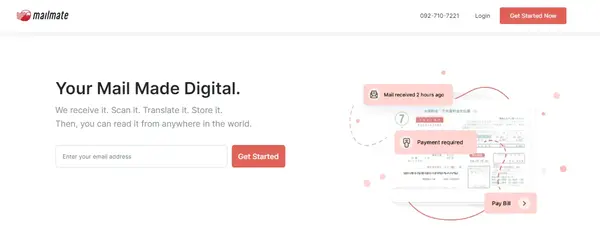
You cannot register an address at city hall on this visa. That makes official mail, deliveries and paperwork harder to handle. A virtual mail service gives you a Japanese address and scans your mail in English.
Get a Japanese address with MailMate
Digital nomads in Japan have no registered address, so physical mail is a common problem. MailMate gives you a Japanese mailing address and lets you read all your mail online.
We can also help pay your bills. Our digital mail management service works anywhere in the world.
Want to meet other remote workers? Many coworking spaces and office space providers host events. You can also find networking events in Japan on Meetup, Eventbrite and Doorkeeper.
Frequently asked questions
Does Japan have a digital nomad visa?
Yes. Japan launched its digital nomad visa on March 31, 2024. It lets remote workers from 51 countries and regions stay for up to six months. You need at least ¥10 million in annual income and private health insurance.
How much does the Japan digital nomad visa cost in 2026?
A single-entry visa costs ¥15,000 for applications from July 1, 2026, unless your nationality is exempt. Before that date, it cost ¥3,000. You also need to pay for private health insurance with at least ¥10 million in medical cover.
What are the Japan digital nomad visa requirements?
You need a passport from one of 51 eligible countries or regions. You also need at least ¥10 million in annual income and private health insurance. All your work must be for employers or clients outside Japan.
How much monthly income is required for the Japan digital nomad visa?
The monthly equivalent is about ¥833,000. That is around $5,200 at August 16, 2026 exchange rates. The rule is fixed at ¥10 million a year, so the dollar amount moves with the yen.
Can I work remotely in Japan on a tourist visa?
Remote work for a foreign employer on a short tourist trip is a grey area. Japan's short-term stay is meant for tourism and business visits, not for living there to work. If you want to stay to work, apply for the digital nomad visa.
Do digital nomads pay tax in Japan?
Usually not. Pay for work done in Japan is exempt under most tax treaties if you stay 183 days or less. Your salary must not come from an employer resident in Japan. Check your country's treaty with a tax professional.
Can I bring my family on the Japan digital nomad visa?
Yes. Your spouse and children can join you for the same period. Each needs health insurance with ¥10 million in medical cover, and a family policy is fine. They cannot work in Japan.
Can I extend the Japan digital nomad visa?
No. The visa lasts up to six months with no extension. You can apply again 6 months after you leave Japan.
Can digital nomads get Japanese residency?
No, not on this visa. Holders do not get a residence card and are not mid- to long-term residents. To live in Japan longer, you need another visa, such as a work visa.
Can I register an address in Japan on a digital nomad visa?
No. Without a residence card, you cannot register at city hall. Many digital nomads use a virtual mail service for a Japanese mailing address.
In closing
The Japan digital nomad visa suits high earners who want to work and travel in Japan for up to six months. Check your nationality, income and insurance first. Then apply at your nearest Japanese embassy.
Plan your banking, phone and address before you move to Japan, because you will not get a residence card.
Sources
✈️ Partner: Planning a Move to Japan? Check Out Japan Remotely
If you’re considering moving to Japan or building a career while working remotely, Japan Remotely is a helpful resource worth exploring.
They specialize in immigration and business support in Japan, offering guidance for remote workers, entrepreneurs, and individuals looking to relocate smoothly.
From visa planning to career and lifestyle support, they take a practical and personalized approach based on each client’s goals.
Whether you want step-by-step assistance or simply need expert guidance while handling the process yourself, Japan Remotely connects clients with trusted support and legal partners to make the transition to Japan easier and more manageable!
花太多時間處理日本郵件?
虛擬郵箱 + 翻譯服務每月僅需 3800 元起。30 天退款保證。