


Digital Mailroom: Streamlining Your Business Mail


A digital mailroom is a service or system that converts incoming physical mail and paper documents into digital files, making them accessible through an online dashboard from any location.
Digital mailroom solutions use technologies like optical character recognition (OCR) and intelligent document processing (IDP) to automate document capture, classification, and data entry.
As of 2026, the global digital mailroom services market is valued at approximately $1.6 billion, with around 68% of organizations adopting mailroom automation to reduce manual mail processing errors by up to 61%.
Whether you run a company with high mail volumes or need a personal virtual mailbox, a digital mailroom can help you cut costs, improve efficiency, and streamline business processes.
This guide covers how digital mailrooms work, the benefits of going digital, and how to choose the right mailroom solution for your organization.
What is a digital mailroom?
Unlike a traditional mailroom where staff manually sort and distribute paper mail, a digital mailroom handles all incoming mail and documents online for an organization or an individual.
It combines physical mail operations with digital information management, allowing users to view, organize, and act on their mail from any device.
Digital mailroom solutions range from enterprise-level systems used by departments like human resources and finance to virtual mailbox services designed for individuals and small businesses.
All mail is forwarded to a secure mailing room facility for scanning and uploading to the user's dashboard.
Both the paper and online mail are managed when requested. For example, you can request the mail to be opened. The working staff will open your mail and scan the contents to the dashboard for you to see. And if you request for the item to be shredded, then the staff will shred it.
How does a digital mailroom work?
Digital mailrooms operate by receiving and scanning physical mail into an online dashboard. Once digitized, users will receive a notification of their mail.
The users can request to open their mail, forward it to themselves, archive it, or integrate it with other softwares for an easier workflow.
Using a digital mailroom can streamline your workflow without sorting through the stacks of mail and documents.
1. Mail is forwarded to a scanning location.

All incoming physical mail and business mail will be forwarded to a secure scanning facility. That can include envelopes, packages, parcels, and paper documents.
2. Mail is scanned and uploaded to the dashboard
Once the physical mail has arrived at the scanning room, each mail will be sorted and prepared for scanning.
The staff has specialized scanning equipment to scan mail, such as high-speed scanners and printers, to convert them into digital images or documents.
These files will be uploaded to a user’s dashboard.
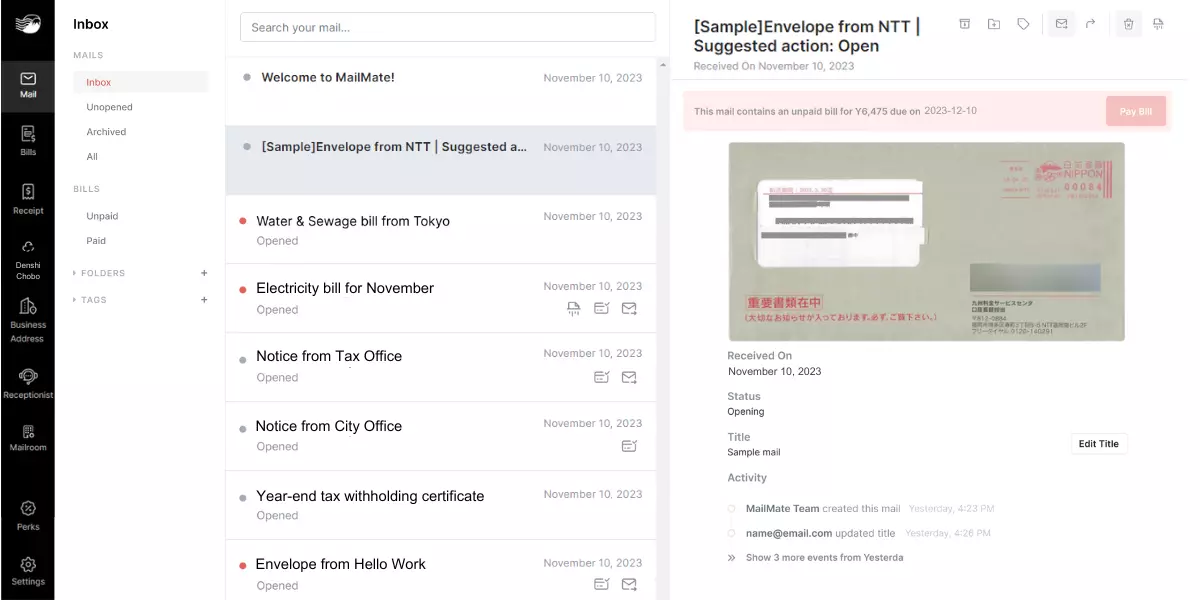
3. Request for the mail to be stored, scanned, shredded, or settled
After scanning, the digital mailroom system lets users manage their mail online, including document processing tasks such as opening, storing, shredding, and settling bills.
You can also contact customer service for further requests and questions.
4. Sort and organize your documents
Similar to an email inbox layout, you can sort, add tags, and organize your scanned mail on your dashboard.
While in the mailroom, the staff will keep track of the mail.
Traditional mailroom vs. digital mailroom
Traditional mailroom |
Digital mailroom |
|
Mail processing |
Manual sorting and delivery of paper mail |
Automated scanning, document capture, and digital routing |
Access |
On-site only, during office hours |
Online dashboard accessible from any location |
Document storage |
Physical filing cabinets and storage rooms |
Cloud-based storage for all files and documents |
Data entry |
Manual entry, higher error rate |
OCR and IDP-powered automated data entry |
Cost |
Ongoing costs for space, staff, and supplies |
Reduced overhead, lower labor and storage costs |
Security |
Physical locks, limited audit trail |
Encrypted digital storage with access controls |
Integration |
Standalone, no connection to business systems |
Integrates with CRM, ERP, and document management systems |
Speed |
Delivery and sorting can take days |
Mail is scanned and accessible within hours |
Benefits of a digital mailroom
A. Improved efficiency
A digital mailroom streamlines all mailroom automation by effectively sorting and scanning incoming mail.
This action will reduce the manual handling of physical mail and reduce any misplacements as everything is processed for you.
Instead of waiting for mail to come to the recipients, they will receive an email notification right away. Then on their dashboard, they can request specific actions for their mail, such as opening or shredding.
B. Enhanced data accuracy and security

Digital mailrooms use advanced technology such as optical character recognition (OCR) and intelligent document processing (IDP) for document capture and automated data entry.
OCR converts scanned images of text into machine-readable files, while IDP adds layers of artificial intelligence and machine learning to classify documents, extract key data fields, and validate the results.
These automated processes achieve significantly greater accuracy than manual data entry, reducing errors and improving data quality across your mail operations.
For businesses handling invoices, contracts, or compliance documents, this level of accuracy in information management can directly improve decision making and customer satisfaction.
C. Streamlined business processes
Using a digital mailroom helps a business streamline its processes by automating the routing and distribution of incoming mail, as well as integrating with other business systems and software.
All incoming documents are scanned and accessible on the online dashboard.
This process eliminates the need for manually distributing paper and electronic mail across departments, reducing delays and ensuring documents reach the correct recipients. For any line of business that depends on fast access to information, from accounts payable to human resources, this automation can transform day-to-day mail operations.
Users can also integrate their digital mailroom with business systems such as customer relationship management (CRM) software, enterprise resource planning (ERP) platforms, and document management systems for smoother data exchanges.
These integrations mean that files, e-mail attachments, and scanned paper documents all flow into the same workflows, giving your organization a single point of access for all incoming mail and data.
D. Cost savings
Organizations will no longer need a separate physical storage space for paper mail, reducing the overhead costs of office space and providing a more efficient use of existing resources.
A digital mailroom can also lower labor costs by reducing the need for dedicated mailroom staff to manually sort, open, and distribute paper and electronic documents.
For companies with remote or hybrid teams, a digital mailroom solution eliminates the cost of forwarding physical mail to multiple locations.
Over time, these savings on storage, labor, and logistics make your mailroom a more cost-effective part of the organization.
Frequently asked questions
What is a digital mailroom and how does it work?
A digital mailroom is a service or system that receives incoming physical mail at a secure facility, scans it using high-speed equipment, and uploads the digital files to an online dashboard. Users receive notifications when new mail arrives and can request actions like opening, forwarding, archiving, or shredding. The entire process replaces manual mail sorting with automated document capture and digital distribution.
How can a digital mailroom help my business?
A digital mailroom can help you reduce mail processing time, lower operational costs, and improve accuracy in data entry and document handling. By automating the intake and routing of incoming mail, your team spends less time on manual paper sorting and more time on higher-value tasks. Businesses that handle large volumes of paper documents, invoices, or correspondence see the most immediate efficiency gains.
What is the difference between a digital mailroom and a virtual mailbox?
A digital mailroom typically refers to an enterprise-level solution that automates document processing for an entire organization, integrating with business systems like CRM and ERP software. A virtual mailbox is a more personal service where individuals or small businesses receive a real mailing address, and staff at a facility scan and upload mail to an online dashboard. Both handle physical mail digitally, but they differ in scale and integration capabilities.
What types of mail and documents can a digital mailroom process?
Digital mailroom solutions can process a wide range of incoming mail including letters, invoices, contracts, government notices, packages, and paper documents of all sizes. Advanced systems use OCR and intelligent document processing to extract data from structured forms as well as unstructured correspondence. Some providers also handle e-mail attachments and electronic documents alongside physical mail for a unified workflow.
Is a digital mailroom secure for handling sensitive information?
Yes. Reputable digital mailroom providers use encrypted cloud storage, role-based access controls, and secure physical facilities to protect your mail and data. Scanned documents are stored with audit trails so you can track who accessed each file and when. For industries with strict compliance requirements such as finance or healthcare, many digital mailroom solutions offer additional security certifications and data handling protocols.
How much does a digital mailroom solution cost?
Costs vary depending on the provider, mail volume, and features included. Virtual mailbox services for individuals or small businesses can start from as little as $25 per month, while enterprise digital mailroom solutions are typically priced based on document volume and the level of integration with existing business systems. Most providers reduce overall costs compared to maintaining a traditional physical mailroom with dedicated staff and storage space.
Can a digital mailroom integrate with my existing business software?
Yes. Most digital mailroom solutions offer integration with common business systems including CRM platforms, ERP software, document management systems, and accounting tools. These integrations allow scanned mail and extracted data to flow directly into your existing workflows, eliminating the need for manual data entry between systems and ensuring all departments have fast access to incoming information.
Who benefits most from using a digital mailroom?
Organizations with high volumes of incoming mail, remote or distributed teams, and compliance-heavy industries see the greatest benefits. Departments like accounts payable, human resources, legal, and customer service all benefit from faster access to documents and reduced paper handling. Individuals living abroad or managing mail across multiple addresses also benefit from virtual mailbox versions of digital mailroom services.
In closing
Investing in a digital mailroom streamlines your mail processing and distribution for better efficiency, accuracy, and security while reducing operational costs.
Whether you need an enterprise-level digital mailroom solution to handle thousands of documents per day or a virtual mailbox service for personal use, the benefits of digitizing your mailroom extend to faster access, fewer errors, and lower costs.
The right solution can help you reclaim time, protect sensitive information, and keep your mail operations running smoothly.
Spending too long figuring out your Japanese mail?
Virtual mail + translation services start at 3800 per month. 30-day money-back guarantee.