


Japanese Document Translation Services: A Complete Guide

Living or doing business in Japan means dealing with documents written entirely in Japanese.
Tax notices, contracts, annual reports, certificates, and government correspondence all arrive in a language that uses three writing systems and layers of formal terminology that machine translation tools consistently struggle with.
This guide covers the types of documents commonly requiring Japanese translation, what to look for in a translation company, how pricing works, and the difference between certified and standard translation.
Why Japanese translation services are in high demand

The demand for Japanese translation services has grown steadily for several reasons:
International companies entering Japan need contracts, marketing materials, and compliance documents translated into Japanese.
Expats and foreign residents in Japan need Japanese-to-English translations of tax documents, pension notices, insurance forms, and ward office correspondence.
Immigration applicants in the United States, Canada, and other countries need certified translation of Japanese birth certificates, marriage certificates, death certificates, and academic transcripts.
Unlike many European languages that share Latin roots, Japanese uses kanji, hiragana, and katakana, each with distinct rules.
Translators must also navigate keigo (formal honorific language) used in business and legal contexts. This complexity is why professional native speakers with subject-matter expertise are essential for producing accurate translated documents.
Common documents that require Japanese translation
The range of documents people need translated between Japanese and English (or other languages like Chinese, Korean, French, German, Portuguese, and Thai) is broad. Here are the most frequently requested categories.
Personal and legal documents
Personal documents make up a large share of Japanese document translation services.
These include birth certificates, marriage certificates, death certificates, divorce decrees, family registers (koseki tohon), passports, and adoption papers. These are typically required documents for immigration applications, visa processing, and legal proceedings in countries like the United States, Canada, and Australia.
Certified translation is almost always required for these documents, as government agencies and courts need assurance that the translation is complete and accurate.
Business and corporate documents
Companies operating in Japan or partnering with Japanese firms frequently need translation of contracts, articles of incorporation, company registers, annual reports, financial statements, tax filings, and board meeting minutes.
These documents require translators who are familiar with Japanese corporate terminology and the legal framework governing business in Japan.
PowerPoint presentations, marketing materials, and internal reports also fall into this category. Whether the target language is English, Chinese, Korean, or another language, the translation must reflect the tone and intent of the original.
Financial and tax documents
Tax returns, tax payment certificates, withholding slips, bank statements, and audit reports are among the most commonly translated financial documents.
For individuals, the annual tax filing process in Japan generates paperwork that often needs to be shared with accountants, legal advisors, or tax authorities in other countries.
Companies in the finance sector regularly require translation of investment reports, regulatory filings, and compliance documentation.
Technical and specialized documents
Industries like engineering, IT, pharmaceuticals, and manufacturing produce highly specialized content. Technical manuals, patents, clinical trial reports, and software documentation all require translators with deep knowledge of industry-specific terminology.
Errors in technical translation can lead to regulatory rejection, safety risks, or costly misunderstandings.
Website and marketing content
Website localization goes beyond simple translation.
It involves adapting content, design, and SEO elements for the Japanese market (or adapting Japanese content for international audiences).
Marketing materials, product descriptions, email campaigns, and social media content all require translators who understand how Japanese consumers respond to messaging. This is sometimes called transcreation, where the translator recreates the persuasive intent of the original rather than translating word for word.
Subtitle and multimedia translation
Video content, training materials, webinars, and corporate presentations increasingly require subtitle translation.
Whether producing Japanese subtitles for English-language content or translating Japanese video materials for global distribution, this process demands both linguistic accuracy and timing precision.
Many translation companies now offer subtitle translation alongside their document services.
What to look for in a Japanese translation company
Not all translation services deliver the same quality. The difference between an average and an excellent Japanese translation company often comes down to a few key factors.
Native speakers with subject-matter expertise
The best Japanese translation services employ translators who are native speakers of the target language.
A native Japanese speaker translating from English into Japanese will produce more natural, culturally appropriate output than a non-native translator.
For specialized content (legal, medical, financial, technical), the translator should also have professional experience or academic training in that field.
A defined quality assurance process
Reliable translation companies use a multi-step process that includes translation, editing, and proofreading, often referred to as TEP.
Some agencies add a fourth step: a final review by a subject-matter expert. Ask any prospective translation company about their quality control process before committing to a project.
Certified translation capabilities
If you need translated documents for official use (immigration, court proceedings, academic admissions, regulatory submissions), make sure the company offers certified translation.
A certified translation includes a signed statement from the translator or agency attesting to the accuracy and completeness of the translation.
In the United States, certified translations submitted to USCIS must include a certification statement on company letterhead. Requirements vary by country, so check what your specific institution or agency requires.
Transparent translation prices
Translation prices for Japanese vary depending on the pricing model (per word, per character, per page, or per hour), the language pair, the complexity of the content, and turnaround time.
As of 2026, general English to Japanese translation typically costs between $0.10 and $0.20 per word.
Specialized or certified translation runs higher, often $0.15 to $0.30 per word or $35 to $60 per page for certified documents.
Japanese to English translation priced per Japanese character typically falls between 10 and 20 yen per character for general content, with specialized documents ranging from 15 to 30 yen or more.
A trustworthy translation company will provide a clear estimate before work begins, with no hidden fees. Many offer a free quote after reviewing your documents.
Range of language pairs and services
If your translation needs extend beyond Japanese and English, look for a company that supports multiple languages.
Many businesses require translation into Chinese, Korean, French, German, Portuguese, Thai, and other languages.
A company that handles a wide range of language pairs can serve as a single point of contact for all your translation projects, which simplifies communication and ensures consistency across deliverables.
Turnaround time and delivery reliability
Deadlines matter. Whether you are submitting documents for a visa application, filing a regulatory report, or launching a marketing campaign, late delivery can have real consequences.
Look for a company that is committed to clear timelines and communicates proactively if delays arise. Many agencies offer rush or express delivery for an additional fee.
Certified translation vs. standard translation
Understanding the difference between certified and standard translation helps you choose the right service for your needs.
Certified Translation |
Standard Translation |
|
|---|---|---|
Purpose |
Official submission to government agencies, courts, universities, and regulatory bodies |
Internal use, personal reference, general business communication |
Certification statement |
Yes, signed and stamped by the translator or agency |
Not included |
Notarization available |
Yes, often required for legal and immigration documents |
Not typically needed |
Typical use cases |
Birth certificates, marriage certificates, death certificates, immigration applications, court filings, academic transcripts, professional licenses |
Emails, meeting notes, internal reports, website content, marketing materials, presentations |
Pricing (2026 range) |
$35 to $60 per page, or $0.15 to $0.30 per word |
$0.10 to $0.20 per word for general content |
Turnaround |
2 to 10 business days depending on page count |
Varies by project scope; often faster for shorter documents |
Accepted by USCIS / IRCC |
Yes, when formatted to meet agency requirements |
No |
When you need certified translation
Certified translation is required whenever a translated document will be submitted to a government agency, court, university, or regulatory body.
Common examples include immigration applications (USCIS in the United States, IRCC in Canada), court filings, academic credential evaluations, and professional licensing applications.
The certification is a formal statement, typically signed and stamped, confirming the translation is accurate and complete.
Some situations also require notarization, where a notary public verifies the identity of the person signing the certification.
In Japan, certain documents may additionally need an apostille from the Ministry of Foreign Affairs (Gaimusho) for use in countries that are members of the Hague Apostille Convention.
It is worth noting that Japan does not have government-sanctioned licensing or accreditation for translators.
However, two professional bodies serve as important industry benchmarks.

Image: Japan Translation Association logo
The Japan Translation Association (JTA) offers a range of certification tests, including the JTA Certified Professional Translator Test for English and Chinese, as well as proficiency tests covering French, German, and other languages.
Passing a JTA exam signals that a translator has met a recognized professional standard.

Image: Japan Association of Translators logo
The Japan Association of Translators (JAT), founded in 1985 and affiliated with the International Federation of Translators (FIT), is the largest professional association of practicing translators and interpreters in Japan, with approximately 800 members across specializations including law, pharmaceuticals, patents, and entertainment.
While neither JTA certification nor JAT membership is legally required to provide certified translation in Japan, working with a translator who holds these credentials adds a layer of confidence in their skills and professionalism.
When standard translation is sufficient
For internal business use, general reference, personal understanding of correspondence, or content not destined for official submission, standard translation is usually sufficient.
This includes translating emails, meeting notes, internal presentations, website content, and informal reports. Standard translation still follows professional quality standards but does not include a certification statement.
How to get started with a Japanese translation project
If you have documents that need translating, here is a straightforward process to follow.
Step 1: Identify your documents and requirements
Gather the documents you need translated and determine whether you need certified or standard translation. Note the target language, any formatting requirements, and your deadline.
Step 2: Request a quote
Contact one or more translation companies and request an estimate. Provide the documents (or at least a word count and description) so the company can give you an accurate price. Most reputable providers offer a free quote with no obligation.
Step 3: Confirm the scope and timeline
Once you select a provider, confirm the scope of work, the delivery timeline, and the payment terms.
Make sure you understand what is included (such as proofreading and formatting) and what might cost extra (such as certification, notarization, or rush delivery).
Step 4: Review the delivered translation
When you receive the translated documents, review them carefully. If something looks incorrect or unclear, communicate with the translation team promptly. A reliable company will address your concerns and make revisions as needed.
How MailMate helps with Japanese document translation
For individuals and businesses in Japan, the challenge of Japanese documents is not limited to one-off translation projects.
Ongoing mail, government notices, tax documents, and utility bills arrive regularly in Japanese, and each piece may require prompt attention.
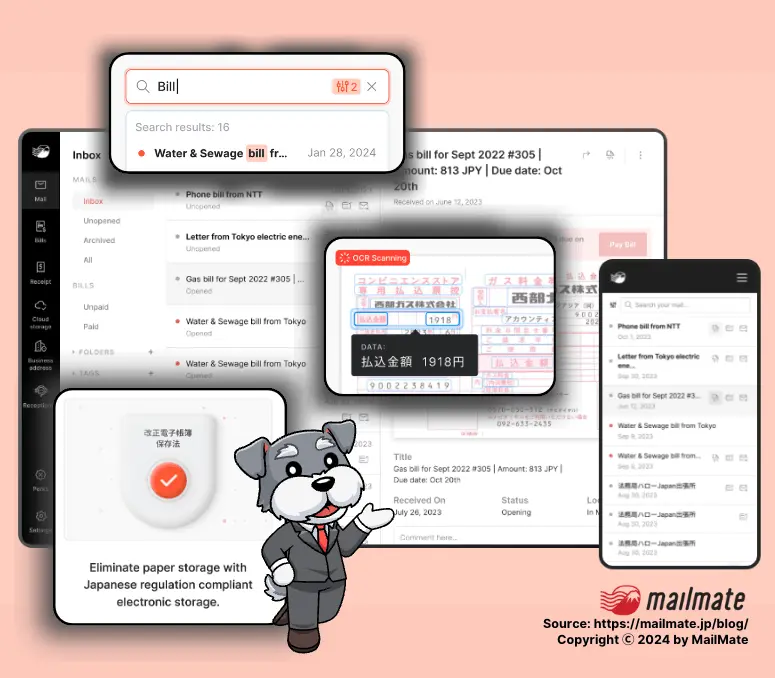
MailMate is Japan's first bilingual virtual mailbox service, built specifically for expats, remote business owners, property owners, and companies operating in Japan.
When you forward your Japanese mail to MailMate, the team receives it, scans it, and stores it in a secure cloud-based dashboard you can access from anywhere in the world.
With one click, you can request a translated summary of any letter, bill, or government notice.
MailMate focuses on the day-to-day reality of managing Japanese correspondence.
Tax assessment notices from the ward office, pension premium updates, health insurance renewals, property tax bills, and utility payment slips are all examples of documents that MailMate's team handles routinely.
Mailmate's bilingual customer support staff speak both English and Japanese fluently, so you can ask questions and get help understanding your documents without navigating a language barrier.
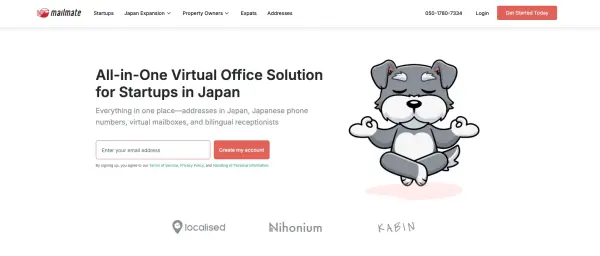
For business clients, MailMate also provides virtual office addresses for company registration, bill payment services, and the ability to share scanned mail with team members, accountants, or legal advisors.
This makes it a practical solution for anyone who needs ongoing, reliable access to their Japanese mail in translated form, rather than a one-time document translation.
Frequently asked questions
What types of documents can Japanese translation services handle?
Professional Japanese translation services can translate virtually any document type. Common examples include birth certificates, death certificates, marriage certificates, contracts, annual reports, tax returns, academic transcripts, technical manuals, marketing materials, PowerPoint presentations, and website content. Many providers also offer subtitle translation for video and multimedia content. The specific documents a company can handle depend on the expertise of their translators and the industries they serve.
How much do Japanese document translation services cost?
Translation prices for Japanese documents vary based on the language pair, document complexity, and whether certification is required. As of 2026, general English to Japanese or Japanese to English translation typically costs between $0.10 and $0.20 per word. Certified translation for official documents usually runs $35 to $60 per page. Specialized fields like legal, medical, and finance translation often carry higher rates due to the expertise and terminology involved. Most translation companies provide a free estimate after reviewing your documents, so request a quote to understand pricing for your specific project.
What is the difference between certified and standard translation?
Certified translation includes a signed statement from the translator or translation company confirming the translation is accurate and complete. It is required when submitting translated documents to government agencies, courts, universities, or regulatory bodies. Standard translation follows the same professional quality standards but does not include a formal certification statement. Standard translation is appropriate for internal business use, general reference, and personal understanding of correspondence.
How long does it take to get a Japanese document translated?
Turnaround times depend on the length and complexity of the document and the workload of the translation team. Simple certified translations of one to three pages (birth certificates, diplomas) are often delivered within two to five business days. Larger projects like technical manuals, annual reports, or website localization can take one to four weeks depending on scope. Many providers offer rush or express delivery options for urgent requests.
Do I need a native Japanese speaker to translate my documents?
For the highest quality results, yes. Native speakers of the target language produce translations that sound natural and are culturally appropriate. This is especially important for legal, medical, and financial documents where precision matters, as well as for marketing content where tone and cultural nuance influence effectiveness. Reputable translation companies assign projects to translators who are both native speakers and subject-matter experts in the relevant field.
Can I get my Japanese mail translated on an ongoing basis?
Yes. Services like MailMate provide ongoing Japanese document translation as part of a virtual mailbox service. Instead of hiring a translation company for each individual piece of mail, MailMate receives your Japanese correspondence, scans it, and provides translated summaries on demand. This is particularly useful for expats, property owners, and businesses that receive regular Japanese-language mail such as tax notices, utility bills, insurance documents, and government correspondence.
What languages besides English can Japanese documents be translated into?
Most established translation companies support a wide range of language pairs. Beyond Japanese to English, commonly requested combinations include Japanese to Chinese, Korean, French, German, Portuguese, Thai, and many others. If you need translation between Japanese and a less common language, contact the provider before placing your order to confirm availability.
How do I choose the right Japanese translation company?
Look for a company that employs native-speaking translators with subject-matter expertise in your industry. Verify that they offer certified translation if you need it. Ask about their quality assurance process (ideally a multi-step translation, editing, and proofreading workflow). Check for transparent pricing with a free quote option, and confirm their track record with delivery reliability. In Japan, translators who have passed the Japan Translation Association (JTA) certification exams or hold membership in the Japan Association of Translators (JAT) have demonstrated professional competency, though neither credential is legally required. Internationally, membership in the American Translators Association (ATA) or ISO certification can also help you evaluate quality.
Spending too long figuring out your Japanese mail?
Virtual mail + translation services start at 3800 per month. 30-day money-back guarantee.