


Gensen Choshu Hyo: How to Read Japan’s Withholding Tax Slip

A gensen choshu hyo (源泉徴収票) is the withholding tax slip your employer in Japan issues each year. It shows your total pay, income after the employment income deduction, total deductions and the income tax withheld from January 1 to December 31.
Employers must issue it by January 31 (February 1, 2027 for the 2026 slip) or within one month of your last day. This guide explains all 15 boxes in English, when you need the slip, and what to do if it is missing.
Key Facts:
| Japanese name | 源泉徴収票 (gensen choshu hyo) |
|---|---|
| English name | Withholding tax slip or withholding tax certificate |
| Issued by | Your employer |
| Covers | Pay and income tax for January 1 to December 31 |
| When you get it | By January 31 of the next year, or within one month of leaving a job |
| Format | A5 paper, or electronic (PDF) if you agreed to it |
| Who gets one | Every employee, including foreign residents and part-timers |
| My Number | Not printed on your copy |
| Cost | Free |
What Is a Gensen Choshu Hyo (源泉徴収票)?
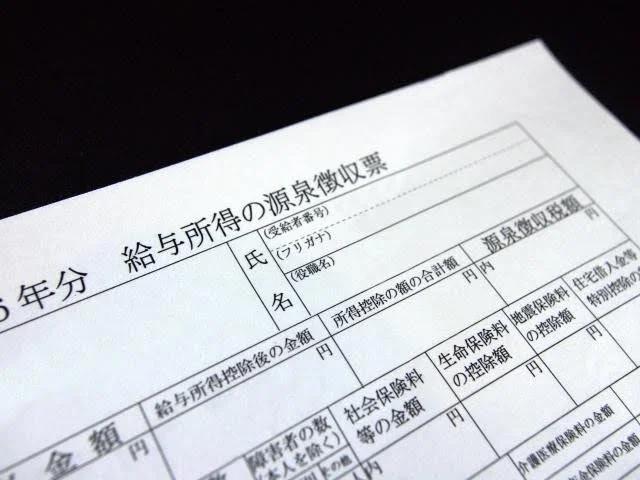
A gensen choshu hyo (源泉徴収票), also written gensen choshuhyo, is Japan's withholding tax slip, often called a withholding tax certificate. Your employer issues it to show how much it paid you in a calendar year and how much income tax it withheld from that pay at source, a system called gensen choshu (源泉徴収).
Why People Call It “Gensen”
The name breaks into three parts: gensen (源泉) means "source", choshu (徴収) means "collection" and hyo (票) means "slip". Put together, it is a slip showing tax collected at the source of your income, your paycheck. In conversation, HR staff and coworkers often shorten it to just "gensen", as in "Did you get your gensen yet?"
The Role of the Employer
In Japan, companies are legally required to manage income tax on behalf of their workforce. Throughout the year, your company deducts estimated income tax directly from your monthly paycheck. At year-end, your employer performs Nenmatsu Chosei (年末調整 — Year-End Tax Adjustment) to balance what was withheld against your actual tax liability.
📩 Issuance: The Gensen Choshu Hyo is issued directly by your employer—usually delivered alongside your December or January payslip—to certify these final figures.
Why This Document Matters
Your Gensen Choshu Hyo is the primary proof of income required across Japanese financial and administrative systems. You will typically need it for:
- Filing a Tax Return (Kakutei Shinkoku / 確定申告): Necessary if you earn secondary income, claim medical expense deductions, or left a job mid-year.
- Immigration & Visas: Frequently submitted as supplementary proof of current-year earnings when renewing a Japanese residence visa or applying for Permanent Residency (Eijuken / 永住権), alongside your municipal Certificate of Taxation (Kazei Shomeisho / 課税証明書) and Certificate of Tax Payment (Nozei Shomeisho / 納税証明書).
- Financial Verification: Essential for renting an apartment, securing a mortgage loan, or applying for a credit card.
Whether you are organizing your personal finances or preparing official paperwork, understanding your withholding tax certificate ensures you navigate Japan’s employment income system with confidence.
Gensen Choshu Hyo vs Other Tax Documents
People often confuse the gensen choshu hyo with other Japanese tax papers. Here's how they differ.
| Document | Issued by | What it shows | When you need it |
|---|---|---|---|
| Gensen choshu hyo (源泉徴収票) | Your employer | Pay and income tax withheld for one calendar year | Tax returns, job changes, loans |
| Kazei shomeisho (課税証明書) | Your city or ward office | Income and resident tax assessed for a year | Visa renewals, permanent residency, daycare |
| Nozei shomeisho (納税証明書) | Tax office or city office | Proof that you paid your taxes | Visa and permanent residency applications. See our nozei shomeisho guide |
| Shiharai chosho (支払調書) | A client who paid you as a freelancer | Fees paid and tax withheld | Freelancers filing a tax return. Clients don't have to give you one |
| Taishoku shotoku no gensen choshu hyo (退職所得の源泉徴収票) | Your employer | A retirement allowance and the tax withheld from it | Only if you received a retirement payment |
👉 For more on each, see our guides to resident tax, the nozei shomeisho and freelancing in Japan.
How Tax Withholding Works for Employees
Japan collects income tax from employees at the source. Each payday, your employer deducts an estimated amount of income tax (shotokuzei, 所得税) from your salary using the National Tax Agency's withholding tables. The estimate is based on your pay after social insurance premiums and on the dependents you listed on your Dependents Declaration Form (扶養控除等申告書) at the start of the year. Japan's income tax rates run from 5% to 45%.
Because monthly withholding is only an estimate, your employer recalculates your tax for the full year in December. This year-end tax adjustment (nenmatsu chosei, 年末調整) adds deductions such as life insurance premiums, then refunds any overpayment or collects any shortfall in your December or January pay. Your gensen choshu hyo records the final result.
Some pay is not taxed at all and doesn't appear in the slip's total pay. The most common example is a commuting allowance of up to ¥150,000 a month for public transport.
If you didn't submit the Dependents Declaration Form to an employer, or the job is a second job, tax is withheld at a higher rate and no year-end adjustment is made. Box 13 below explains how to spot this on your slip.
When and How You Get Your Gensen Choshu Hyo
Obtaining your Gensen Choshu Hyo is a straightforward process managed directly by your employer. Depending on your employment status and timing throughout the year, here is how you can access your official withholding tax slip in Japan:
📅 Standard Annual Issuance
Most employers hand out the gensen choshu hyo between mid-December and late January, after the year-end tax adjustment.
The legal deadline is January 31 of the following year.
For the 2026 slip, it is February 1, 2027, because January 31 falls on a Sunday. It is free, and you receive it on paper with your payslip or as a PDF through your company's HR portal. Your employer can only issue it electronically if you agreed to that, and must give you a paper copy if you ask for one.
🚪 Departing Employees & Resignations
If you leave a company mid-year, or quit before December, request your Gensen Choshu Hyo rather than waiting for the normal year-end distribution; your employer is legally required under Japanese tax law to issue it within one month of your official resignation date (Taishoku-bi / 退職日), which may fall after your last physical day in the office if you use remaining paid leave.
Before leaving, be sure to update your mailing address, personal email, and any return details if you are moving back to your home country with Human Resources so they can deliver the document to you promptly.
Having this partial-year withholding tax certificate ready is essential, as you must provide it to your new employer so they can consolidate your total annual income during their year-end tax procedures.
🏢 Handling Multiple Jobs & Missing Slips
- Slips from Multiple Employers: If you changed jobs sequentially during the calendar year, collect a separate Gensen Choshu Hyo from each previous employer and submit them to your current company so they can consolidate your income during Nenmatsu Chosei. If you held two or more jobs simultaneously—or left a job without starting a new one before year-end—you will need to gather all slips and file an individual income tax return (Kakutei Shinkoku / 確定申告).
- Requesting Replacement Copies: If you lose or damage your slip, simply contact your company’s Human Resources or Payroll department to request a re-issuance.
Keeping track of your Gensen Choshu Hyo ensures you always have the necessary documentation ready whenever official proof of income is required in Japan.
How to Read the Gensen Choshu Document
The image below shows a blank gensen choshu hyo (the employee copy) with 15 numbered boxes. Each number matches a heading in this section, so you can follow along with your own slip.
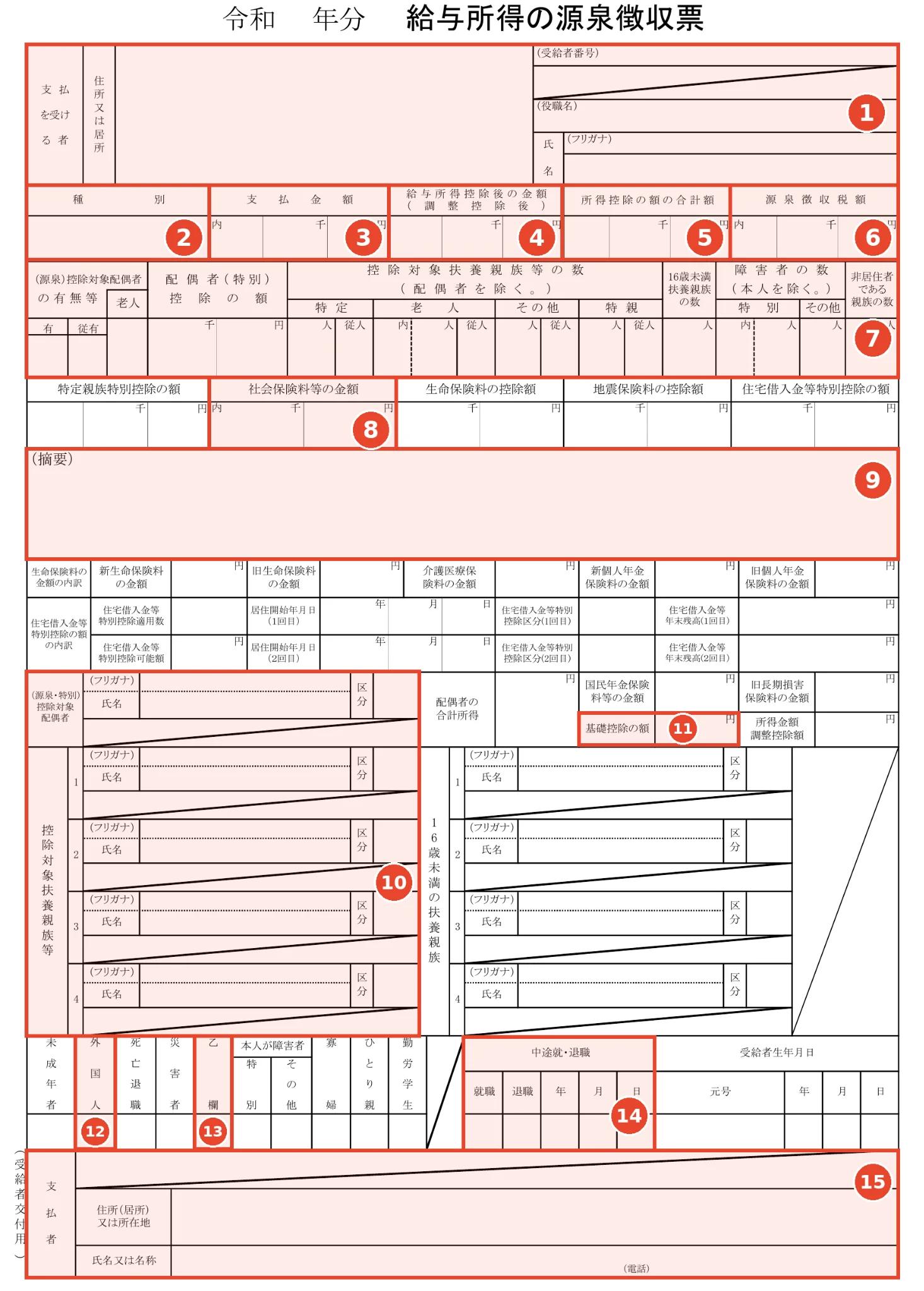
A blank gensen choshu hyo (employee copy), with each numbered box explained below. Source: National Tax Agency . Annotated by MailMate.
1. Recipient (支払を受ける者)
This box shows your address and your name, with a katakana reading (フリガナ). The address is the one your employer has on record when it prepares the slip. Check it: resident tax is charged by the city where you live on January 1, so tell HR if you moved. Your My Number is not printed on this copy. It appears only on the copy your employer sends to the tax office.
2. Type of Payment (種別)
For most employees this reads 給料・賞与 (salary and bonus), or 給料 if you had no bonus. It tells you what kind of pay the slip covers. A retirement allowance is never included here; it gets its own slip, the 退職所得の源泉徴収票.
3. Total Pay (支払金額)
This is your gross pay from January 1 to December 31: base salary, overtime, bonuses and taxable allowances, before any tax or deductions. Tax-free pay, such as a commuting allowance within the ¥150,000 monthly limit, is not included. If your employer included pay from your previous job in its year-end adjustment, it is counted here too. Banks, landlords and immigration usually mean this figure when they ask for your annual income.
4. Income After the Employment Income Deduction (給与所得控除後の金額)
The full label reads 給与所得控除後の金額 (調整控除後). It is your total pay minus the employment income deduction (kyuyo shotoku kojo, 給与所得控除), a standard deduction every employee gets instead of claiming work expenses. For 2026 the minimum deduction is ¥740,000. "調整控除後" means an extra adjustment deduction has also been taken off, which applies only to people earning over ¥8.5 million who support a child under 23 or a family member with a special disability. Tax forms call this result your employment income (給与所得).
5. Total Deductions (所得控除の額の合計額)
This is the sum of every income deduction applied to you: social insurance (box 8), the basic deduction (box 11), spouse and dependent deductions, and life and earthquake insurance deductions. Your taxable income is box 4 minus box 5. If this total looks higher than last year's, the 2026 rise in the basic deduction is the likely reason.
6. Tax Withheld (源泉徴収税額)
This is your income tax for the year, including the 2.1% special reconstruction income tax. If your employer did a year-end adjustment, it is your final, settled tax: any overpayment was refunded and any shortfall collected in your December or January pay. If you left the job mid-year (box 14), it is only the total withheld so far, and you may be owed money back. This is the number most often asked for in tax returns and home-country tax filings.
7. Spouse and Dependents Claimed (控除対象配偶者・扶養親族の数)
This row shows whether your employer counted a spouse for a deduction, the spouse deduction amount, and how many dependents you claimed by category. 特定 means dependents aged 19 to 22, 老人 means 70 or older, and 16歳未満 counts children under 16. The row also counts family members with a disability and 非居住者である親族, relatives who live outside Japan. Check every number against the Dependents Declaration Form you gave HR, and ask for a corrected slip if anything is wrong.
8. Social Insurance Paid (社会保険料等の金額)
This is the total social insurance deducted from your pay during the year: employees' health insurance, employees' pension insurance, employment insurance and, from age 40, long-term care insurance. All of it is deductible, which is why it also counts toward box 5. The small 内 field shows iDeCo and other small business mutual aid contributions deducted through payroll, if you have them.
9. Notes (摘要)
This free-text box explains anything the other boxes can't. After a job change, it lists your previous employer's name and the pay, tax and social insurance carried into the year-end adjustment. It also lists the names of extra dependents when there is no room in box 10. If it's empty, nothing unusual applied to you.
10. Spouse and Dependents: Names and Codes (控除対象配偶者・扶養親族)
This section lists the names of the spouse and dependents your employer claimed for you. A code in the 区分 column shows when someone lives outside Japan: 01 for under 30 or 70 and over, 02 for students studying abroad, 03 for people with a disability, and 04 for relatives who received ¥380,000 or more from you that year. Relatives abroad aged 30 to 69 who fit none of these can't be claimed, which is a common surprise for foreign residents supporting family overseas. Children under 16 are listed in the 16歳未満の扶養親族 section beside it.
11. Basic Deduction (基礎控除の額)
This shows the basic deduction applied to you. For 2026 it is ¥1,040,000 if your total income is ¥4.89 million or less, ¥670,000 up to ¥6.55 million and ¥620,000 up to ¥23.5 million, with smaller amounts above that. In 2025 the maximum was ¥950,000, so this box explains much of any change in your tax. The basic deduction for resident tax stays at ¥430,000.
12. Foreign National (外国人)
This box is marked if you are a foreign national. It doesn't change any amount on the slip. Whether you are taxed as a resident or non-resident depends on where you live and how long you stay, not on this box.
13. Secondary Withholding (乙欄)
If this box is marked, your employer withheld tax at the higher secondary (otsu) rate. That happens when this is your second job, or when you didn't submit the Dependents Declaration Form (扶養控除等申告書) to this employer. No year-end adjustment is done in that case, so you usually need to file a tax return. Foreign residents often miss this form when they start a job, so check this box first if your tax looks high.
14. Joined or Left Mid-Year (中途就・退職)
This box shows 就職 (joined) or 退職 (left) with the date, if you started or left this job during the year. If 退職 is marked, your employer usually did no year-end adjustment, so too much tax was often withheld. Give the slip to your new employer before their year-end adjustment, or file a tax return to get the difference back.
15. Employer Details (支払者)
This box shows your employer's address, name and phone number. Use it if you need a reissued or corrected slip, or if you have to report a missing slip to the tax office. The employer's corporate number appears only on the tax office copy.
When You Need a Tax Withholding Slip
Your Gensen Choshu Hyo is more than just a summary of your yearly salary—it is your official legal withholding tax certificate in Japan. Whenever official administrative, financial, or tax procedures require verified proof of your earnings and tax compliance, this document is essential.
Annual Income Tax Filing (Kakutei Shinkoku / 確定申告)
While regular salaried employees usually have their income tax finalized by their employer through the Year-End Tax Adjustment (Nenmatsu Chosei / 年末調整), you must use your Gensen Choshu Hyo to file an individual income tax return (Kakutei Shinkoku / 確定申告) in several situations:
- High Earnings or Multiple Income Sources: If your annual gross salary exceeds ¥20,000,000 or if your net side income (profit after expenses) exceeds ¥200,000 (Fukugyo / 副業).
- Tax Deductions & Refunds: When claiming deductions not processed by your employer, such as medical expense deductions (Iryohi Kojo / 医療費控除), the Hometown Tax donation scheme (Furusato Nozei / ふるさと納税) beyond five municipalities, or first-year home mortgage credits (Jutaku Loan Kojo / 住宅ローン控除).
Changing Employers Mid-Year
If you change jobs during the calendar year and join your new company before they process the Year-End Tax Adjustment in November or December, you must obtain a partial-year Gensen Choshu Hyo from your previous employer and hand it to your new HR department. Your new employer needs these exact figures to combine your year-to-date earnings and previously withheld national income tax (Shotokuzei / 所得税) into a single, unified year-end tax adjustment in December. (If you leave a job mid-year and are not employed at year-end, you will use this slip to file an individual tax return yourself.)
Proof of Income Applications
Because it is certified by your employer under National Tax Agency (Kokuzeicho / 国税庁) oversight, third parties across Japan rely on the Gensen Choshu Hyo as legal proof of financial status:
- Housing & Mortgages: Applying for an apartment rental, home mortgage, or bank loan.
- Visa Renewal & Status Change: Submitting income verification to Immigration (Nyukan / 入管) for visa extensions or permanent residency (Eijuken / 永住権) applications.
- Credit & Guarantors: Qualifying for credit cards, personal loans, or acting as a financial guarantor (Hoshonin / 保証人).
Departing Overseas Residents (Shukoku / 出国)
If you leave Japan permanently mid-year, your employer will, as a general rule, issue your final Gensen Choshu Hyo within one month of your departure (or resignation). You or your tax representative (nozei kanrinin, 納税管理人) will need this slip to file your final tax return and claim back any overpaid tax. Because a mid-year leaver gets no year-end adjustment, that return often ends in a refund.
Pension Refunds and Home-Country Tax Returns
If you leave Japan and claim the pension lump-sum withdrawal payment, income tax is withheld from that payment too. You can reclaim it with a tax return filed by your tax representative, and if you also worked in Japan that year, the return includes your salary from your gensen choshu hyo.
Your home country may also want these figures. US citizens, for example, report worldwide income on their US return, using box 3 (total pay) and box 6 (tax withheld) to claim the foreign earned income exclusion or the foreign tax credit. See our guide to the US-Japan tax treaty for how the two systems interact.
What to Do If Your Slip Is Missing
If you’ve misplaced your Gensen Choshu Hyo (源泉徴収票) or spot an error on the page, don't worry—getting it sorted out in Japan is straightforward:
1. Request a Replacement from Your Employer
If your slip is missing or damaged, your first step is simply reaching out to your company's Human Resources or Payroll department. Employers generally keep payroll tax records for seven years, so most will issue a duplicate on request, even if you left the company years ago.
2. Correcting Incorrect Information
If you notice mistakes—like an incorrect dependent count or mismatched income numbers—let your HR department know right away so they can issue a corrected Gensen Choshu Hyo and adjust your Year-End Tax Adjustment (Nenmatsu Chosei / 年末調整) if needed. (If only your street address is outdated, updating HR ensures your municipal Resident Tax goes to the right city office, though a minor address discrepancy does not affect your national income tax filing.)
3. Escalating to the Local Tax Office
Employers are legally required to issue the slip under Article 226 of the Income Tax Act. If yours refuses or ignores your requests, submit a Report of Non-Issuance of a Withholding Slip (源泉徴収票不交付の届出書) to the tax office for your address.
Attach a copy of a payslip and proof that you asked the employer, such as an email. The tax office will then contact the employer and instruct it to issue the slip. It won't issue the slip itself, and this report doesn't cover replacing a slip you received and lost. If the company has closed, ask the tax office how to report your income without it.
4. If It Was Sent to Your Old Address
Employers usually mail the slip to the address in their records, so it often goes missing after a move or after you leave Japan. Japan Post mail forwarding redirects mail for one year from the date you apply, but not forever, and not abroad. Give HR your new address, or a Japanese address that won't change, before your last day.
What's New for the 2026 Gensen Choshu Hyo
Japan's 2026 tax reform raised two deductions that appear on your slip, and many employees will notice the difference at the December year-end adjustment.
- Higher basic deduction (box 11): ¥1,040,000 for total income of ¥4.89 million or less, ¥670,000 up to ¥6.55 million and ¥620,000 up to ¥23.5 million. In 2025 the maximum was ¥950,000.
- Higher minimum employment income deduction (box 4): up from ¥650,000 to ¥740,000.
- More salary free of income tax: together, these changes mean a salary of up to ¥1.78 million is free of income tax, up from ¥1.6 million.
- A bigger December refund for many: monthly withholding from January to November 2026 used tax tables that don't include these changes, so the year-end adjustment refunds the difference. Monthly withholding uses updated tables from January 2027.
- A new deduction line: 特定親族特別控除の額 (special deduction for specific relatives) applies if you support a relative aged 19 to 22 who earns too much to count as a regular dependent.
- Resident tax is unchanged: the resident tax basic deduction stays at ¥430,000, so your resident tax won't fall by the same amount.
How Long to Keep the Withholding Tax Slip
In Japan, individual employees are not legally bound by a strict retention deadline for personal copies of their Gensen Choshu Hyo, unlike corporations that must archive payroll records for seven years. However, keeping your withholding tax slip in Japan for at least five to seven years is strongly recommended for practical and legal protection.
📂 Why Retaining Your Records Matters
- Tax Audits & Revisions (Zeimu Chosa / 税務調査): The National Tax Agency (Kokuzeicho / 国税庁) can review or audit individual income tax returns (Kakutei Shinkoku / 確定申告) for up to five years (seven years in cases of fraud or deliberate concealment). Having your original withholding tax certificate on hand ensures you can verify reported income and deductions immediately.
- Future Tax & Administrative Procedures: Multi-year income records are frequently required when applying for a home mortgage (Jutaku Loan / 住宅ローン), renewing a long-term visa, or applying for Permanent Residency (Eijuken / 永住権), which typically requires up to five consecutive years of tax documentation.
🔐 Best Practices for Storage
Because paper slips can easily fade or get misplaced, scan or download a PDF copy from your employer’s HR portal and store it in an encrypted cloud folder. Keeping well-organized digital backups alongside your physical originals ensures instant access whenever official proof of income is needed.
Never Miss Your Tax Documents with MailMate
Important financial paperwork in Japan—including your Gensen Choshu Hyo (源泉徴収票), municipal Resident Tax (Juminzei / 住民税) bills, and National Tax Agency (Kokuzeicho / 国税庁) notices—is still overwhelmingly sent by physical post. If you relocate within Japan, travel frequently, or leave the country mid-year, missing a single envelope can delay your tax return (Kakutei Shinkoku / 確定申告) or cause missed payment deadlines.
MailMate’s virtual mail forwarding service in Japan gives you a dedicated Japanese mailing address and an online dashboard to manage your physical mail from anywhere in the world:
- Instant Digital Scans: Receive high-resolution PDF scans of your withholding tax slip in Japan and government notices as soon as they arrive.
- Bilingual Summaries & Support: Easily understand complex Japanese tax terminology without struggling through dense administrative paperwork.
- Global Forwarding & Secure Storage: Forward original physical documents internationally whenever needed, or securely archive your tax records online.
Whether you are a busy expat or preparing to depart Japan, MailMate ensures your vital tax documents stay accessible, organized, and completely stress-free!
Frequently Asked Questions
What is a gensen choshu hyo in English?
A gensen choshu hyo is a withholding tax slip, also called a withholding tax certificate. Your employer in Japan issues it after each calendar year to show your total pay, deductions and the income tax withheld from your salary. You need it to file a tax return, change jobs or prove your income.
Do I need to attach my Gensen Choshu Hyo when filing a tax return (Kakutei Shinkoku)?
No, you no longer need to physically attach or upload your Gensen Choshu Hyo (源泉徴収票) when submitting an individual income tax return (Kakutei Shinkoku / 確定申告). The requirement to attach it was dropped for returns filed from 2019. However, you still need the exact figures from your slip to fill out your return accurately, and you should keep the slip safely for your personal records.
How can I get an older Gensen Choshu Hyo from a former employer?
Contact your former employer's HR or payroll department and ask for a duplicate for the year you need. Employers generally keep payroll tax records for seven years, so most can reissue it. If the company refuses to issue a slip it never gave you, you can file a report of non-issuance (源泉徴収票不交付の届出書) with your local tax office, which will instruct the employer to issue it.
Does my Gensen Choshu Hyo include my municipal Resident Tax?
No. The withholding tax amount (Gensen Choshu Zeigaku / 源泉徴収税額) shown on your Gensen Choshu Hyo (源泉徴収票) reflects only your national income tax (Shotokuzei / 所得税). Your local Resident Tax (Juminzei / 住民税) is calculated separately by your municipality using the income data reported on this slip, and it is billed starting in June of the following year.
When do employers typically distribute the Gensen Choshu Hyo?
Most employers hand it out between mid-December and late January. The legal deadline is January 31 of the following year, which for the 2026 slip is February 1, 2027, because January 31 falls on a Sunday. If you leave a job, your employer must issue it within one month of your last day.
Can I receive or view my Gensen Choshu Hyo online instead of on paper?
Yes. Employers are permitted to issue your Gensen Choshu Hyo (源泉徴収票) electronically (Denshi Kofu / 電子交付) — typically as a downloadable PDF through your company’s HR or payroll portal—provided you give prior consent. Electronic copies carry the exact same legal validity as paper slips for filing an individual income tax return (Kakutei Shinkoku / 確定申告) via e-Tax, applying for loans, or submitting visa documentation. However, if you still prefer or need a physical copy, you have the legal right to request a paper printout from your employer, and you can also check the National Tax Agency (Kokuzeicho / 国税庁) website for the latest guidance on digital tax submissions.
Do freelancers get a gensen choshu hyo?
No. A gensen choshu hyo is only for employees. Freelancers may receive a payment record (shiharai chosho, 支払調書) from clients, but clients don't have to give you one, so keep your own records of income and tax withheld for your tax return.
In Closing
Navigating Japan’s tax system becomes far less overwhelming once you know how to read your Gensen Choshu Hyo (源泉徴収票). Far more than a routine year-end payroll summary, this official withholding tax certificate serves as your verified proof of annual earnings, personal deductions, and national income tax (Shotokuzei / 所得税) compliance.
Whether you are reconciling your taxes through an individual income tax return (Kakutei Shinkoku / 確定申告), transitioning to a new employer mid-year, applying for a home loan, or preparing for a visa renewal, keeping your withholding tax slip in Japan organized and accessible ensures you are always prepared.
Be sure to review your figures carefully upon receipt each December or January, store secure digital backups alongside your physical copies, and reach out to your employer’s Human Resources department promptly if anything needs correction. With a solid understanding of how this single document works, you can manage your financial life in Japan with confidence.
Spending too long figuring out your Japanese mail?
Virtual mail + translation services start at 3800 per month. 30-day money-back guarantee.