


Japan Tax-Free Shopping 2026: How the November Refund System Works (Old vs New)

Japan's tax-free shopping changes on November 1, 2026.
Until October 31, eligible tourists skip Japan's consumption tax at the register. From November 1, visitors pay the tax-inclusive price in-store, then claim a refund at the airport before leaving Japan, according to Japan's National Tax Agency.
The saving stays the same with 10% on most eligible purchases over ¥5,000 (excluding tax), or 8% on food and non-alcoholic beverages. Only the timing of the refund moves.
This guide covers tax-free eligibility, the new step-by-step refund method, what stays from the old tax-free system, and what residents need to know.
👉 Read also: Japan E-Visa: The Complete Guide to Applying Online (2026)
Key facts at a glance
| Detail | Figure |
|---|---|
| Consumption tax rate | 10% standard rate (8% on food and non-alcoholic beverages) |
| Minimum total purchase | ¥5,000 (excluding tax) |
| New system start date | November 1, 2026 |
| Refund location (new system) | Airport or seaport, before departure |
| Refund window | 90 days from purchase date |
| Eligible stay length | Under six months |
| Overseas shipping of tax free items | Not permitted (since April 2025) |
| Purchases over ¥1,000,000 | Detailed product information required |
What is Japan's tax-free shopping system?
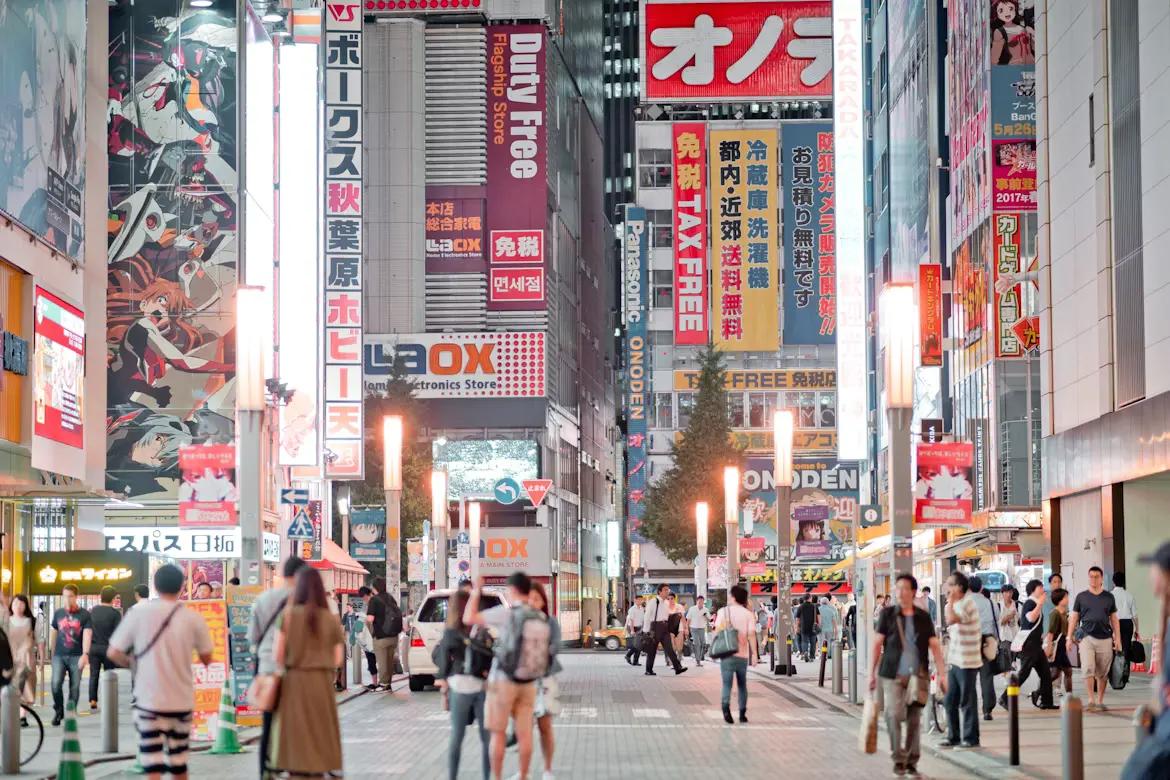
Photograph by Jezael Melgoza
Japan's tax-free shopping system lets foreign visitors skip the country's consumption tax on certain purchases, according to the Japan Tourism Agency. The tax exemption applies at Tax-Free Shops across the country, including many department stores, electronics retailers, and select convenience stores.
The system exists to encourage tourist spending. It does not apply to everyone. Eligibility depends on visa status, length of stay, and the total purchase amount at a single store.
Here's a simple example: A ¥10,000 purchase at an eligible electronics store saves you ¥1,000 through the consumption tax exemption, since electronics fall under the 10% standard rate. Food and non-alcoholic beverages are taxed at a reduced 8% rate, so the saving on those items is proportionally smaller. The math stays identical under both the old and new systems. Only the refund method changes.
Who qualifies for tax-free eligibility?
Not every visitor qualifies for tax-free purchases. Japan's rules are specific about residency status and stay length.
You qualify if:
- You entered Japan as a foreign visitor or temporary visitor on a short-stay basis
- You have been in Japan for less than six months
- You present your passport at the time of payment
- Your total purchase at the same store on the same day reaches ¥5,000 or more, excluding tax
- You arrived by cruise ship with a landing permit (different delivery slips and documentation apply)
You do not qualify if:
- You are a foreign resident living in Japan on a work, student, spouse, or business visa
- You have stayed in Japan for more than six months
- You are a Japanese national living in Japan (Japanese nationals who have lived outside Japan for two or more years can qualify, with proof of that overseas residence)
- You are military personnel stationed in Japan under certain arrangements (check with your base exchange, as separate procedures and eligibility can apply under SOFA status)
Old system vs new system: What changes on November 1, 2026
Every detail below is drawn from the National Tax Agency's official refund method overview and the Japan Tourism Agency's explanation of the new tax-free system.
| Old System (until Oct 31, 2026) | New System (from Nov 1, 2026) | |
|---|---|---|
| When you save | At the register, instantly | At the airport, as a refund |
| What you pay in-store | Price minus consumption tax | Full tax inclusive price |
| Minimum total purchase | ¥5,000 excluding tax, per category | ¥5,000 excluding tax, combined |
| Food and drinks category | Separate rules, sealed packaging | Combined with general items |
| Daily purchase cap | ¥500,000 on food and drinks | Abolished |
| Refund location | Store register | Airport or seaport, before departure |
| Export/refund deadline | 30 days to export consumables, 6 months for general goods | 90 days from purchase to complete customs confirmation |
| International parcels | Not accepted for tax free items (since April 1, 2025) | Not accepted for tax free items |
| Purchases over ¥1,000,000 | Standard purchase record required | Detailed product information required (brand, model number, serial number) |
A note on misinformation
There's some misinformation online claiming that the ¥5,000 minimum purchase amount is being abolished in November. That is not correct.
The ¥5,000 minimum stays in place. What changes is how stores calculate it.
Under the old system, food, drinks, and cosmetics were counted separately from general items like electronics and clothing. Under the new system, every category counts toward one combined total. Be aware of this distinction before you shop.
How the new refund method works: Step-by-step
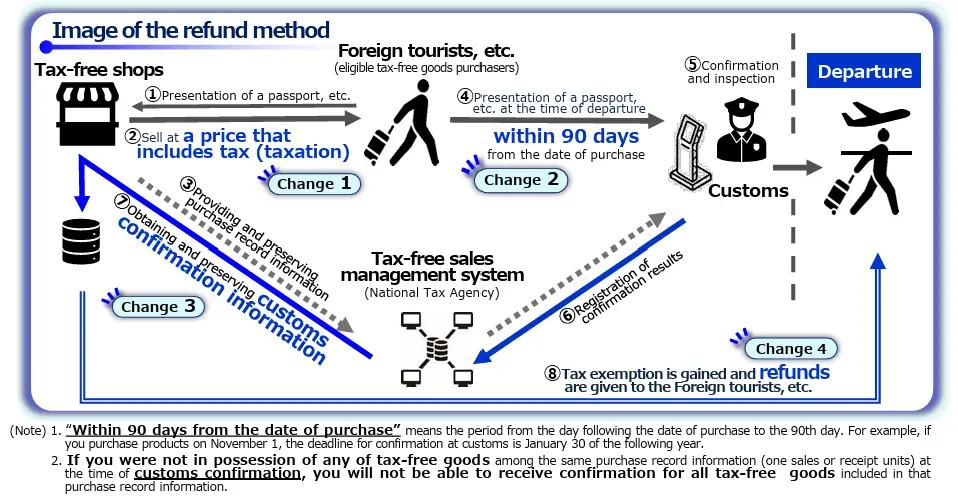
Image source: NTA Japan
From November 1, 2026, the refund method for tax-free shopping follows five steps, as laid out by Japan's official tourism board.
Step 1: Shop at a registered tax-free store
Look for the tax free system sign at the entrance or register. Present your passport before payment. Staff register your purchased items digitally through the National Tax Agency's Tax-Free Sales Management System, then charge you the full tax inclusive price.
Step 2: Register your refund details
Before or immediately after paying, confirm how you want your refund issued. The National Tax Agency's own guidance states plainly that the Consumption Tax Act does not prescribe a single refund method: stores or their contracted refund providers can pay by bank transfer, credit card transfer, app transfer, or cash at the port of departure, and the choice is up to the individual retailer.
Many stores handle this by giving you a QR code on your receipt, which you scan to register your passport number, contact details, and payment or bank account information with the store's refund platform.
If a store offers this digital registration, do it before you leave the shop rather than at the airport, since a spotty connection or a forgotten step at departure can delay your refund. Ask staff directly which refund method they offer. Some retailers issue refunds only as in-store credit or facility vouchers, which are of no use once you've left Japan.
Step 3: Keep your receipts and items accessible
Carry your receipts and purchased items with you, not packed in checked bags. Customs inspections are conducted per receipt, and if even one item from a transaction is missing, none of the items on that receipt qualify for a refund.
Step 4: Complete the airport refund process
Allow extra time at the airport. Locate the tax-free procedure terminal before checking in your luggage, present your passport and purchase records, and let customs staff verify your export at the customs examination.
Step 5: Receive your refund payment
Refunds arrive through the store or a contracted refund service, using whichever method you registered in Step 2. The National Tax Agency does not set a standard processing time, since this depends on the store or refund operator. In practice, credit card refunds commonly take one to two weeks and bank transfers two to four weeks, though this varies by provider. Some airports offer immediate cash refunds.
Practical tip: Budget 45 to 60 minutes for the airport refund process. Major international airports have dedicated refund counters. Smaller regional airports may have limited capacity in the months right after the changeover.
The ¥5,000 minimum: How it works now
The ¥5,000 minimum purchase threshold, excluding tax, remains the core rule for tax-free eligibility. Here's exactly how it applies under the new system.
Buy ¥3,000 in cosmetics and ¥2,500 in accessories at the same store on the same day. That combined total of ¥5,500 now qualifies for the exemption. Under the old system, those categories would have been counted separately and neither purchase would have qualified alone.
One exception applies. Purchases totaling ¥1,000,000 or more, excluding tax, at a single store require the store to file detailed product information, such as the brand, model number, and serial number, with the National Tax Agency to help confirm the goods leaving Japan match what was sold.
Duty-free vs tax-free: What's the difference?
Visitors often confuse duty-free with tax-free shopping. They are separate systems with separate rules.
Tax-free shopping applies at eligible stores throughout Japan, including department stores and specialty retailers. It exempts non-residents from paying consumption tax on qualifying purchases.
Duty-free shopping happens only at airport shops after you clear immigration on departure. It waives consumption tax along with liquor tax, tobacco tax, and customs duty, with no separate refund step required, according to Japan Customs' passenger clearance procedures.
The November 2026 update affects only the in-store tax-free system. Duty-free airport shops continue as normal, with no changes to service or payment.
Can I wear tax-free clothes in Japan? And other practical questions
Can I wear tax-free clothing while I'm still in Japan?
Before November 1, general items like clothing could be worn once the paperwork was done. From November 1, be more careful. You must still be able to present the item at the customs examination before departure. Visibly worn items may draw questions from customs staff. The safest approach is to keep items in their original packaging until after the refund process.
Can I pack tax-free items in checked bags?
Only after you complete the refund process. Under the new system, you must show your tax free items at the airport terminal before departure. If those items are already checked into your luggage, you cannot present them. Keep them in your carry-on, or check your bags after finishing the refund step at airports that support post-security processing.
What if I lose my receipt?
Purchase records register digitally to your passport at the time of sale. A lost receipt is less of a problem than under the old system, but keep it as backup proof where possible.
What if I leave Japan more than 90 days after my purchase?
You will not qualify for the refund. The 90-day window is a hard deadline from the purchase date, so plan your shopping around your departure date.
Tax-free shopping for Japan residents
If you hold a long-term visa, such as a work, student, spouse, or business manager visa, the tax-free shopping system does not apply to you. You pay consumption tax on all retail purchases, the same as any resident of the country.
Some long-term residents have tried to use the tourist tax-free system anyway, particularly at large electronics stores where staff do not always verify visa status carefully. From November 2026, digital registration links every purchase to a passport and visa status. This creates a clear record, and Japan's National Tax Agency has signaled stricter enforcement going forward.
The exception: Japanese nationals who have lived outside Japan for two or more years, and who can show proof of that overseas residence, can use the tourist tax-free system when visiting Japan.
A related update: the Visit Japan Web system, already used for immigration and entry procedures, is integrating with the new tax-free refund system, per Japan's Digital Agency. Visitors registering through Visit Japan Web may access QR-code-based tax free purchases at participating stores by late 2026.
If you are renewing a long-term visa rather than visiting, the tourist tax-free system isn't the only rule changing this year. See MailMate's guide to Japan visa renewal fees for 2026 for what else is changing at the immigration counter and the residence card renewal guide for the paperwork involved.
Japan tax-free shopping news: The wider context
The November 2026 change fits into a broader pattern of Japan tightening its consumption tax rules.
- April 2025: Tax-free eligibility ended for items shipped through international parcels; visitors must now carry purchased items out of the country themselves
- October 2023: Japan introduced the qualified invoice system for business-to-business consumption tax
- November 1, 2026: The instant in-store exemption changes to an airport-based refund system
Japan's National Tax Agency and Ministry of Finance have cited misuse as the main driver behind the change, under the FY2025 Tax Reform. Officials identified cases involving misrepresented residency status and tax-free items resold domestically instead of leaving the country. The updated system brings Japan closer to the refund-at-departure model already used in the EU, Australia, and Singapore, all of which confirm export at departure before releasing a refund. South Korea uses a related but hybrid approach, offering both an instant in-store deduction and an airport or downtown refund option.
👉 For a broader look at how consumption tax works in Japan year-round, see MailMate's Japan consumption tax guide.
Frequently asked questions
What are the rules for tax-free shopping in Japan?
Eligible visitors, meaning temporary visitors staying under six months, can claim back Japan's consumption tax on purchases of ¥5,000 or more, excluding tax, at the same store on the same day. Until October 31, 2026, the exemption applies instantly at the register. From November 1, visitors pay the full price and claim a refund at the airport before departure. Foreign residents on long-term visas do not qualify.
How much do I save with tax-free shopping in Japan?
You save 10% of the pre-tax purchase amount on most eligible items, or 8% on food and non-alcoholic beverages, which are taxed at a reduced rate. A ¥50,000 electronics purchase saves ¥5,000. A ¥10,000 cosmetics purchase saves ¥1,000, since cosmetics fall under the standard 10% rate. The saving percentage is identical under the old and new systems; only the refund timing changes.
Do I need to show tax-free goods when leaving Japan?
Yes. Under the new system starting November 1, 2026, you must present your purchased items at the customs examination before departure. Purchases register digitally to your passport at the time of sale, but staff may still ask to see the physical items. This applies at every international departure point, including airports and seaports.
Can I wear my tax-free clothes while in Japan?
With some caution. You must still be able to present the item for inspection before you leave. Wearing clothing does not automatically cancel your refund eligibility, but visibly used items may raise questions from customs staff. Keep items in original packaging where possible until the refund step is complete.
Can I put tax-free items in checked luggage in Japan?
Only after finishing the customs refund process. You must present items at the terminal before departure, which usually happens before check-in or after security, depending on the airport. Pack tax free items in carry-on bags to avoid problems, or confirm the refund location at your departure airport in advance.
How do I choose how my tax-free refund gets paid?
Ask the store or its refund provider before you pay, since the National Tax Agency does not mandate one refund method. Stores can offer bank transfer, credit card transfer, app transfer, or cash at the port of departure, and some issue a QR code for you to register your payment details online. Confirm your preferred method upfront, since some retailers default to in-store credit or vouchers that are not usable once you've left Japan.
Is the ¥5,000 minimum purchase amount being abolished in 2026?
No. This is a common misunderstanding. The ¥5,000 minimum, excluding tax, at a single store on a single day still applies. What changes is that food, drinks, cosmetics, and general items now combine into one total instead of being counted in separate categories.
What is the difference between duty-free and tax-free shopping in Japan?
Tax-free shopping applies at eligible stores throughout Japan and refunds consumption tax on qualifying purchases for non-residents. Duty-free shopping happens only at airport shops after immigration, and waives consumption tax, liquor tax, tobacco tax, and customs duty at the point of payment. The November 2026 update only affects the in-store tax-free system.
Can I use tax-free shopping if I live in Japan?
No. Foreign residents on long-term visas, including work, student, spouse, and business manager visas, cannot use the tourist tax-free system regardless of nationality. You pay full consumption tax on your purchases, the same as any other resident.
In closing
The core saving under Japan's tax-free shopping system has not changed. Visitors to Japan still get 10% back on most eligible purchases over ¥5,000, or 8% on food and non-alcoholic beverages. What changes on November 1, 2026, is the refund method, moving from an instant discount at the register to a refund claimed at the airport before departure.
For residents living in Japan long-term, the tax-free system was never available to you, and the new digital registration process makes that distinction stronger than ever. If you are managing Japanese mail from abroad or juggling official notices about tax and customs rules, MailMate's online mail management service keeps your correspondence organized and accessible, whether you're a resident handling tax notices or a traveler who needs someone watching your mailbox while you're away on a trip. Visit mailmate.jp to see how it works.
Related articles
- Internet in Japan: A Guide for Tourists and Expats — free Wi-Fi, eSIM, and pocket Wi-Fi options for getting online the moment you land
- The Best smartEX Shinkansen English Guide to Book a Ticket — how to book bullet train tickets in English before your trip
- JAL ABC's Airport Baggage Delivery Service: An Easy Guide — send your luggage from the airport straight to your hotel
- Japan's Luggage Delivery Services: A How-to Guide — forward your bags between hotels, stations, and airports so you can travel hands-free
Spending too long figuring out your Japanese mail?
Virtual mail + translation services start at 3800 per month. 30-day money-back guarantee.