


Master Japanese Honorifics: A Business Operator's Guide to Japanese Honorific Suffixes (2026)
Japanese honorifics, known collectively as keishō (敬称), are suffixes and titles attached to a person's name to signal respect, social standing, and the level of intimacy between speakers. The five honorifics every learner and business operator encounters first are -san (さん), -sama (様), -kun (君), -chan (ちゃん), and -sensei (先生), each tied to a different level of formality and relationship.
Referring to someone by name alone, with no honorific attached, is generally considered rude in Japanese culture unless you are close family or close friends. Much like English ties certain titles to a role, addressing a catholic priest as Father or a physician as Doctor, Japanese ties honorifics to social relationship and hierarchy rather than profession alone.
Honorifics sit inside a larger system of polite language called keigo (敬語), which splits into three categories: teineigo (丁寧語, general politeness), sonkeigo (尊敬語, respectful language that elevates the other person), and kenjōgo (謙譲語, humble language that lowers the speaker).
This guide covers how each honorific works, how they show up in Japanese business situations and correspondence, and the specific mistakes foreign business owners make when addressing clients, vendors, and staff.
Quick reference: common Japanese honorifics
| Honorific | Kanji/Kana | Formality | Typical use |
|---|---|---|---|
| -san | さん | Neutral, gender neutral | The most common honorific, safe for almost anyone |
| -sama | 様 | High | Customers, clients, formal letters, higher-ranking individuals |
| -kun | 君 | Casual | Younger males, male peers, sometimes junior female staff |
| -chan | ちゃん | Casual | Children, close friends, young women, familial honorifics |
| -sensei | 先生 | High | Teachers, doctors, lawyers, martial arts instructors, experts in their respective fields |
| -senpai | 先輩 | Respectful | Seniors in school or the workplace |
| -shi | 氏 | Formal | Used mainly in writing, legal documents, and news articles rather than everyday speech |
The complex system behind Japanese honorific suffixes
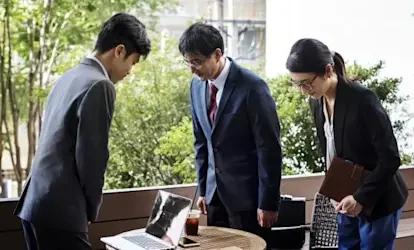
Honorifics are one of the clearest ways Japanese speech marks social relationships and hierarchies. The honorific you choose signals where you stand relative to the person you're addressing: same age or higher rank, close friend or stranger, junior status or company president.
Choosing the appropriate honorific is less about memorizing a list and more about reading the relationship correctly, which is why the system can feel complex even to native speakers in unfamiliar situations.
A few general rules apply across almost all of them:
- Honorifics are used when referring to someone else to show respect. Never use an honorific to refer to yourself. Attaching -san or -sama to your own name comes across as arrogant, even cocky, to native speakers.
- Dropping an honorific when one is expected is considered bad manners. It's rude to drop honorifics in formal or unfamiliar relationships.
- Omitting honorifics usually signifies a close relationship or familiarity, most often between best friends, romantic partners, or people who grew up together.
- Honorifics are usually dropped when referring to family members, particularly within the immediate household. A big sister, older brother, or big brother is typically addressed by a familial term rather than name plus honorific.
-san: the only honorific you need in most situations
-San (さん) is the honorific you'll use more than all the other forms combined. It works in business contexts, casual conversation, and almost anywhere you're unsure which honorific fits.
Attached to a last name (Suzuki-san, Tanaka-san), it reads as a straightforward, respectful "Mr." or "Ms." with no gender distinction. It can also turn a common noun into a title, the classic example being a butcher's shop owner addressed as a stand-alone title tied to the shop itself.
-sama: showing greater respect
-Sama shows a more formal version of respect than -san, reserved for customers, clients, and people of clearly higher rank. Retail and hospitality staff in Japan use -sama constantly, the honorable customer address okyaku-sama (お客様) is a fixture of everyday service language. In writing, -sama is also the honorific used on envelopes and formal letters, and it extends to divine entities and and other figures addressed with reverence.
A related term worth knowing in business writing is onsha (御社) or kisha (貴社), which literally means "honorable company." Both are used in the third person to refer respectfully to the other party's company in formal letters and emails, the same way -sama shows respect for an individual.
-kun and -chan: casual honorifics
-Kun (君) is typically used for younger males or male peers, especially among students or junior staff, though it also appears when older men address younger female employees in some workplaces.
-Chan (ちゃん) is an informal suffix generally reserved for close friends, children, and young women, and it carries a casual, affectionate air rather than a professional one. Neither is common in business contexts once a formal working relationship is established.
-sensei and -senpai: honorifics relating to expertise and seniority
-Sensei (先生) is used for teachers, doctors, lawyers, and experts, and, unusually among honorifics, it can stand alone without a name attached.
-Senpai (先輩) addresses seniors in educational or workplace settings, tied to seniority of experience rather than age alone. Someone who joined a company two years before you, even if younger, may still be senpai.
-shi: the formal honorific suffix used in writing
-Shi (氏) is a formal honorific used mainly in writing rather than everyday speech, appearing in legal documents, contracts, and news articles when referring to a named individual. It's one of the honorific forms English speakers rarely encounter in conversation but will run into when reading official Japanese documents.
Honorifics in Japanese business culture
Business contexts are where honorifics carry the most weight and where potentially awkward slip-ups do the most damage to a professional relationship. The rules below aren't abstract, they show up in specific, recurring moments, such as introducing yourself, exchanging business cards, addressing someone by title, and talking about your own company to an outside client.
Job titles frequently replace or combine with a name + honorific in formal situations. A department head might be addressed as buchō (部長) alone, or as Suzuki-buchō, combining the family name and title. This pattern extends up the org chart to kachō (課長, section chief) and shachō (社長, company president).
Example: introducing yourself without an honorific.
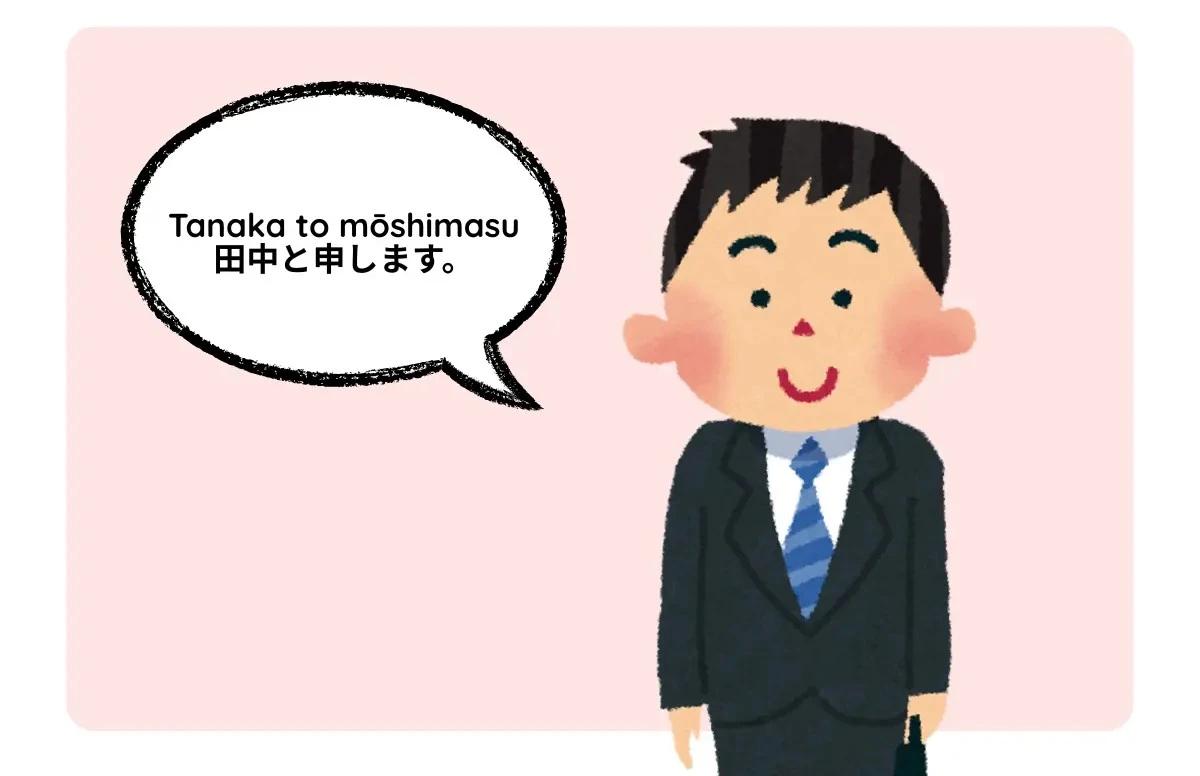
When you meet a Japanese client for the first time, you never attach san or sama to your own name, even in the most formal introduction.
Instead of a plain "I am Tanaka," the standard formal self-introduction uses a humble verb: "Tanaka to mōshimasu" (田中と申します), literally "I humbly call myself Tanaka."
Mōshimasu is the kenjōgo form of "to say," and using it in place of the plain "ii-masu" is what signals politeness, not any suffix on your own name.
Example: the business card exchange (meishi kōkan).
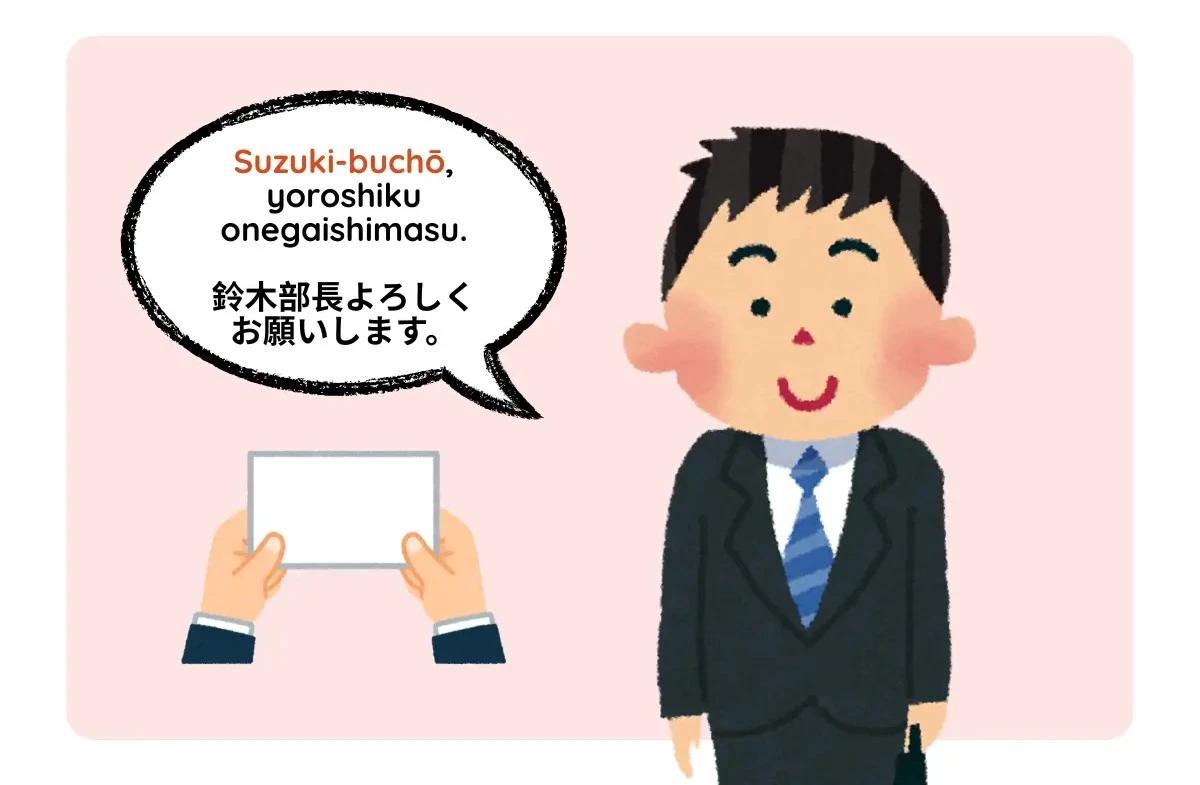
Business cards, meishi (名刺), are exchanged with both hands at the start of almost every first meeting, and the honorific system is baked into the ritual.
You say your own name without an honorific while handing over your card, then read the other person's name and title back with the correct honorific once you receive theirs, for example, "Suzuki-buchō, yoroshiku onegaishimasu."
The card itself tells you the exact title to use going forward, which is why glancing at it before the meeting even starts matters.
Example: why "buchō-san" is a common mistake.
A job title like buchō, kachō, or shachō already carries a built-in level of respect, so attaching -san on top of it, as in buchō-san, is a redundant and mildly awkward mistake many learners make.
The title alone, or the title combined with the family name (Suzuki-buchō), is the correct formal address, no honorific suffix is layered on top of it.
Example: talking about your own company's president to a client.
Honorifics and titles used for your own company are dropped when speaking to an outside company.
Internally, you'd refer to your own company president as shachō without hesitation. But telling a client "our shachō will attend the meeting," using the title as if it were neutral, can come across as elevating your own side rather than staying humble.
A more careful phrasing drops the title in favor of a plainer reference to "our company's representative," saving the honorific-bearing title for how the client refers to their own leadership, not yours.
Praising or elevating your own company's staff in front of an outside company is seen as poor manners, almost the opposite of how many English speakers are taught to present their own leadership.
Honorifics in written business correspondence
Spoken Japanese and written Japanese business correspondence follow the same honorific logic, but the stakes are higher in writing since there's no tone of voice to soften a mistake.
The examples below show how honorifics and keigo actually appear inside a real business email, not just in the greeting line.
Example: a typical business email opening.
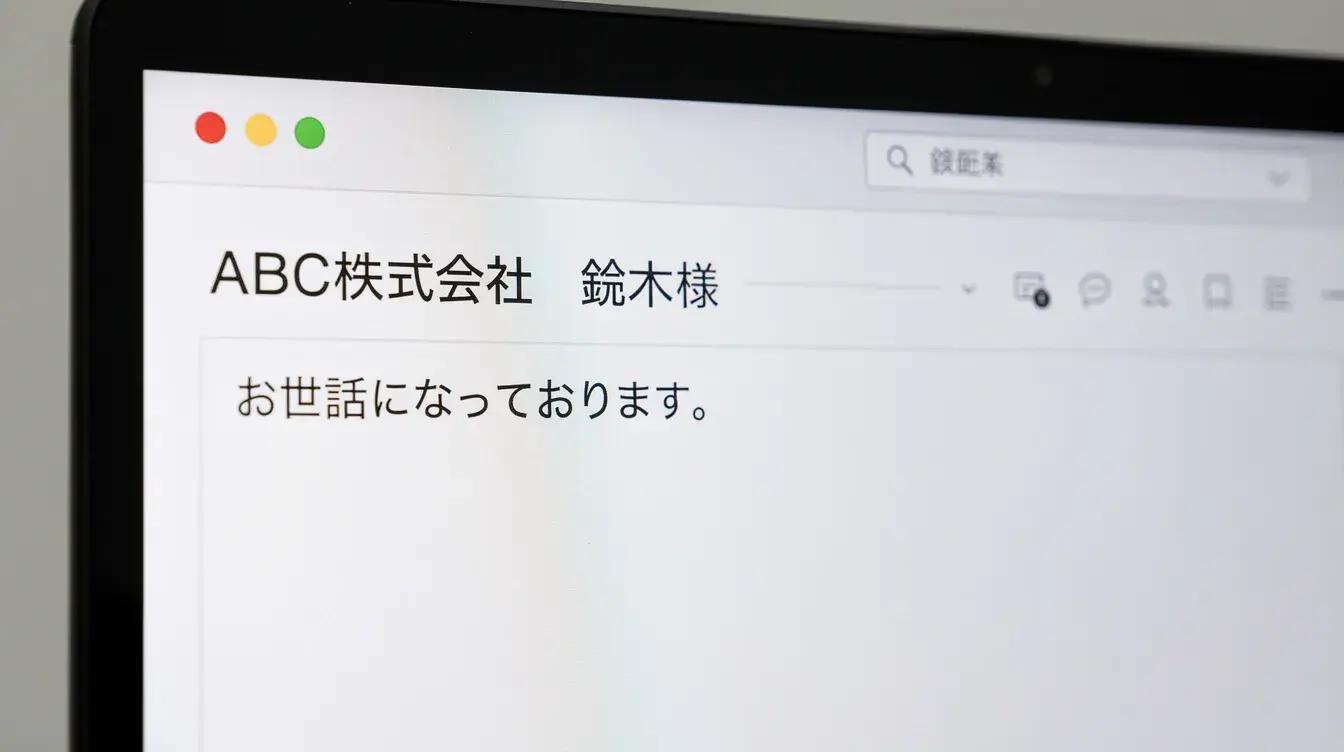
A formal email to a client or vendor almost always opens with the company name followed by the recipient's family name and sama, for example "ABC株式会社 鈴木様" (ABC Corporation, Suzuki-sama), even if you'd call the same person Suzuki-san on the phone.
Directly under that, the near-universal opening line in Japanese business email is "Osewa ni natte orimasu" (お世話になっております), roughly "Thank you for your continued support," a set phrase that appears at the top of almost every ongoing business relationship regardless of what the email is actually about.
Example: addressing a group of recipients.
When a formal email or notice goes out to many people at once, rather than repeating -sama after every name, Japanese business writing often uses kakui (各位), meaning "to all concerned" or "everyone," as in "お客様各位" (all customers) or "関係者各位" (all concerned parties).
Kakui itself already functions as a group-level honorific, so it isn't combined with sama or san.
Example: sonkeigo and kenjōgo verb pairs in practice.
Keigo appears throughout formal business writing, not just in the honorific attached to a name. The same everyday verb often has two entirely different polite forms, one that elevates the reader (sonkeigo) and one that lowers the writer (kenjōgo):
| Plain verb | Sonkeigo (elevates the reader) | Kenjōgo (lowers the writer) |
|---|---|---|
| iku (to go) | irasshaimasu (いらっしゃいます) | mairimasu (参ります) |
| suru (to do) | nasaimasu (なさいます) | itashimasu (致します) |
| miru (to see/check) | goran ni narimasu (ご覧になります) | haiken shimasu (拝見します) |
| iu (to say) | osshaimasu (おっしゃいます) | mōshimasu (申します) |
Example: an apology email using kenjōgo.
A formal apology for a delay or error leans heavily on kenjōgo rather than a simple "sorry."
A common formal line is "Fukaku owabi mōshiagemasu" (深くお詫び申し上げます), "I offer my deepest apologies," where mōshiagemasu is an even more humble variant of mōshimasu.
The depth of the apology is carried by the verb form as much as by the words themselves.
Example: closing a business email.
Almost every formal Japanese business email closes with a set phrase rather than a personal sign-off, most commonly "Yoroshiku onegai itashimasu" (よろしくお願いいたします), a humble, all-purpose closing that roughly means "I appreciate your continued support" or "thank you in advance."
Itashimasu, again, is the kenjōgo form of suru, so even the closing line follows the same humble-language pattern as the rest of the message.
A letter or email that drops down from -sama to -san partway through a relationship, or from formal keigo to more casual phrasing, often signals the relationship has shifted to a more familiar footing.
It's a useful signal to watch for in ongoing vendor or client correspondence.
Government and bank correspondence in Japan is almost always addressed with -sama and written in a formal register, which is one reason official mail can read as more serious or urgent than an equivalent letter would in English.
Honorifics in practice: two full email examples
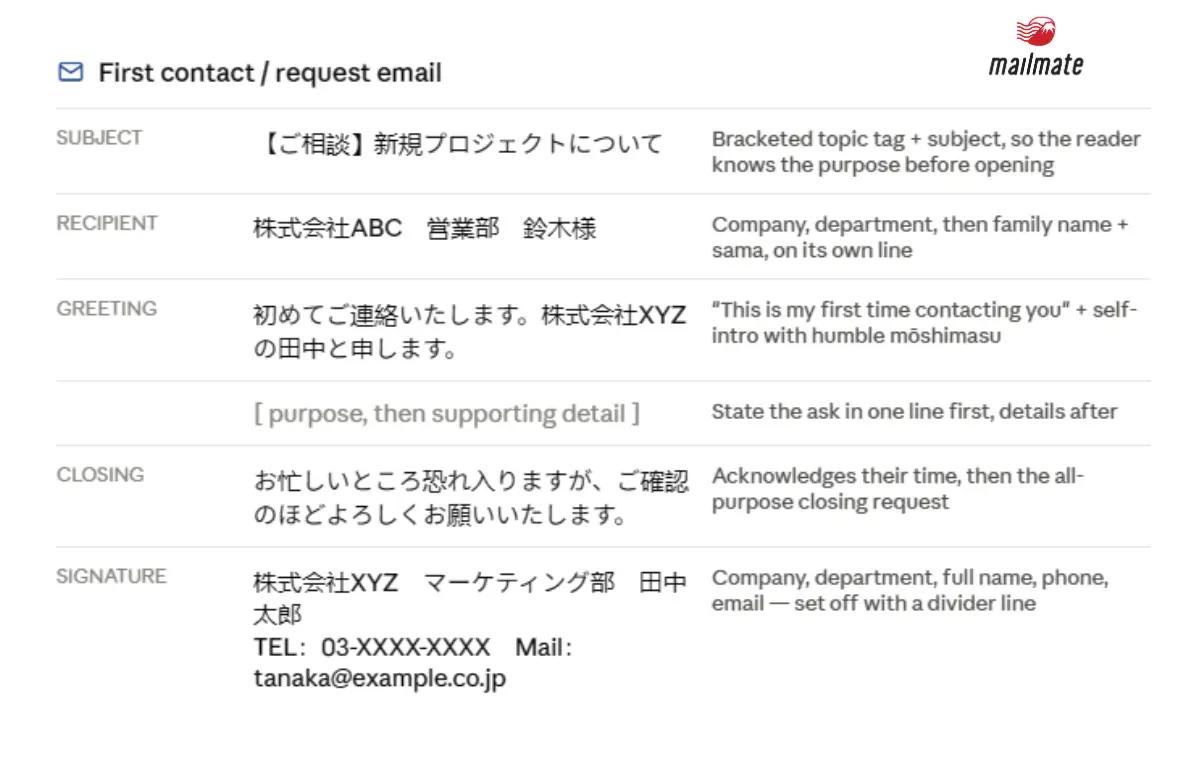
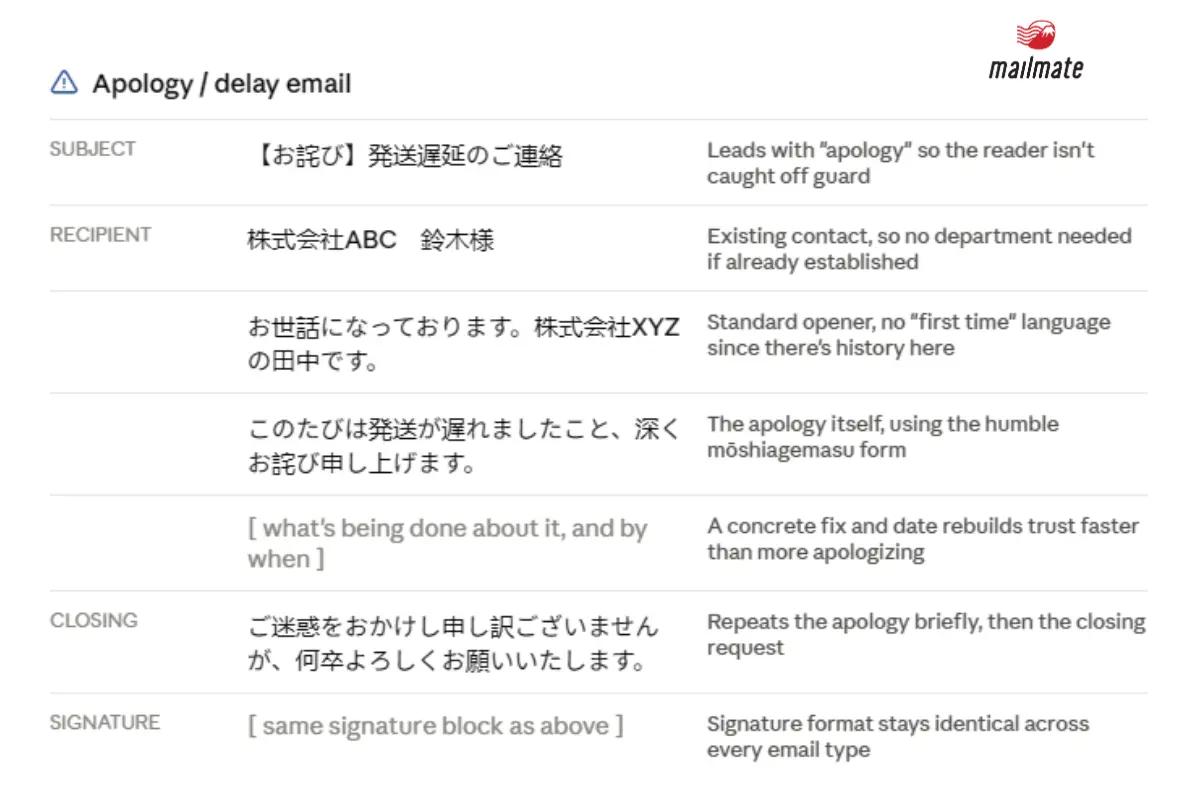
The patterns above are easier to see laid out inside a full email rather than as isolated phrases. Below are two common templates, a first-contact email and a delay-or-apology email, broken down part by part so you can see exactly where each honorific and keigo form lands, from the subject line down to the signature.
First contact/request email
Apology email
Common honorific mistakes foreign business operators make
- Using -san with a first name. Japanese honorifics are generally tied to the family name, not the given name. Suzuki-san is standard; Ken-san (using a first name) reads as unusually familiar unless you already have that kind of relationship.
- Using -sama for internal colleagues. -Sama is generally reserved for customers, clients, or people of clearly higher rank. Using it for a coworker at the same level sounds oddly formal, even sarcastic.
- Referring to yourself with an honorific. This is one of the most common slip-ups among English speakers learning Japanese honorific speech, and it reads as self-important every time.
- Getting the "own company vs. outside company" direction backwards. Praising your own company's staff or leadership to an outside client, using their full title and honorific, can come across as boastful rather than professional.
- Dropping honorifics too early with new contacts. Omitting an honorific too soon with a new client or vendor can come across as presumptuous, even if the intent was to seem friendly.
Addressing clients, vendors, and staff correctly
| Who you're addressing | Typical honorific | Notes |
|---|---|---|
| A new client or vendor contact | -sama | Especially in written correspondence |
| An established client contact | -san or -sama | Follow the client's own tone and lead |
| A colleague at your level | -san | The safest default in almost any office |
| A manager or department head | Title alone or title + name | Buchō, or Suzuki-buchō |
| Your own staff, spoken to internally | -san, or nothing among close teams | Varies by company culture |
| Your own staff, referenced to an outside company | Often no honorific | Reflects the humbling convention for your own company |
| A teacher, doctor or lawyer | -sensei | Can stand alone without a name |
Frequently asked questions
What's the fastest way to master Japanese honorifics for business use?
Start with -san, since it's the only honorific you'll need in the vast majority of situations, then learn -sama for clients and formal correspondence. Most business operators can function well with just those two, adding -sensei, job titles, and the humble form of speech as specific situations call for them.
Which honorific suffix is used to refer to young males in Japanese?
-Kun is the honorific suffix used to refer to young males, male peers, and male friends, most often among students or junior staff. It's a casual form and generally isn't used once a professional relationship becomes more formal.
Do Japanese people always use an honorific when addressing a stranger's name?
Yes, in the vast majority of situations. Japanese people generally treat a bare name, with no honorific attached, as either overly familiar or outright rude when addressing someone they don't know well. -San is the safe, neutral default when the relationship or preferred honorific isn't clear yet.
Is dropping honorifics more common among the younger generation in Japan?
Casual dropping of honorifics does show up more among the younger generation, particularly between close friends of the same age, but it's still tied to familiarity rather than age alone. In business and with anyone outside a close circle, the same formal rules apply regardless of generation.
What is kenjōgo, the humble form of Japanese, and when should I use it?
Kenjōgo is the humble form within keigo that lowers the speaker's own actions to show respect toward the listener, phrases like "I will humbly send" instead of a plain statement. It shows up constantly in formal business writing, alongside sonkeigo, which elevates the other person's actions instead.
Why is it considered cocky to refer to yourself with an honorific, even in the third person?
Honorifics exist to show respect toward someone else, so attaching one to your own name, or referring to yourself in the third person with a title, comes across as praising yourself rather than showing humility. Native speakers read it as arrogant regardless of intent.
What does onsha (御社) literally mean, and why is it used for honorifics relating to another company?
Onsha literally means "honorable company" and is one of several honorifics relating to businesses rather than individuals. It's used in the third person, in formal writing and speech, to refer respectfully to the company you're addressing or discussing, similar to how -sama shows respect for a person.
Do honorifics matter as much in written Japanese as in spoken Japanese?
Yes, and arguably more, since written correspondence has no tone of voice to soften a misstep. Formal letters and business emails combine honorifics with keigo, the broader system of polite speech, and a shift in either one partway through a relationship is often a meaningful signal worth noticing.
In closing
Japanese honorifics are a compact but essential part of how the language expresses social standing, hierarchy, and respect, whether you're learning conversational Japanese or running a business that depends on getting client and vendor correspondence right. The safest default in almost any uncertain situation is -san, escalating to -sama for clients, customers, and formal written correspondence, and paying attention to how job titles and keigo shift over the course of a relationship.
If you're managing a business in Japan and need to keep up with the Japanese mail that lands in your mailbox, from client letters to bank and government correspondence, MailMate translates and organizes it so you're never guessing at the honorifics, the tone, or the urgency. Learn more at mailmate.jp.
Spending too long figuring out your Japanese mail?
Virtual mail + translation services start at 3800 per month. 30-day money-back guarantee.