


Is There a Zillow in Japan? The Best Sites to Find Property as an American (2026)

If you're American and looking for property in Japan, you might think to check Zillow first. Here's why that doesn't work and what to use instead.
Japan's property market runs on a completely different system from the US. There's no centralized public database, no dominant English-language portal, and no equivalent to the MLS. What exists instead is a fragmented network of Japanese-only sites that were never built with foreign buyers in mind.
As of 2026, roughly 72,000 Americans live in Japan, and US search traffic for Japanese property has grown 38% in the past six months alone. But interest doesn't make the search process easy.
This guide covers:
- Why Zillow has no presence in Japan
- Which Japanese portals hold the listings
- Which English-language platforms actually work for foreign buyers
- What paperwork you need before you can close
| Key Facts | Detail |
|---|---|
| Foreign ownership rights | Fully legal for US citizens, no residency required |
| Japan's largest portal | SUUMO (Japanese only) |
| Best English-language options | RealEstate.co.jp, AkiyaMart, AkiyaJapan |
| Typical closing costs | 7–10% on top of purchase price |
| Tax rep requirement | Mandatory for non-resident owners |
| FEFTA report deadline | 20 days after acquisition (from April 2026) |
Why Zillow Japan doesn't exist
In America, nearly every property listed by a licensed agent flows into a shared, standardized database (MLS).
Zillow pulls from that database and displays it publicly, and any buyer can see the same inventory any agent sees.
Japan doesn't have that.
How Japan's listing system works
Japan's version of the MLS is called REINS (Real Estate Information Network System).
It's a government-supervised database run by the Ministry of Land, Infrastructure, Transport and Tourism, established in 1988.
The key difference from the US MLS:
- REINS is accessible only to licensed agents
- Buyers cannot search it directly
- Sellers cannot post to it themselves
- There is no public-facing version
The consumer portals you'll find online (SUUMO, AtHome, Homes.co.jp) are private businesses. They pull a portion of REINS listings and mix in properties sourced from their own agency networks.
Why listings in Japan are scattered
Because agencies choose which portals to post on, coverage can be inconsistent. A property might appear on SUUMO but not AtHome. Another might sit in a private agent network that no public site ever touches. Additionally, experts estimate up to 30% of transactions in Japan happen entirely off-market.
For Zillow, there's simply nothing to connect to.
Japan real estate portals: SUUMO, AtHome, Homes.co.jp, and Yahoo! Real Estate
These four sites hold the largest volume of listings in the Japanese real estate market. They're what licensed agents and Japanese buyers use every day. Here's what each one offers and where they fall short for English speakers.
SUUMO (スーモ)
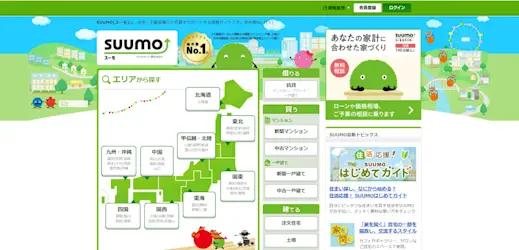
SUUMO is Japan's largest property portal, operated by Recruit Co., Ltd.
It averages around 44 million monthly visits and covers rentals, purchases, and new developments across all 47 prefectures.
The problem for English speakers:
- No official English interface
- No foreigner-specific search filters
- Google Translate works for basic navigation, but mistranslates key real estate terms
Terms like key money (reikin), management fees (kanri-hi), and building age (chikunensuu) can all come out wrong once a browser translator processes them. Reading a mistranslated listing and making an offer based on it is a real risk.
Practical workaround:
- Open SUUMO in Chrome and enable page translation
- Use the map view (no Japanese required)
- Set price and size using the numeric filters
- Pass any listing URL to a bilingual licensed agent to follow up
Homes.co.jp (LIFULL HOME'S)
LIFULL HOME'S is the second-largest portal, operated by LIFULL Co., Ltd. It has a distinct model: agents can list for free until a property sells, which encourages broader inventory.
With over 5 million listings, it also has a built-in nationwide akiya bank (空き家バンク) function useful for buyers looking at rural or vacant properties.
Like SUUMO, it runs entirely in Japanese with no English support.
One note: because agencies choose their platforms, a listing on HOME'S may not appear on SUUMO at all. Checking both gives you a wider picture.
AtHome (アットホーム)
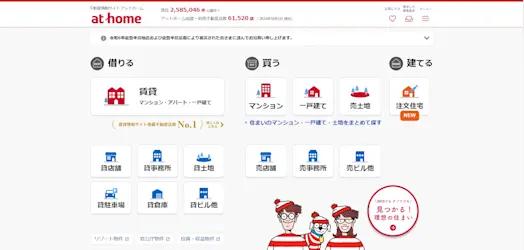
AtHome has the most extensive agency network of the three, with over 55,000 affiliated real estate firms (AtHome Co., Ltd.). It's heavily used by agents through its ATBB cloud management system. That means AtHome sometimes shows listings that the other two portals don't.
AtHome's website is entirely in Japanese and has no English tools or foreigner-specific filters.
Yahoo! Real Estate
Yahoo! Real Estate is operated by Yahoo Japan and consistently ranks as the fourth most visited property site in Japan. It aggregates listings from many of the same agencies that post to SUUMO and AtHome, so there is significant overlap. That said, some smaller regional agencies post exclusively here.
Like the other Japanese portals, it has no English interface and no foreigner-specific tools.
Can you use Google Translate to search Japanese property sites if you don't speak Japanese?
Browser translation gets you far enough to browse and filter. However, it won't get you far enough to negotiate, review contracts, or understand the legally required Explanation of Important Matters (juyou jiko setsumeisho, 重要事項説明書) that a licensed agent must deliver before any purchase contract is signed.
Another barrier is that many Japanese agents simply don't respond to inquiries from foreign buyers. Whether due to language concerns or unfamiliarity with the process, non-responses are common when contacting agencies directly through Japanese portals.
English-language platforms that pre-screen agents for foreign buyer experience solve this problem.
English-language real estate sites in Japan
Foreign interest in Japanese property has produced a growing set of English-language platforms built specifically for buyers who don't speak Japanese. Here are a few you should know:
RealEstate.co.jp
One of the most established English-language property platforms in Japan.
Key features:
- All listed agents are bilingual in Japanese and English
- Full English property search interface
- Regular free webinars on buying as a foreigner
- Comprehensive akiya bank directory organized by prefecture
- Agent network with REINS access for off-market finds
Best for: urban and suburban buyers in Tokyo, Osaka, Fukuoka, and other major cities.
AkiyaMart
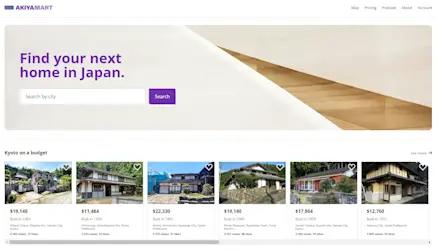
Founded in San Francisco, AkiyaMart focuses on Japan's vacant home market.
What it offers:
- 900,000+ listings with map-based interface
- Price data, hazard maps, and Airbnb income estimates
- Fully remote buying process in English
- Target timeline of approximately 90 days from search to keys
What to know before you pay: AkiyaMart is not a licensed brokerage. Its "Direct" program connects buyers with on-the-ground licensed agents for a fee ($5,000 for the purchase process; $25 for an initial consultation). Search subscriptions run $12 to $30/month. You're paying for a curated search interface and agent introductions, not for the agent's services directly.
Best for: remote buyers looking at rural or regional properties.
Old Houses Japan
Old Houses Japan focuses on kominka (古民家) farmhouses and machiya (町家) townhouses. Listings are hand-curated with editorial commentary rather than algorithmically aggregated. It also offers:
- Free browsing
- Paid buyer liaison and agent introduction services
- A weekly newsletter
- A free "Buying an Akiya" class
Best for: buyers specifically interested in traditional Japanese architecture.
Akiya Japan
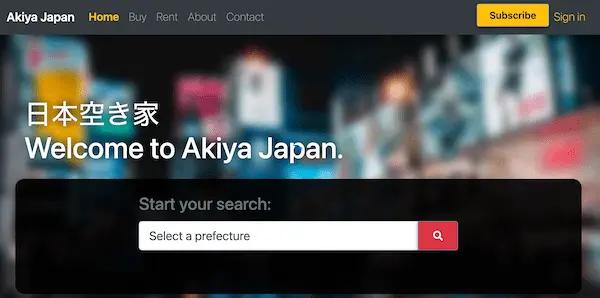
Akiya Japan runs the largest English-language property database in Japan as of 2026:
- 1.27 million+ listings from 520+ Japanese data sources (Akiya Japan, 2026)
- Covers all 47 prefectures
- Includes akiya houses, land, apartments, and municipal akiya bank listings
- Every listing links back to its original Japanese source for independent verification
- Licensed brokerage partner for buyers ready to purchase
Best for: buyers who want the widest possible search before narrowing down.
NipponHomes
NipponHomes is built specifically for foreign buyers in Japan. It aggregates listings from across Japan into a single English-language search interface with map-based browsing, price filters, and property type categories. The platform addresses one of the core frustrations of using Japanese portals: all listings are surfaced in English, without requiring Google Translate or browser workarounds.
Best for: buyers who want a straightforward English search experience across a wide inventory.
Tokyo Portfolio
Tokyo Portfolio is designed for English-speaking buyers focused on Tokyo's mid-to-high-end property market. It provides end-to-end support for foreign buyers, covering property search, bilingual agent introductions, transaction management, and post-purchase services. The platform is particularly useful for buyers who want a managed experience rather than a self-directed search.
Best for: buyers looking at premium Tokyo properties who want full-service support in English.
Platform comparison
| Platform | Language | Best For | Brokerage |
|---|---|---|---|
| SUUMO | Japanese | All types | Via agents |
| Homes.co.jp | Japanese | All types + akiya bank | Via agents |
| AtHome | Japanese | All types | Via agents |
| Yahoo! Real Estate | Japanese | All types | Via agents |
| RealEstate.co.jp | English | City properties | Bilingual agents listed |
| Akiya Mart | English | Rural/vacant homes | Partner agents |
| Old Houses Japan | English | Traditional homes | Buyer liaison |
| Akiya Japan | English | All types, widest search | Licensed brokerage partner |
| NipponHomes | English | All types, broad search | Via agents |
| Tokyo Portfolio | English | Premium Tokyo properties | Full-service end-to-end |
Can Americans buy property in Japan? Rules, costs, and what to prepare
Can US citizens buy property in Japan?
Japan allows US citizens to buy land and buildings with the same freehold rights as Japanese nationals. No visa, no residency, no quotas. The market is more open to foreign buyers than most countries in Asia.
Two administrative rules took effect in 2026, but neither blocks a purchase:
- From April 2026: Non-resident buyers must file FEFTA Form 22 with the Bank of Japan within 20 days of acquisition
- From October 2026: All buyers must disclose nationality during property registration—an administrative record, not a public entry
Getting a mortgage in Japan as a foreigner
Most non-resident Americans cannot access Japanese bank financing. Lenders require long-term residency and stable yen-based income, and FATCA obligations create additional friction with some banks.
In practice, most US buyers wire funds internationally and purchase outright. Budget an additional 7 to 10% on top of the purchase price for closing costs: agent commission, registration tax, stamp duty, judicial scrivener fees, and the FEFTA filing.
👉 For a full breakdown see our guides on Japan property tax and real estate acquisition tax.
Documents required to buy property in Japan as a non-resident
Buying remotely as a non-resident requires paperwork that Japanese residents don't need to prepare. Get these in order before you make an offer.
- Proof of residency or citizenship status. An affidavit or certified declaration confirming who you are and where you legally reside, prepared and notarized by a licensed attorney in your home country. Confirm the exact format with your bilingual agent or judicial scrivener before commissioning it, as requirements vary by prefecture.
- Power of attorney. If you can't be physically present in Japan to sign, you'll need a power of attorney (委任状, inin-jo) authorizing your agent or judicial scrivener to complete the transaction on your behalf. It must be notarized, apostilled through your state's Secretary of State office, and translated into Japanese. Allow 1 to 2 weeks for the apostille process.
- Translation support. Not every Japanese agent or akiya bank provides bilingual services. Key documents that will need translation include the sales contract (売買契約書), the Explanation of Important Matters (重要事項説明書), and the property registration certificate (登記事項証明書). Allow 2 to 3 business days per document.
Managing Japanese property from Abroad: Address, tax rep, and utilities
Once you own the property, two things are non-negotiable if you're not living in Japan full-time.
- A Japanese address. You need a contact address in Japan for agent correspondence, property tax notices (kotei shisan zei, 固定資産税), and official notices from municipal offices. Without one, there's nowhere for these to land. MailMate provides a real Japanese mailing address with mail scanning and English translation — no physical presence required.
- A tax representative (nozei kanrinin). Non-resident property owners are legally required to appoint a tax representative under Article 117 of Japan's National Tax Law. Your tax representative receives tax notices, forwards bills, and files the relevant notifications with the tax office. They do not file your annual return—that requires a licensed tax accountant. Cost: typically 30,000 to 100,000 yen per year.
Ongoing tax obligations include fixed asset tax, city planning tax, and a one-time real estate acquisition tax due 6 to 12 months after purchase.
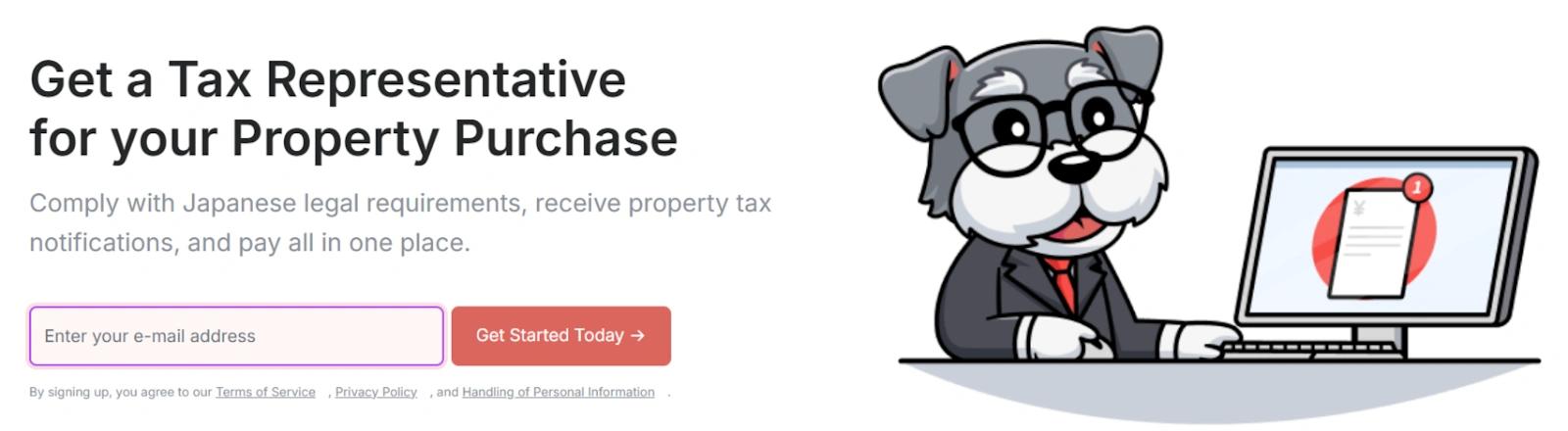
MailMate's tax representative service manages all property-related taxes on your behalf.
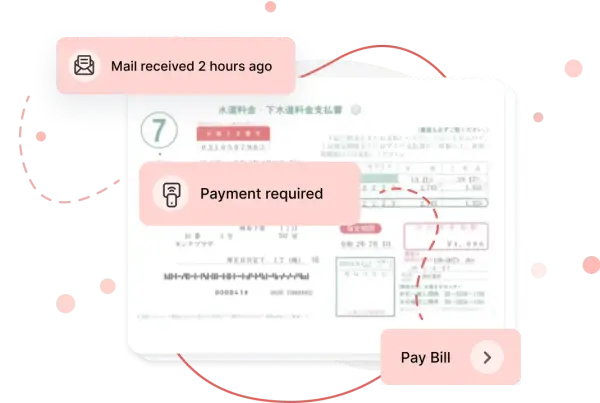
Utility bills. Gas, electricity, water, and internet bills keep arriving whether you're in Japan or not. A virtual mailbox service like MailMate receives bills digitally, translates them, and can pay them on your behalf — no Japanese bank account required.
Frequently Asked Questions
Can US citizens buy property in Japan?
Yes. US citizens can buy land and buildings in Japan with the same freehold ownership rights as Japanese nationals. No visa, residency, or citizenship is required. From April 2026, non-resident buyers must file a FEFTA Form 22 within 20 days of acquisition. From October 2026, nationality must be disclosed during property registration. Neither rule restricts the purchase itself. Japan remains one of the most open property markets in Asia for foreign buyers.
Is there a Japanese Zillow?
There is no single centralised, public-facing property search site in Japan that covers the full market. The closest equivalents are SUUMO, Homes.co.jp, and AtHome, but all three are Japanese only and don't offer the open-access MLS infrastructure that Zillow depends on. For English speakers, platforms like RealEstate.co.jp and Akiya Japan are the practical alternative, though none covers the whole market the way Zillow covers the US.
How do I find cheap houses in Japan?
The best way to find cheap houses in Japan is to start with an akiya (空き家): vacant homes in rural areas, sometimes listed for under 1 million yen. English-language platforms including AkiyaMart, Old Houses Japan, and Akiya Japan aggregate these listings. Municipal akiya banks (空き家バンク) are government databases with renovation subsidies attached to many listings. Factor in renovation costs (often 5 to 10 million yen for a basic project) and closing costs of 7 to 10% on top of the purchase price before setting your budget. See our full guide to cheap houses in Japan for a region-by-region breakdown.
Do I need to speak Japanese to buy property in Japan?
No, but you need bilingual professional support. The legally required Explanation of Important Matters must be delivered by a licensed agent and understood by the buyer before any contract is signed. All English-language platforms in this guide connect buyers with agents who communicate in English. Google Translate helps with browsing; it's not sufficient for contracts or negotiation.
What is an akiya bank?
An akiya bank (空き家バンク) is a government-operated database listing vacant homes available for purchase or rent. Local cities, towns, and villages run their own versions. The two nationwide databases are operated by Homes.co.jp and AtHome, though many municipalities also maintain separate listings not covered by either. Because no single coordinated database exists, aggregator platforms like Akiya Japan pull from multiple sources at once. For a curated list of the best akiya banks for foreigners, see our dedicated guide.
What do US buyers need to handle after purchasing property in Japan?
Non-resident owners must:
- Appoint a nozei kanrinin (tax representative) to receive and manage property tax notices
- Pay annual fixed asset tax (kotei shisan zei)
- Report Japanese rental income on their US tax return
- File FBAR for Japanese bank accounts over $10,000
- For condominiums: appoint a domestic administrator for building management from 2026
Can I get a mortgage as a US citizen buying in Japan?
Most non-resident US citizens cannot. Japanese lenders typically require long-term residency and stable yen-based income. FATCA obligations add friction with some banks. US residents of Japan with permanent residency have significantly better options, with major banks including MUFG, Mizuho, and SMBC open to applications under standard terms.
Does buying property in Japan give me the right to live there?
No. Buying property in Japan does not grant a visa or residency. Japan has no golden visa or investment-based residency program tied to real estate purchases. US citizens can buy freely on a 90-day tourist visa waiver and manage the property remotely, but ownership does not extend the right to stay. If you want to live in Japan long-term, you will need a separate visa pathway such as the Business Manager Visa or a work visa. See our full guide: Can I Live in Japan If I Buy a House?
In Closing
Finding property in Japan as an American is entirely doable in 2026. The legal path is open, and the market welcomes foreign buyers more than most countries do. Whether you're buying a vacation home, an investment property, or planning to retire in Japan, the process starts with knowing which search tools actually work.
The challenge is practical: Japanese portals that don't speak English, a fragmented listing infrastructure, and post-purchase admin that requires a physical presence in Japan to handle.
The answer is straightforward:
- Start your search on an English-language platform (RealEstate.co.jp for cities, AkiyaMart or Akiya Japan for rural)
- Engage a bilingual licensed agent before making any offers
- Set up your Japan address and tax representative before you close
MailMate handles the address and correspondence side. A virtual Japanese mailing address keeps you connected to agents, tax offices, and official mail from wherever you are. To get started, visit mailmate.jp.
This article is for informational purposes only. It is not legal, tax, or financial advice. Work with a licensed Japanese real estate agent and a CPA familiar with both US and Japanese tax law before purchasing.
Spending too long figuring out your Japanese mail?
Virtual mail + translation services start at 3800 per month. 30-day money-back guarantee.