


Rent in Tokyo: Prices by Area, Apartment Type, and What Foreigners Need to Know (2026)
Rent in Tokyo ranges from around ¥60,000 to ¥95,000 a month ($400 to $630 USD) for a compact 1K studio in outer wards like Adachi or Katsushika, or up to ¥150,000 to ¥300,000+ ($1,000 to $2,000 USD) for a 1LDK or 2LDK in central areas like Shibuya, Shinjuku, or Minato. It's worth nothing that Tokyo's 23 wards have posted rent increases for 26 consecutive months, with the average rise running 6.5% to 8.2% year on year.
This guide walks through rent prices in Tokyo by area and apartment size, what foreigners specifically need to prepare for, and the full process of finding and signing for a place to live.
Rent prices in Tokyo by area and ward (2026)
Tokyo is not one rental market. It is dozens of smaller ones, and the difference between a "cheap" ward and an "expensive" one can be double the monthly rent for the same size apartment. The table below gives a general sense of what to expect by area for a standard 1K studio, a 1LDK, and a 2LDK.
| Ward | 1K (Studio) | 1LDK | 2LDK |
|---|---|---|---|
| Minato-ku (港区) | ¥120,000–¥200,000 | ¥200,000–¥350,000 | ¥300,000+ |
| Shibuya (渋谷区) | ¥100,000–¥160,000 | ¥160,000–¥280,000 | ¥250,000+ |
| Shinjuku (新宿区) | ¥80,000–¥130,000 | ¥120,000–¥220,000 | ¥200,000+ |
| Shinagawa-ku (品川区) | ¥85,000–¥130,000 | ¥130,000–¥210,000 | ¥190,000+ |
| Koto-ku (江東区) | ¥75,000–¥110,000 | ¥110,000–¥170,000 | ¥160,000+ |
| Kita-ku (北区) | ¥65,000–¥95,000 | ¥95,000–¥140,000 | ¥130,000+ |
| Setagaya (世田谷区) | ¥70,000–¥110,000 | ¥110,000–¥180,000 | ¥160,000+ |
| Adachi (足立区) | ¥60,000–¥85,000 | ¥85,000–¥130,000 | ¥120,000+ |
At current exchange rates (roughly ¥150 to $1), ¥100,000 a month works out to about $667 USD. Central wards, particularly Minato, Shibuya, and Chiyoda, are running 30% to 50% above the 23-ward average, so the size of the apartment is only part of the story. Location, and how close you are on foot to a train station, moves the number just as much.
Source: 全国統計データ (Hato Mark Site) , operated by Zentakuren (全宅連), Japan's government-recognized real estate broker association. Tokyo ward data last updated June 2026.
Tokyo apartment types explained: 1K, 1DK, 1LDK, 2LDK
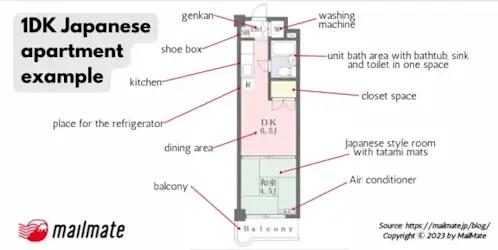
Every rental listing in Japan uses a shorthand for apartment size and layout. It looks confusing the first time you see it, but once you understand the pattern it makes browsing properties much faster.
| Type | Layout | Typical Size | Best For |
|---|---|---|---|
| 1R (1 Room) | Single room with kitchen inside it | 18-25 sqm | Solo, tightest budget |
| 1K | One room plus a separate kitchen | 20-30 sqm | Solo renters, students |
| 1DK | One room plus a dining-kitchen | 25-40 sqm | Solo professionals |
| 1 LDK | One room plus living-dining-kitchen | 35-55 sqm | Singles or couples |
| 2 LDK | Two rooms plus living-dining-kitchen | 50-70 sqm | Couples, small families |
| 3 LDK | Three rooms plus living-dining-kitchen | 65-90 sqm | Families |
The "L," "D," and "K" refer to living room, dining area, and kitchen. A number before those letters tells you how many separate bedrooms there are. Japanese apartments are also measured in square metres rather than square footage, and floor plans tend to use space efficiently, so a 30 sqm apartment in Tokyo often lives larger than the number suggests once you see it in person.
What does it actually cost to move into a Tokyo apartment?

Rent isn't the only thing you need to think about when singing a contract for an apartment. Additional fees like the ones I've listed below will directly affect your budget planning.
- Shikikin (敷金) – security deposit, typically 1 to 2 months' rent, partially refundable after move-out inspection
- Reikin (礼金) – key money, a non-refundable payment to the landlord, typically 0 to 2 months' rent and increasingly rare in outer wards and newer buildings
- Agency fee (仲介手数料) – the real estate agent's commission, typically one month's rent plus 10% consumption tax
- Fire insurance (火災保険) – mandatory for nearly all leases, typically ¥15,000 to ¥20,000 for a two-year policy
- Guarantor company fee (保証会社) – typically 50% to 100% of one month's rent upfront, required for most foreign residents, plus a small annual renewal fee
- Lock replacement fee – sometimes charged, typically ¥10,000 to ¥20,000
For an apartment renting at ¥80,000 a month, the fees above alone typically add up to ¥280,000 to ¥400,000 ($1,867 to $2,667 USD) before you've paid a single month of rent. Add the first month's rent on top, and total move-in costs land at roughly 4 to 6 months' rent all in.
Key money in particular surprises a lot of new arrivals because, unlike a deposit, none of it comes back. If you want the full walkthrough of how key money works and how to find listings that skip it, MailMate has a dedicated guide to key money in Japan.
Can foreigners rent apartments in Tokyo?
Yes. Foreign residents can and do rent apartments across Tokyo every year, but the process has a few extra steps that Japanese renters do not deal with.
- You need a guarantor. Most landlords require either a Japanese personal guarantor or a guarantor company. Since most foreigners do not have family in Japan to act as a guarantor, a paid guarantor company is the standard workaround. The company checks your visa status and income, then agrees to cover your rent if you fall behind, for a fee of roughly half to one full month's rent.
- The language barrier. Most agents and landlords communicate entirely in Japanese, and contracts are written in Japanese too. Choosing a foreigner-friendly agency with English-language support, such as Real Estate Japan, PLAZA HOMES, or Sakura House, makes this far less stressful.
- The residence card catch. You generally need a registered Japanese address to update your residence card, but some landlords expect to see a residence card before they will rent to you. Working with an agency that regularly handles this case for new arrivals is the easiest way through it.
- Foreigner-friendly buildings. Not every landlord accepts international tenants, even though there is no legal basis for refusing one. Foreigner-friendly agencies filter their listings for landlords who do, which saves a lot of wasted applications.
Once your apartment is confirmed and you sign the lease, that address becomes your official one. You register it at the ward office, and from that point your health insurance card, residence tax notices, utility contracts, and bank correspondence are all tied to it.
If you're arriving in Japan without a permanent address yet, or you already know you'll be moving again within a year or two, a stable mailing address that does not change with every move is genuinely helpful.
Popular areas to rent in Tokyo by budget and lifestyle
Where you choose to live shapes your daily commute, your monthly budget, and honestly your whole quality of life in the city. Every extra 10 minutes of commute time from a major hub tends to reduce rent by ¥5,000 to ¥15,000 a month. Decide how much commute time you're willing to trade for lower rent first, then use that to narrow down which of the areas below fits you.
- Shibuya and Shinjuku – Central, walkable, and expensive, but unmatched for train access. Shinjuku sits where JR, Tokyo Metro, Toei, and several private lines, including the Shinjuku Line, all converge, so almost anywhere in the city is a short ride away. Best for young professionals who want to live near work and nightlife.
- Koto-ku and Shinagawa-ku – Waterfront and business-district living with newer apartment stock and reasonable rent for the location. Good for families and commuters heading toward central Tokyo or Haneda Airport.
- Setagaya – Residential, green, and popular with couples and families who want more space without moving too far out.
- Kita-ku – Quieter and consistently undervalued relative to its transit access, a good pick for anyone chasing value.
- Adachi and Katsushika – The most affordable option still inside the 23 wards, best for renters maximising their budget who don't mind a longer commute.
How to find and rent an apartment in Tokyo as a foreigner: Step by Step
- Set your budget and shortlist areas using the price ranges above, and be honest with yourself about commute time versus rent trade-offs.
- Choose your search platform. SUUMO, Homes.co.jp, Real Estate Japan, and GaijinPot Housing all let you browse apartments for rent by ward, size, and station distance.
- Contact a fudosan (estate agent), either directly through a listing site or through a foreigner-friendly agency that already understands your situation.
- View properties in person if you can. Viewings in Tokyo move fast and decisions are often expected within a day or two of seeing a place you like.
- Submit your application (moushikomi) with your residence card, proof of employment or income, and your guarantor's details.
- Sign the contract. It will be in Japanese. Ask your agent for an English summary or bring your own translation support so you fully understand what you're agreeing to before you sign.
- Pay the upfront costs, usually by bank transfer, and collect your keys.
- Register your new address at the ward office (区役所) within 14 days of moving in. This step is legally required and it's what triggers your residence card update and health insurance enrollment.
- Set up utilities (electricity, gas, water), all of which require your registered address.
- Set up how you'll manage your mail. Tax notices, insurance letters, and other official correspondence will all arrive at your registered address from this point on. If you're not able to check a physical mailbox regularly, or you expect to be away or moving again, a mail management service like Mailmate keeps you from missing anything time-sensitive.
Short-term rentals in Tokyo: Monthly mansions, share houses, and serviced apartments
Standard Japanese leases run two years and assume a guarantor, key money, and a long-term commitment, which doesn't work for everyone. Students, digital nomads, corporate relocations, and anyone on a 90-day visa-free stay usually need something more flexible.
- Monthly mansions (マンスリーマンション) are fully furnished apartments rented by the month, typically ¥80,000 to ¥150,000 a month with no key money, no guarantor, and no two-year commitment. Popular with corporate relocations and anyone bridging the gap before a standard lease starts.
- Share houses run ¥50,000 to ¥80,000 a month all-in, usually including utilities and Wi-Fi, with a private room and shared common areas. A common entry point for students and first-time arrivals who want to meet people and skip the paperwork.
- Serviced apartments sit above monthly mansions in price and amenities, often used by corporate relocations that need a hotel-like standard without a hotel bill.
The trade-off across all three is a higher monthly rate in exchange for skipping nearly all the upfront costs standard leases require.
Rent in Tokyo vs. other major cities
| City | 1-Bed Central | 1-Bed Outer | Notes |
|---|---|---|---|
| Tokyo | $800–$1,300 | $400–$700 | Weak yen has made this an especially good time for USD-based renters |
| New York | $3,000–$5,000 | $1,800–$3,000 | 3 to 4 times more expensive |
| London | $2,000–$3,500 | $1,200–$2,000 | 2 to 3 times more expensive |
| Sydney | $1,800–$3,000 | $1,200–$1,800 | Roughly 2 times more expensive |
| Singapore | $2,500–$4,000 | $1,500–$2,500 | 2 to 3 times more expensive |
Tokyo is genuinely affordable for a global city of its size. Its reputation as an expensive place to live mostly comes from the high upfront moving-in costs, not the monthly rent itself. Compared to Osaka, Japan's other major rental market, Tokyo runs noticeably higher: Osaka 1K studios average ¥55,000 to ¥70,000 a month, roughly 20% to 30% cheaper than an equivalent Tokyo studio outside the central wards.
Frequently asked questions
How much is rent in Tokyo per month?
A 1K studio in outer Tokyo costs ¥60,000 to ¥85,000 a month ($400 to $570 USD). Central areas like Shibuya and Shinjuku run ¥80,000 to ¥160,000 a month ($530 to $1,070 USD) for a comparable size. A 1LDK in central Tokyo typically costs ¥150,000 to ¥250,000 a month ($1,000 to $1,670 USD).
How much is monthly rent in Tokyo?
On a citywide basis, monthly rent in Tokyo averages around ¥81,000, compared to a national average of about ¥55,700, roughly 1.5 times higher. That blended figure spans everything from small studios to family units, which is why the ward and apartment-type breakdown earlier in this guide gives a more useful number to budget against than a single citywide average.
Is Tokyo expensive to rent compared to other cities?
By global standards, no. Tokyo is significantly cheaper than New York, London, Sydney, or Singapore for equivalent apartment size in a comparable central area. The upfront costs, including key money, deposit, and agency fees, are high, but the ongoing monthly rent is reasonable for a city of Tokyo's size.
Can foreigners rent apartments in Tokyo?
Yes. Foreign residents rent apartments across Tokyo every year, though some landlords still prefer Japanese tenants. Foreigner-friendly agencies specifically list properties from landlords who welcome international tenants and offer English-language support throughout the process.
What is key money in Japan?
Key money (礼金, reikin) is a non-refundable payment made to the landlord when signing a lease, historically treated as a gesture of gratitude with no legal function. It typically ranges from 0 to 2 months' rent and is increasingly rare in outer wards and newer buildings, though it's still common in central Tokyo.
How much do you need upfront to rent in Tokyo?
Budget for the security deposit, key money if applicable, agency fee, guarantor company fee, and fire insurance to add up to roughly 3.5 to 5 months' rent in fees alone. Add your first month's rent on top and total move-in costs land at 4 to 6 months' rent. For an ¥80,000 a month apartment, that's about ¥280,000 to ¥400,000 in fees, plus the first month's rent.
Do you need a guarantor to rent in Tokyo?
Most landlords require either a Japanese personal guarantor or a guarantor company. Foreign residents without family connections in Japan typically use a guarantor company, which charges an initial fee of about 50% to 100% of one month's rent plus a small annual renewal fee.
Can I rent an apartment in Tokyo without a residence card?
Some landlords and foreigner-friendly agencies will let you sign a lease before your residence card is issued, particularly if you can show proof of your visa approval in the meantime. Agencies like Real Estate Japan and Sakura House have experience handling this case for new arrivals. A virtual address service like MailMate can also bridge the gap while your paperwork is being processed.
What is the cheapest area to rent in Tokyo?
Adachi, Katsushika, Kita-ku, and Nerima consistently offer the lowest rents among Tokyo's 23 wards, with 1K studios available from around ¥60,000 a month ($400 USD), while still keeping reasonable train access into the city centre.
Can I rent an apartment in Tokyo for a short term stay?
Standard two-year leases aren't designed for short stays, but monthly mansions, share houses, and serviced apartments fill that gap for anyone staying a few weeks to a few months. See the short-term rentals section above for pricing and how each option compares.
In closing
Rent in Tokyo genuinely comes down to a trade-off between location, apartment size, and how far you're willing to commute, and the ward-by-ward numbers above should give you a realistic starting budget either way. The single most important thing to plan for as a foreigner is the upfront cost of moving in, not the monthly rent itself. Prices, exchange rates, and specific landlord requirements shift over time, so treat this guide as a starting point and confirm current figures with your agent before you sign anything.
Once you find your apartment and register your address, staying on top of the mail that follows, from your residence card update to your first utility bill, is one less thing to worry about while you settle into life in Tokyo.
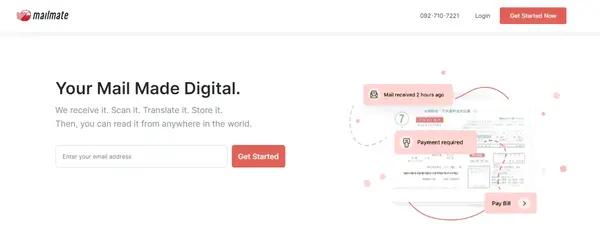
MailMate provides a registered Japanese address and mail management service, so official mail, from your ward office registration to your first utility bill, reaches you from day one.
Spending too long figuring out your Japanese mail?
Virtual mail + translation services start at 3800 per month. 30-day money-back guarantee.